


What role does HEDP·Na4 play in industrial scale inhibition?
HEDP·Na4 plays a practical role in industrial scale inhibition by keeping scale-forming metal ions and crystals from becoming hard deposits on heat-transfer surfaces, pipelines, membranes, and process equipment. It is the tetrasodium salt form of HEDP, an organophosphonate commonly used in water-treatment formulations where calcium carbonate, calcium sulfate, and related mineral deposits create operating problems.
Its value is not that it removes an existing heavy scale layer. Instead, HEDP·Na4 helps prevent dissolved minerals from forming adherent crystals as water is heated, concentrated, or repeatedly recirculated. That distinction matters when selecting a treatment program: an antiscalant supports clean operation, while an established deposit may require cleaning or a separate descaling process.
How HEDP·Na4 interrupts scale formation
Scale develops when dissolved ions in water become concentrated enough to precipitate. In an industrial cooling system, evaporation leaves minerals behind and raises the concentration of calcium, magnesium, alkalinity, silica, or sulfate. In a boiler, heat and changing water chemistry can accelerate precipitation. In membrane systems, concentration becomes higher close to the membrane surface than in the incoming feedwater.
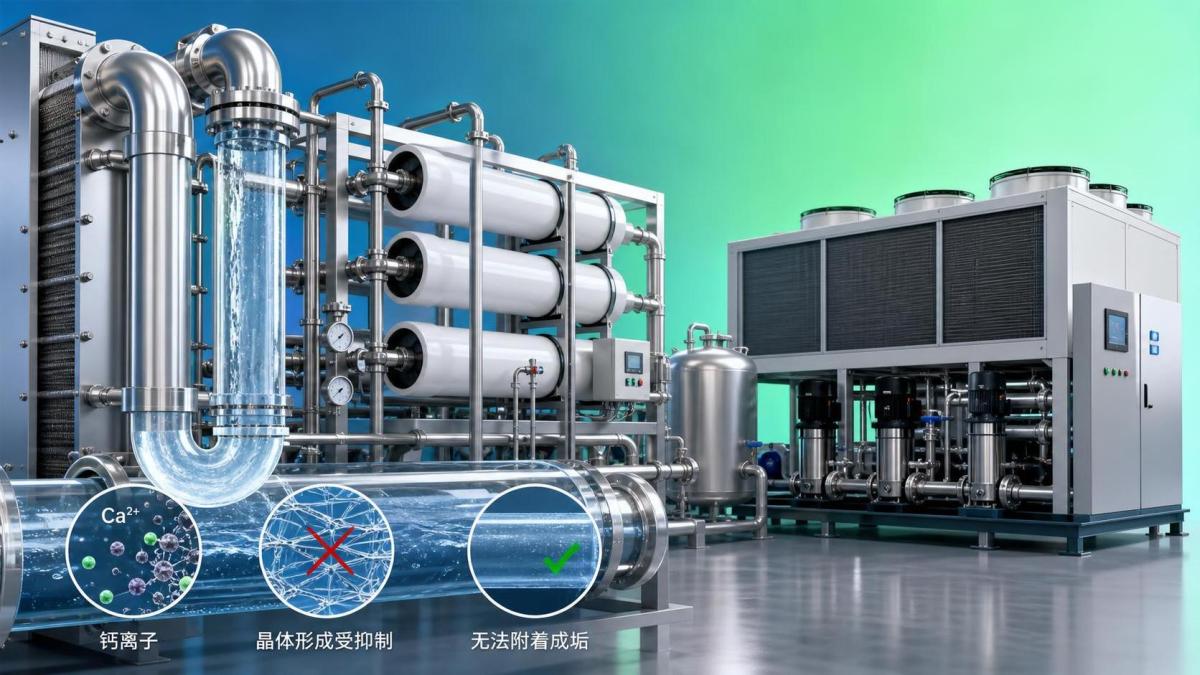
HEDP·Na4 interferes with this process through several related actions:
- Threshold inhibition: it can delay crystal formation even when scale-forming ions are present at levels that would otherwise favor precipitation.
- Chelation: phosphonate groups interact with metal ions such as calcium and magnesium, reducing the amount immediately available to form insoluble deposits.
- Crystal modification: it can alter the growth pattern of mineral crystals, making deposits less compact and less likely to attach firmly to equipment surfaces.
- Dispersion support: in a formulated program, it helps keep fine particles suspended so they can leave with blowdown, filtration, or other solids-removal steps.
These mechanisms explain why a comparatively low concentration of a phosphonate can have a noticeable effect on deposition control. They also explain why chemical choice alone is not enough. If concentration cycles, pH, temperature, or suspended solids are outside the intended operating range, scale can still form despite continuous dosing.
Where it is most useful
HEDP·Na4 is often considered for alkaline circulating cooling water, boiler-related water treatment, and other systems where hardness minerals are likely to deposit under concentration or heat. Its sodium salt form is generally easier to incorporate into water-based alkaline formulations than the corresponding acid form, which can simplify blending and dosing design.
In cooling-water systems, the main objective is usually to protect condensers, heat exchangers, cooling tower fill, and recirculating pipework. The treatment program must manage not only mineral scaling but also corrosion, suspended solids, microbiological growth, and the system’s blowdown rate. HEDP·Na4 may be one component in a broader formula that also includes polymers, corrosion inhibitors, biocides, or dispersants.
For boiler makeup water and pre-boiler treatment, the question is more specific: which salts are likely to precipitate after heating and concentration? A treatment approach that works in a moderate-temperature cooling loop cannot simply be transferred to a high-pressure boiler. Boiler pressure, feedwater quality, condensate return, alkalinity control, and internal treatment chemistry all affect the appropriate choice.
In reverse osmosis pretreatment, phosphonates can be relevant to mineral scale control, but membrane compatibility and the chemistry of the feedwater require closer review. Calcium, barium, strontium, sulfate, silica, iron, and aluminum each behave differently. A membrane system also has restrictions around oxidants, biological fouling, and concentrate disposal. HEDP·Na4 should therefore be assessed as part of the full pretreatment and antiscalant strategy rather than treated as a universal RO chemical.
What determines whether HEDP·Na4 is the right fit
The same product can perform very differently in two systems with the same visible scale problem. The deposit may look similar, but its composition and formation conditions may not be. Before selecting or adjusting an HEDP·Na4 program, focus on the water chemistry and operating conditions that create supersaturation.
A common mistake is to select an inhibitor based only on total hardness. Hardness matters, but it does not identify the full scaling risk. For example, calcium carbonate scale is strongly influenced by alkalinity and pH, while sulfate and silica deposits can require a different treatment emphasis. Deposit analysis, when material is available, is often more informative than making assumptions from appearance alone.
Why dosage cannot be treated as a fixed recipe
HEDP·Na4 is commonly used in low-dose water-treatment programs, but the suitable addition rate depends on the water analysis, system volume, makeup rate, cycles of concentration, temperature, and the other ingredients in the formulation. Applying a generic dose without matching it to those conditions can lead to under-treatment, unnecessary chemical consumption, or misleading conclusions about product performance.
Dosing point is also important. The chemical should reach the circulating water with sufficient mixing before scale-prone equipment, rather than being introduced at a location where it is immediately diluted, discharged, or exposed to incompatible concentrated chemicals. Continuous metering is typically more stable than intermittent additions for systems with steady makeup water, although the best arrangement depends on how the system operates.
Routine monitoring should connect chemical control with equipment condition. Conductivity, pH, hardness, alkalinity, inhibitor residual where applicable, makeup water quality, and blowdown behavior provide useful operating signals. A rising approach temperature across a heat exchanger, a falling flow rate, or increasing differential pressure can indicate deposit formation before a full blockage occurs.
HEDP·Na4 is often part of a formulation, not a complete answer
Industrial water problems rarely arrive one at a time. A system may have calcium scaling, corrosion risk, fine particulate fouling, and biological activity simultaneously. HEDP·Na4 addresses mineral deposition through chelation and threshold inhibition, but it does not replace filtration, blowdown control, cleaning procedures, microbiological control, or corrosion management.
Where water has higher temperature exposure, difficult barium carbonate conditions, or a need for stronger multidentate chelation, other organophosphonates may be evaluated alongside HEDP chemistry. For example, Diethylene Triamine Penta (Methylene Phosphonic Acid) (DTPMPA) is used in water-treatment formulations for scale inhibition, corrosion inhibition, and chelation. It is particularly relevant when formulation design calls for robust performance in alkaline circulating cooling water or demanding thermal conditions. This is not a direct one-for-one replacement decision: the water chemistry, formulation compatibility, and intended operating conditions determine which phosphonate, polymer, or blend is appropriate.
Three operational mistakes that reduce scale-control performance
Treating every deposit as mineral scale. A deposit may contain corrosion products, biological material, oil, process fibers, or insoluble solids. Increasing HEDP·Na4 dosage will not resolve a fouling mechanism that is mainly mechanical or biological.
Ignoring concentration control. Antiscalant chemistry works within a treatment window. When blowdown is inadequate and dissolved solids continue to accumulate, mineral loading can exceed the program’s control capacity.
Evaluating only after equipment has fouled. Scale inhibition is preventative. Waiting for measurable loss of heat transfer or a membrane-pressure problem makes it difficult to distinguish current scale formation from deposits that accumulated before the treatment program was adjusted.
What to confirm before moving from research to use
Start with a current makeup-water analysis and identify how the water changes inside the system. For a cooling tower, that means understanding evaporation, blowdown, and cycles of concentration. For a boiler, it means reviewing feedwater, condensate return, operating pressure, and internal water chemistry. For RO, it means evaluating both feedwater and concentrate-side scaling risk.
Then define the real objective: reducing calcium carbonate deposition, protecting heat-transfer efficiency, limiting membrane scaling, controlling a mixed deposit, or supporting a combined scale-and-corrosion program. HEDP·Na4 is a useful industrial scale inhibitor when the treatment need matches its chemistry and the system is controlled as a whole. Its strongest role is preventative: helping keep dissolved minerals from becoming the hard deposits that interrupt efficient operation.

ONLINE CONSULTATION
If you have any questions, please contact us and we will contact you as soon as possible.