


What to compare when selecting a China water treatment chemicals manufacturer
What to Compare When Selecting a China Water Treatment Chemicals Manufacturer
Selecting a China water treatment chemicals manufacturer is rarely a simple price comparison. In industrial water systems, a lower drum price can be quickly outweighed by higher dosage, inconsistent active content, membrane cleaning frequency, unplanned shutdowns, or corrosion-related maintenance. This is especially true for circulating cooling water, reverse osmosis systems, oilfield reinjection water, boiler makeup water, desalination and complex industrial wastewater.
A practical purchasing decision should focus on whether the supplier can deliver the same usable chemical performance from batch to batch, support the intended water chemistry, and maintain supply when consumption rises. The right comparison is not “Which quotation is lowest?” but “Which supplier creates the lowest operating risk and the most predictable treatment cost?”
Compare the actual active content, not only the product name
Many water treatment products are sold under familiar chemical names: phosphonates, polymeric dispersants, corrosion inhibitors, chelating agents, defoamers, and RO antiscalants. However, the commercial name alone does not tell a buyer enough. The meaningful comparison starts with the specification sheet and certificate of analysis for the offered grade.
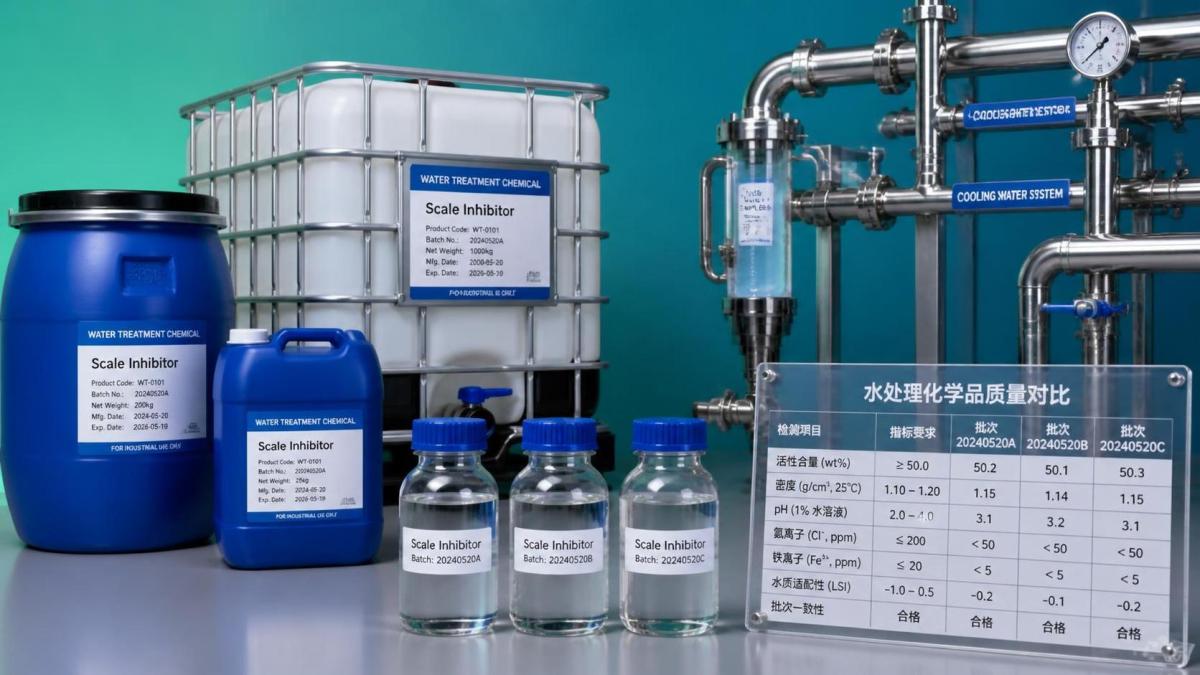
For liquid products, active content, solids content, density, pH, chloride level, iron content and appearance can all affect formulation calculations and field performance. If two quotations appear similar but one material has materially lower active content, the price per kilogram may be misleading. Procurement should convert quotations into cost per unit of active ingredient where possible, then compare expected dosage and freight costs.
Trace impurities deserve attention as well. In sensitive applications, excessive iron or chloride can be a concern, depending on the process and downstream requirements. This does not mean every project needs an ultra-high-purity grade. It means the grade should match the water system rather than be selected solely because it is available at a lower cost.
Check compatibility with the real water condition
Water treatment chemicals perform within a system, not in isolation. A scale inhibitor that works well in moderate-hardness cooling water may require a different dosage strategy in high-calcium water, high-iron water, high-temperature circulation loops, or oilfield water containing barium and suspended solids. Similarly, an RO antiscalant must be considered alongside membrane type, recovery rate, feedwater analysis and cleaning procedure.
Before selecting a supplier, provide a usable technical brief: water analysis, operating temperature, pH range, concentration cycles, metallurgy, flow rate, existing treatment program and the main problem being addressed. “Scaling” is not enough information. Calcium carbonate scale, barium sulfate scale, silica fouling and iron deposition do not call for exactly the same chemistry.
For example, in oilfield and circulating cooling water applications, a buyer assessing a phosphonate-based chelant may review Aminoethyl Ethanolamine Tri(methylene phosphonic acid) Sodium Salt (AEEA Phosphonate Sodium Salt) against the actual calcium, iron and temperature conditions. This material is supplied as a light yellow transparent liquid and is positioned for scale control and chelation, with stated tolerance to calcium and iron and resistance to elevated temperature. Its listed active content is at least 32.0% as acid and at least 42.0% as salt, while total solids are at least 50.0%. Those figures are useful only when considered alongside the full treatment formula and operating conditions.
Look beyond laboratory data: ask how quality is controlled at production scale
A supplier can provide an attractive technical data sheet and still struggle with consistency at scale. This is one of the more expensive problems in industrial chemical purchasing because batch variation is often discovered after the material has entered a treatment formulation or reached a customer site.
A serious China water treatment chemicals manufacturer should be able to explain its production arrangement clearly: whether it operates its own production base, how raw materials are controlled, whether batches are tested before release, and which parameters are routinely recorded. Ask for recent certificates of analysis from more than one batch rather than reviewing a single ideal sample. The purpose is not to audit every internal process; it is to identify whether the supplier has a repeatable quality-control discipline.
It is also reasonable to ask who is responsible when an off-specification issue occurs. Procurement teams should clarify the complaint process, sample retention practice, technical investigation capability and replacement terms before the first large shipment. These details matter much more when the chemical is an input to a proprietary blended product.
Separate bulk supply capability from formulation capability
Not every project needs a custom treatment program. For a stable, standardized application, bulk supply of a known active ingredient may be the most economical route. But systems with variable hardness, difficult corrosion control, severe foaming, mixed wastewater, or unusual temperature conditions can require formula adjustment instead of a commodity purchase.
This distinction changes what should be compared. A bulk supplier needs dependable production capacity, suitable packaging, clean export documentation and predictable delivery. A formulation partner additionally needs laboratory capability, knowledge of interactions between actives, and enough technical depth to interpret water data. Buyers should avoid paying for “customization” when a standard product is sufficient, but they should not force a standard grade into a difficult system simply to reduce the purchase price.
Prio New Materials operates across both areas: standardized bulk materials, condition-specific formula development and water-condition technical support. Its product range includes water treatment monomers, organophosphorus scale-inhibiting chelating agents, polycarboxylate scale dispersants and industrial defoamers. For a purchaser, the relevant point is not the breadth of a catalog by itself; it is whether the supplier can connect a specific raw material choice with a documented operating requirement.
Evaluate supply reliability in the packaging and delivery details
Supply reliability is often discussed in broad terms, yet the practical questions are quite specific. Can the supplier support trial quantities and later scale to regular container orders? Is the product available in packaging that fits the receiving plant? Are drums, pallets and IBCs appropriate for the destination and handling method? Can the supplier provide batch traceability across repeated shipments?
For the AEEA phosphonate sodium salt example, available package formats include 25 kg units, 250 kg drums and 1,250 kg IBC tanks. The right option depends on annual consumption, storage space, local handling equipment and the risk of leaving partly used containers open for extended periods. IBCs can reduce packaging cost for larger users, but they are not automatically the best choice where warehouse turnover is slow or unloading equipment is limited.
Ask suppliers to distinguish between stock availability and normal production lead time. These are different promises. Also confirm export packaging, labeling, safety documentation, shelf-life guidance and the point at which responsibility transfers during shipment. A low unit price becomes less attractive if delivery uncertainty forces a plant to hold excessive emergency inventory.
Technical support should be practical, not just sales support
When a treatment problem persists, the useful supplier is the one that asks technical questions rather than immediately recommending a higher dosage. In cooling water, for instance, rising conductivity, changes in makeup-water hardness, microbiological control, acid feed, filtration performance and blowdown management may all influence deposit formation. In RO systems, an apparent antiscalant problem may instead be related to pretreatment, oxidation exposure or membrane cleaning practice.
A capable manufacturer should be prepared to review water analysis, recommend product screening where appropriate, and explain limitations. Laboratory testing and site guidance can be valuable, but they should not be treated as a guarantee that overrides plant operating discipline. The best technical discussion is candid about what can be confirmed in a lab and what must be validated under actual field conditions.
Build the comparison around total treatment cost
The final decision should combine chemical cost with technical and supply considerations. A simple comparison sheet can include price per active unit, expected dosage, qualification sample results, batch consistency, packaging cost, lead time, technical response, documentation and replacement handling. This gives procurement a clearer view than comparing FOB prices alone.
When selecting a China water treatment chemicals manufacturer, do not assume that the most expensive offer is safest or that the lowest offer is economical. The stronger choice is the supplier that can show consistent product parameters, understand the water chemistry behind the application, supply the required volume in a workable format, and respond competently when operating conditions change. That is the comparison that protects both treatment performance and purchasing cost over time.

ONLINE CONSULTATION
If you have any questions, please contact us and we will contact you as soon as possible.