


When scale and corrosion inhibitors need combined dosing
Combined dosing is justified when scale control and corrosion control cannot be separated without creating an operating risk. This commonly occurs in recirculating cooling systems with rising cycles of concentration, boilers with variable makeup-water quality, oilfield injection systems carrying hardness and iron, and wastewater loops where suspended solids complicate both deposit formation and metal protection.
The decision is not simply to add a scale inhibitor and a corrosion inhibitor to the same tank. A program can prevent calcium carbonate deposition yet accelerate localized corrosion, or create a protective corrosion film while allowing phosphate, iron oxide, or hardness salts to settle in heat-transfer zones. Effective combined dosing treats the water chemistry, metallurgy, operating temperature, and hydraulic conditions as one system.
When a single-function program stops being adequate
Scale and corrosion are connected by the conditions that drive them. Increasing concentration cycles in a cooling tower can improve water efficiency, but it also raises calcium, alkalinity, chloride, sulfate, silica, and dissolved solids. Higher pH and temperature can push calcium carbonate or calcium phosphate toward precipitation. At the same time, elevated chloride and conductivity may increase corrosion exposure for carbon steel, copper alloys, or mixed-metal systems.
A scale-only program may keep mineral salts dispersed but leave metal surfaces insufficiently protected. A corrosion-focused program may rely on inorganic or film-forming components that become difficult to manage in hard, alkaline water. Where these effects overlap, separate treatment objectives become operationally inseparable.
Combined dosing deserves consideration when one or more of the following conditions is present:
- Heat exchangers show both deposit buildup and under-deposit corrosion indicators.
- Water chemistry changes materially with seasons, production load, source-water blending, or reuse-water contribution.
- Higher concentration cycles are required, reducing the margin before precipitation or corrosion risk rises.
- Iron transport, suspended solids, or turbidity creates fouling sites that interfere with corrosion-film formation.
- The system contains several metallurgies, such as carbon steel, copper alloy, stainless steel, galvanized components, or aluminum-containing equipment.
- A treatment component introduced for corrosion protection creates a secondary deposition risk, particularly phosphate- or zinc-associated deposits under unsuitable conditions.
The central question is not whether both problems exist somewhere in the plant. It is whether the same water conditions, surfaces, and operating intervals cause one problem to undermine control of the other.
Why dosage balance matters more than adding more chemistry
Scale inhibitors and dispersants generally work by interfering with crystal growth, distorting crystal structure, or keeping particles suspended long enough to leave through blowdown, filtration, or controlled discharge. Corrosion inhibitors use different mechanisms: adsorption on metal surfaces, formation of protective films, oxygen scavenging in specific boiler applications, or stabilization of passivating conditions.
These mechanisms can support each other, but only if the formulation and feed ratios fit the water. Excessive dispersant does not automatically solve a precipitation problem caused by inadequate blowdown or a sudden hardness increase. Excess corrosion inhibitor does not guarantee better protection if deposits prevent the active chemistry from reaching the metal surface. A feed rate that performs well at normal load may be inadequate during startup, shutdown, idle periods, or low-flow zones.
The balance must account for the actual control window rather than nominal design water quality. Important variables include:
- Hardness and alkalinity: These determine the tendency for carbonate and phosphate mineral formation.
- pH: A change in pH can alter calcium solubility, corrosion behavior, and the performance of inhibitor packages.
- Temperature and heat flux: Deposits frequently form first on the hottest surfaces, where bulk-water analyses may understate the local saturation condition.
- Chloride, sulfate, and conductivity: These affect corrosivity and can limit the safe concentration cycle target.
- Iron and suspended matter: These can produce deposit nuclei, carry corrosion products through the system, and consume dispersant capacity.
- Microbiological control chemistry: Oxidizing and non-oxidizing biocides can affect compatibility with some corrosion inhibitor components.
For a project, this means dosing equipment should not be designed around a fixed “ppm per day” assumption alone. The system needs a defensible control basis: makeup rate, recirculation volume, blowdown behavior, operating pH, conductivity target, and the expected range of critical ions. Without that basis, an automated dosing skid can deliver chemical consistently while still delivering the wrong treatment response.
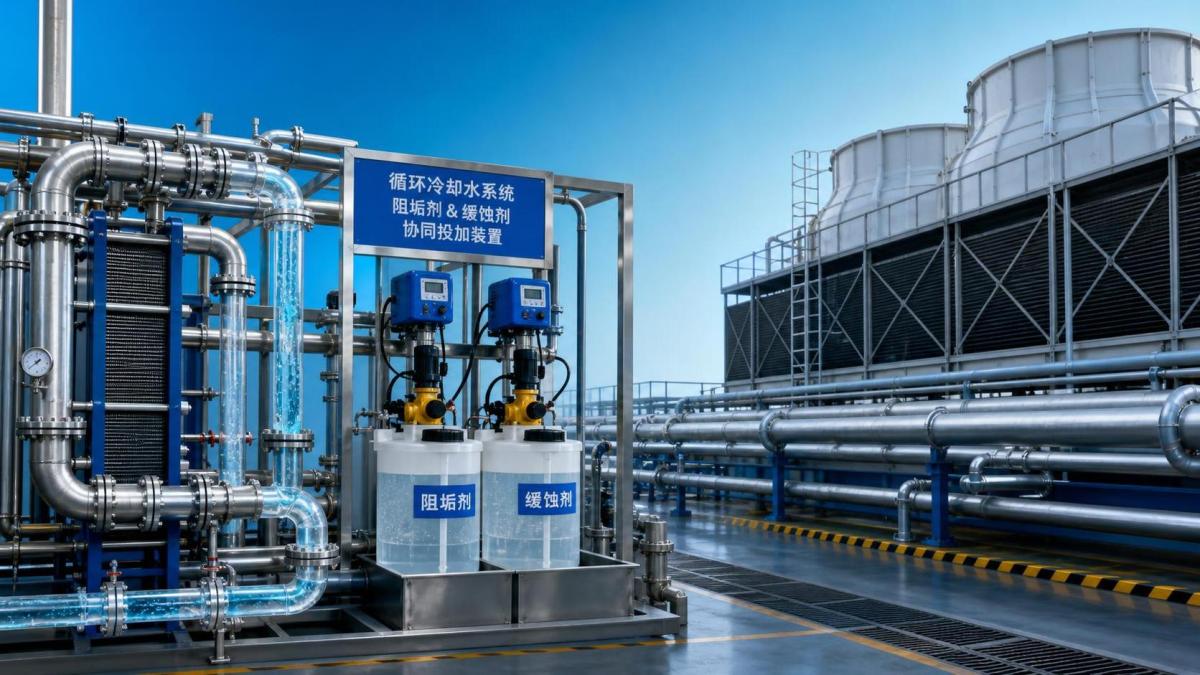
Compatibility is a design requirement, not a product attribute
Compatibility has three layers. The first is chemical compatibility in the product drum or day tank. The second is compatibility after dilution in the feed line and bulk water. The third, and most important, is compatibility at the equipment surface, where temperature, concentration polarization, and deposits differ from average system conditions.
For example, polyphosphates, zinc salts, organophosphonates, and polymeric dispersants may be used in treatment programs for different purposes. Their value depends on whether they remain soluble and functional under the system’s hardness, pH, thermal conditions, and residence time. A formulation that appears stable in a sample bottle may still contribute to deposition at a high-temperature exchanger surface if local conditions exceed its practical operating range.
Acrylic-acrylate-sulfosalt copolymers are relevant where a combined program needs strong dispersancy alongside corrosion-inhibitor components. Acrylic-acrylate-sulfosalt copolymer PR-613 is designed as a scale inhibitor and dispersant for conditions involving high temperature, high pH, high hardness, and high alkalinity. Its stated compatibility with polyphosphates, zinc salts, and organophosphonates is useful in evaluating a multi-component program, particularly where iron oxide, calcium phosphate, zinc phosphate, and calcium carbonate deposits are part of the risk profile. Compatibility, however, should still be confirmed using the intended water and feed sequence rather than inferred from a general ingredient list.
Build the treatment program around failure modes
Combined dosing works best when the project team defines what failure it is trying to prevent at each critical asset. “No scale and no corrosion” is too broad to guide chemistry selection or monitoring.
In a cooling-water system, the priority may be preventing carbonate scale on condenser tubes while maintaining corrosion protection for carbon-steel pipework. In a boiler makeup train, the concern may be hardness leakage and deposits before water enters a more tightly controlled boiler circuit. In oilfield injection water, the challenge may include iron solids, incompatible waters, and deposit formation that reduces injectivity. In turbid recirculating dust-removal water, solids control can become inseparable from mineral scale control.
This asset-based view changes the implementation plan. It identifies where samples should be taken, which exchanger or pipe section provides the earliest warning, and whether a problem is chemical, mechanical, or operational. A low inhibitor residual, for instance, may point to underfeed, but it can also result from a makeup-water surge, chemical degradation, poor pump calibration, adsorption onto solids, or an unrecognized leak or overflow.
Water analysis alone is not enough
Baseline testing should include the conventional parameters relevant to the system—pH, conductivity, calcium hardness, magnesium hardness, total alkalinity, chloride, sulfate, silica where applicable, iron, and suspended solids. Yet a usable combined-dosing plan also needs operating information: maximum and minimum flow, water temperature, heat-transfer surface temperature where available, retention time, blowdown control method, chemical injection points, and the location of dead legs or low-flow branches.
It is important to distinguish between bulk-water conditions and deposit-forming conditions. A laboratory result may show that the circulating water is within a calculated limit, while a partially blocked strainer, low-flow exchanger pass, or hot tube surface creates a localized concentration zone. Similarly, a corrosion coupon placed in a well-mixed bypass line may not represent a stagnant branch or a crevice-prone connection.
Before full deployment, a practical program should therefore verify:
- Whether the selected scale dispersant remains effective at the planned cycles, pH, and temperature.
- Whether corrosion inhibitor components are compatible with the system metallurgy and biocide schedule.
- Whether feed points allow adequate mixing before water reaches sensitive equipment.
- Whether the dosing pump range can handle both normal consumption and short-term correction demand.
- Whether monitoring points reflect the water reaching the protected assets, not merely the water leaving the chemical feed station.
Control limits should trigger decisions, not just generate reports
A combined program needs operating limits that link measurements to action. Conductivity may control blowdown, but conductivity alone does not indicate whether calcium concentration, alkalinity, or corrosive ions remain within the treatment window. Residual testing can confirm chemical presence, but it does not by itself prove deposit control or metal protection.
Useful monitoring combines online and periodic indicators. Online pH, conductivity, makeup and blowdown flow, and dosing pump status can reveal fast deviations. Routine laboratory checks of hardness, alkalinity, inhibitor residual where applicable, iron, and turbidity help explain the chemical condition. Corrosion coupons, probes, deposit inspection, filter loading, heat-transfer performance, and differential pressure provide evidence of the physical outcome.
The purpose is to avoid a common project failure: treating all alarms as dosage problems. If corrosion product transport rises because of poor oxygen exclusion, a contaminated makeup source, or deteriorated equipment, increasing dispersant alone may conceal the symptom without correcting the cause. If scaling follows a loss of blowdown control, raising inhibitor feed without restoring concentration control can increase chemical cost while leaving the system unstable.
Implementation risks that are often underestimated
Start-up is usually the most vulnerable period. Existing deposits, corrosion products, construction debris, preservatives, and incomplete flushing can consume treatment chemicals or create misleading water results. A program intended for clean operating conditions may require a separate cleaning, passivation, or transition approach before normal combined dosing can be evaluated fairly.
Chemical handling also affects performance. Feed lines should avoid cross-contamination, incompatible concentrated-product mixing, and long stagnant sections. Day-tank dilution water must be suitable for the formulation. Pump calibration needs verification against actual discharge, not only stroke settings. Where system load changes sharply, flow-paced or feedback-supported control may be more reliable than a fixed manual feed rate, provided the feedback variable has a clear relationship to treatment demand.
Combined Scale and Corrosion Inhibitors are therefore best viewed as a coordinated operating program rather than a pair of products. The right solution is the one that preserves heat transfer, protects relevant metallurgy, stays stable under the real water envelope, and gives the operating team measurable conditions for intervention. Where those requirements cannot be met with one chemistry package, the answer may be separate but coordinated feeds—not a forced combination in one drum.

ONLINE CONSULTATION
If you have any questions, please contact us and we will contact you as soon as possible.