


What documentation should a scale inhibitor manufacturer supply
What Documentation Should a Scale Inhibitor Manufacturer Supply?
When selecting a scale inhibitor manufacturer, quality control and safety teams need more than a product specification sheet. Reliable documentation verifies chemical composition, regulatory compliance, batch consistency, safe handling requirements and performance under real operating conditions.
This guide explains the essential certificates, technical documents and test reports a manufacturer should provide to support risk control, procurement decisions and stable industrial water treatment performance.
Start With a Complete Documentation Package
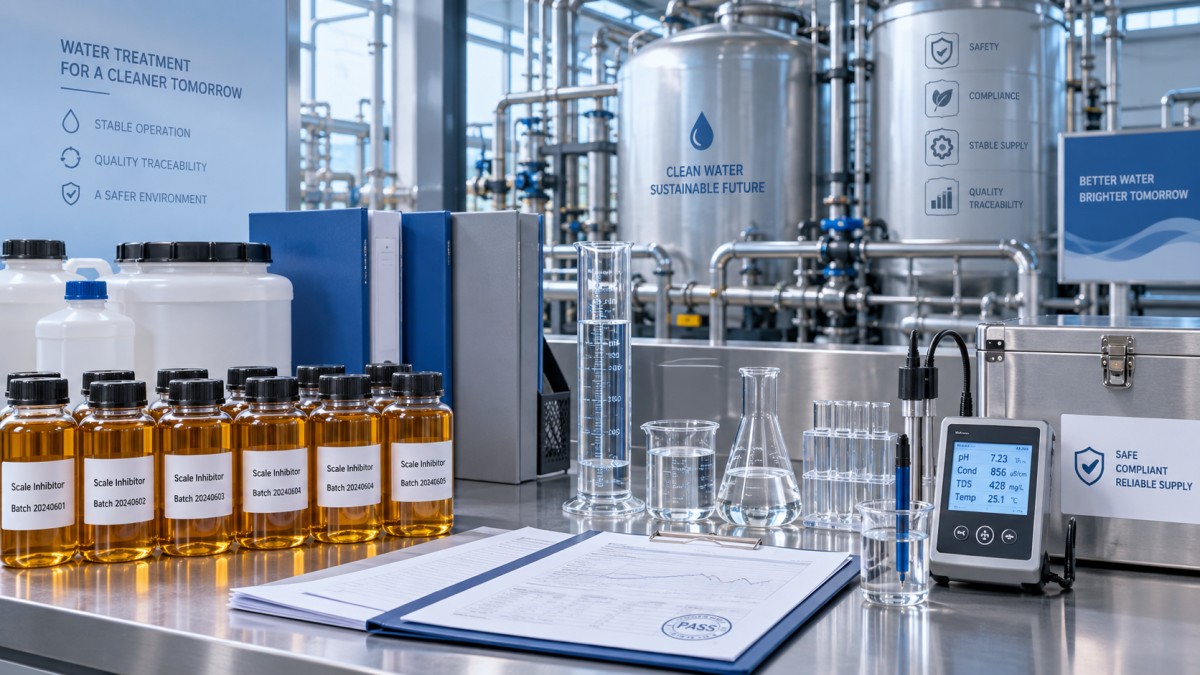
A qualified scale inhibitor manufacturer should provide a controlled documentation package before shipment, during qualification, and whenever a formula, process, raw material, or regulatory status changes.
For quality and safety teams, the objective is traceability. Every delivered batch should be identifiable, testable, safely handled, and connected to approved technical requirements.
The package should not be treated as a procurement formality. It is evidence that the supplier can control product quality across production cycles and operating conditions.
At minimum, request a technical data sheet, safety data sheet, certificate of analysis, regulatory declarations, packaging information, and applicable performance test reports.
For critical applications, request additional evidence covering raw material control, change management, manufacturing quality systems, third-party testing, and site-specific compatibility evaluations.
Technical Data Sheet: Define What the Product Is Expected to Do
The technical data sheet, or TDS, should clearly state the product identity, chemical category, intended applications, recommended dosage range, storage conditions, and key physical properties.
Quality personnel should compare TDS values against internal acceptance standards. Broad or undefined descriptions make it difficult to verify whether delivered material matches approved performance expectations.
Important parameters often include active content, density, pH, appearance, viscosity where relevant, solubility, molecular characteristics, and recommended compatibility with other treatment chemicals.
The document should identify application limitations. A product suitable for moderate cooling-water conditions may not remain effective in high-temperature, high-alkalinity, or high-hardness systems.
A reliable scale inhibitor manufacturer should also explain whether dosage depends on calcium hardness, alkalinity, pH, temperature, cycles of concentration, retention time, or contaminant loading.
For example, a terpolymer used as a dispersant and scale inhibitor should describe its ability to control calcium carbonate, calcium phosphate, zinc deposits, and iron oxide.
Products such as Carboxylate-Sulfonate-Acrylate Terpolymer (AA/AMPS/HPA) should have documented solid content, density, pH, appearance, compatibility, and operating-condition suitability before qualification.
Safety Data Sheet: Confirm Safe Transport, Storage, and Use
The safety data sheet, or SDS, is essential for safety managers because it translates chemical hazards into practical requirements for receiving, storage, dosing, emergency response, and disposal.
Check that the SDS follows the Globally Harmonized System format and is current for the destination market, language requirements, and supplied formulation.
Section 2 should identify hazard classifications, signal words, pictograms, hazard statements, and precautionary statements. These details affect labeling, warehouse segregation, and operator training.
Section 3 should disclose composition information at a useful level. Confidential ingredient claims may be legitimate, but hazardous components still require sufficient identification for risk assessment.
Review Sections 7 and 8 carefully. They should specify handling controls, storage temperatures, incompatible materials, ventilation requirements, personal protective equipment, and exposure-control recommendations.
For acidic polymeric scale inhibitors, confirm whether corrosion-resistant containers, splash protection, eyewash facilities, and acid-compatible transfer equipment are required at the customer site.
Transport information in Section 14 should match shipping labels and commercial documents. Inconsistencies can create customs delays, improper handling, or regulatory nonconformance.
Certificate of Analysis: Verify Each Delivered Batch
A certificate of analysis, or COA, is the batch-specific document that connects production testing to the material received by the customer.
It should show the product name, batch number, manufacturing date, retest or expiry date, test methods, specification limits, actual results, and release authorization.
Do not accept a generic certificate that repeats target specifications without measured results. Actual numerical values provide evidence of production consistency and support incoming inspection.
For water treatment chemicals, typical COA items include appearance, solid content, density, pH, and other application-specific indicators such as viscosity, active component concentration, or residual monomer limits.
Quality teams should confirm that the batch number on the COA matches the drum label, intermediate bulk container label, packing list, invoice, and any retained sample.
Establish written acceptance rules for borderline values. A batch may meet a broad supplier limit while still falling outside the performance range validated for your system.
Request information about analytical methods when results influence critical control decisions. Consistent methods improve comparison between batches, suppliers, laboratories, and long-term performance records.
Regulatory Declarations: Reduce Compliance and Market Access Risk
Regulatory documentation should reflect both the product and the intended market. Requirements vary according to country, industrial sector, application, transport route, and downstream customer obligations.
Common requests include REACH status, TSCA status, inventory declarations, RoHS statements, SVHC declarations, California Proposition 65 information, and country-specific chemical inventory confirmations.
For export supply, verify that declarations identify the legal entity issuing them, the issue date, product scope, and regulatory version. Undated statements are weak compliance evidence.
Where applicable, request confirmation that restricted substances, heavy metals, persistent pollutants, or intentionally added hazardous constituents are controlled according to contractual and regulatory requirements.
Safety teams should also evaluate wastewater implications. A scale inhibitor may be effective in circulation systems but require discharge review because of phosphorus content, metal stabilization, or biodegradability concerns.
Ask whether the manufacturer can provide ecological information, biodegradation data, aquatic toxicity information, and disposal guidance relevant to local wastewater treatment and environmental permits.
Performance Reports: Confirm Fit for Actual Water Conditions
Product specifications alone do not prove scale control in a specific system. Performance reports help teams determine whether the chemistry matches actual water composition and operating severity.
Useful tests may include static scale inhibition, dynamic simulation, calcium tolerance, iron dispersion, zinc stabilization, membrane compatibility, thermal stability, and corrosion-inhibition compatibility testing.
Test conditions must be visible. Results without water chemistry, pH, temperature, dosage, concentration factor, test duration, and control comparisons cannot support an engineering decision.
For reverse osmosis applications, request test evidence related to membrane compatibility, feedwater composition, anticipated recovery rate, and interaction with pretreatment chemicals or cleaning agents.
For cooling water systems, performance evidence should address high cycles, elevated pH, hardness, alkalinity, suspended solids, corrosion inhibitor programs, microbiological control agents, and temperature variation.
In oilfield, petrochemical, steel, and power applications, ask for examples involving high salinity, metal ions, iron contamination, temperature stress, or complex mixed-chemical conditions.
Third-party reports can add confidence, but laboratory testing should still be followed by controlled field evaluation when scaling risk, asset value, or process interruption costs are high.
Quality System and Change-Control Evidence
Quality documentation should demonstrate that results are repeatable, not merely that one sample passed. Ask for ISO 9001 certification or equivalent quality-system evidence where appropriate.
Certification alone is insufficient. Request an explanation of incoming raw material controls, batch release procedures, retained samples, nonconformance handling, calibration management, and complaint investigation processes.
A capable manufacturer should notify customers before material changes that may affect performance, safety, regulatory status, labeling, packaging, or compatibility with existing treatment programs.
Change-control expectations should be written into supply agreements for critical products. Include triggers such as raw material substitutions, manufacturing-site changes, analytical-method changes, and specification revisions.
For long-term projects, quality teams may request supplier audit access or remote audit materials. Production flowcharts, quality plans, laboratory capabilities, and traceability records help assess control maturity.
Packaging, Storage, and Logistics Documents Matter Too
Packaging documentation supports both safe handling and product stability. Confirm container materials, net weight tolerances, closure requirements, pallet configuration, labeling details, and transport protection measures.
The manufacturer should state recommended storage temperature, shelf life, freezing precautions, heat exposure limits, sunlight protection, and actions required when product separation or crystallization occurs.
For 25 kg containers, 250 kg drums, and 1250 kg IBC tanks, confirm that packaging is compatible with the chemical and suitable for receiving equipment.
Shipping documents should include packing lists, commercial invoices, transport classifications, certificates requested by destination authorities, and batch traceability information for every shipment.
Receiving procedures should include label verification, visual inspection, leak checks, COA review, sample retention, and escalation instructions for damaged, mislabeled, or out-of-specification deliveries.
Use Documentation as a Supplier Qualification Tool
The best documentation package enables a structured supplier review rather than a paperwork exercise. It helps quality, procurement, operations, environmental, and safety teams assess the same risks.
Set a document matrix before approving a new supplier. Define which documents are mandatory, who reviews each document, how often updates are required, and what conditions trigger requalification.
Prioritize evidence that affects plant reliability: batch COAs, current SDS files, formulation-change notifications, performance reports under representative water conditions, and clear technical support channels.
Documentation gaps are not always disqualifying, but they should trigger questions. A manufacturer that cannot explain testing methods, hazards, or consistency controls may create avoidable operational risk.
Conclusion
A dependable scale inhibitor manufacturer supplies more than sales literature. It provides controlled technical, safety, quality, regulatory, performance, and logistics documentation that supports informed industrial water treatment decisions.
For quality control and safety teams, the strongest approach is to verify documents against actual operating conditions, receiving procedures, regulatory duties, and defined acceptance criteria.
When documentation is complete, current, batch-specific, and technically credible, it becomes a practical control tool for safer handling, stable treatment performance, and more reliable supply.

ONLINE CONSULTATION
If you have any questions, please contact us and we will contact you as soon as possible.