


Why local technical service matters when choosing a scale inhibitor manufacturer
The practical value of a scale inhibitor is only proven after it enters a working water system. That is why choosing a scale inhibitor manufacturer should involve more than comparing active content, price, packaging, and delivery terms. For a plant manager or procurement team, responsive local technical service can determine whether a treatment program remains stable or turns into repeated cleaning, unplanned downtime, membrane fouling, corrosion concerns, and chemical overspend.
Scale formation is not caused by a product name alone. It is the result of the actual water chemistry, operating temperature, concentration cycles, flow conditions, contaminants, equipment materials, and changes in production load. A product that performs well in one cooling-water system may need a different dosage, blend, or monitoring approach in another. Local technical support matters because it connects the supplied chemical to these site-specific conditions.
Why product specifications are not enough
Technical data sheets are necessary, but they cannot describe every factor that affects performance on site. A water sample taken during normal operation may differ significantly from one taken after make-up water changes, equipment cleaning, rainfall, process leakage, or an increase in reuse water. The scale risk may also shift from calcium carbonate to calcium sulfate, silica, barium sulfate, strontium sulfate, or mixed deposits.
Without technical interpretation, buyers can make a reasonable-looking but incomplete decision: select a low-cost inhibitor with suitable laboratory indicators, apply a standard dosage, and assume the program is finished. When scale still appears, the chemical itself is often blamed first. In reality, the cause may be an incorrect dosing point, insufficient residence time, an incompatible corrosion inhibitor, poor blowdown control, a failed dosing pump, or water chemistry outside the original design basis.
A manufacturer with accessible technical personnel can help distinguish between a chemistry problem and an operating problem. That distinction protects the purchasing decision. Replacing a chemical too quickly may increase cost without addressing the cause of the deposit.
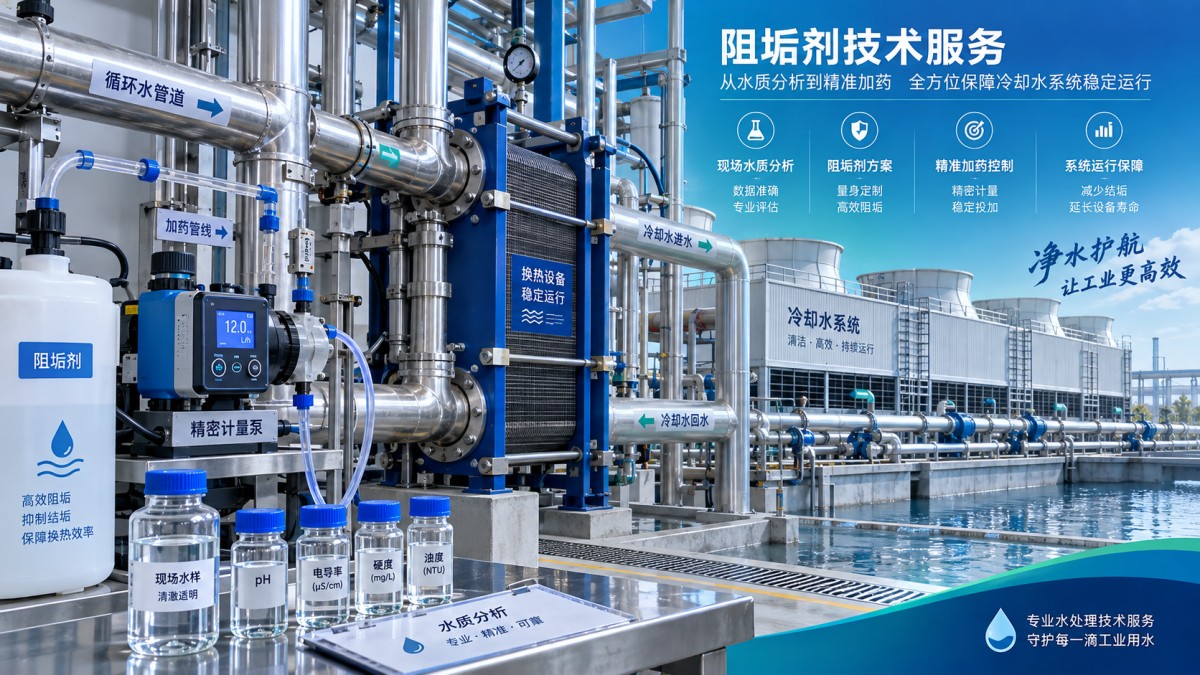
Local support shortens the path from symptom to corrective action
In industrial water treatment, delays matter. Deposits can reduce heat-transfer efficiency, restrict flow, damage pumps, increase pressure drop, and contribute to under-deposit corrosion. In reverse osmosis systems, untreated scaling or fouling can reduce permeate output and lead to more frequent cleaning. In oilfield water injection, mineral deposits can affect injection lines and formation compatibility.
Remote support can be useful for routine questions, especially when water quality and system operation are stable. It becomes less effective when a site has a changing problem that requires representative sampling, a physical inspection of deposits, verification of dosing equipment, or coordination with plant operations. Local technical service gives the manufacturer a clearer view of the process rather than relying solely on a brief email description.
The best support is not simply an emergency visit after a failure. It includes an agreed response process: what operating data should be collected, which water streams should be sampled, who reviews the results, and what changes can be made safely. This makes troubleshooting more disciplined and reduces the risk of changing several variables at once.
What technical service should contribute before an order is placed
A capable supplier should be able to discuss the system in terms that lead to a usable treatment decision. Procurement teams do not need a theoretical lecture; they need evidence that the proposed program matches their operating conditions and can be supported after delivery.
- Water analysis: Review hardness, alkalinity, pH, conductivity, chloride, sulfate, silica, iron, suspended solids, and any process-specific contaminants that influence scaling or corrosion.
- System mapping: Identify the make-up source, recirculating volume, temperature profile, concentration cycles, blowdown practice, filtration, and critical heat-transfer or membrane equipment.
- Deposit-risk assessment: Clarify which mineral scales are plausible under the actual conditions, rather than treating every deposit as a generic calcium problem.
- Compatibility review: Check whether the inhibitor can work with the current corrosion inhibitor, dispersant, biocide, coagulant, defoamer, or cleaning program.
- Dosing and monitoring plan: Define the injection location, control target, testing frequency, and the operational signals that should trigger review.
This work is particularly important when a facility is changing water sources, increasing water reuse, raising cycles of concentration, expanding production capacity, or moving from a single treatment chemical to a blended program. These changes can alter both the type of scale formed and the margin for dosing error.
Do not confuse proximity with useful technical capability
A nearby distributor is not automatically the same as a manufacturer with meaningful local technical service. The useful question is whether the supplier can take ownership of the technical process. Can its team interpret water results? Can it recommend a controlled adjustment rather than simply proposing more chemical? Can it access formulation support when the site requires a change? Can it help investigate a deposit before recommending a replacement product?
The third model is usually more valuable for systems with high downtime cost, difficult feedwater, strict reliability requirements, or multiple interacting treatment chemicals. A simple, stable utility-water application may not require frequent on-site support, but it should still have a clear escalation route when conditions change.
Specialty scale problems require a more specific conversation
Some applications cannot be managed well by selecting an inhibitor only because it is commonly used for cooling water. Oilfield injection water, for example, may create difficult barium and strontium sulfate deposition risks. A product chosen for ordinary calcium carbonate control may not provide the same protection under these conditions. The manufacturer should ask about ion composition, mixing points, pressure and temperature changes, and whether the treatment must also support corrosion control.
For systems where barium or strontium scale is a concern, a technical discussion may include products such as Polyhydric Alcohol Phosphate Ester (PAPE). This type of chemistry is used in oilfield water injection and circulating cooling-water treatment, with scale-inhibiting and corrosion-inhibiting functions. Its relevance depends on the water analysis and the rest of the treatment program, including compatibility with polycarboxylates, organophosphonates, inorganic phosphates, and zinc salts. It should be evaluated as part of a complete operating condition, not selected solely from a product description.
Questions to ask a scale inhibitor manufacturer
Before approving a supplier, ask questions that reveal how the company will support the application after purchase:
- What information do you need before recommending an inhibitor or dosage?
- How do you assess scale type when a deposit has already formed?
- Can you review compatibility with our existing water-treatment chemicals?
- Who will respond if water quality changes or the system begins to foul?
- Can the formulation be adjusted if the standard product does not fit the water condition?
- What operating records should our team maintain for routine performance review?
The quality of the answers is often more revealing than a sales presentation. A reliable technical partner will request water and system data, explain the assumptions behind its recommendation, and identify the limits of a proposed program. A supplier that promises a universal solution without asking about the system is not providing a dependable basis for selection.
Service should be part of the commercial comparison
When comparing quotations, separate chemical price from total treatment cost. A slightly lower unit price can lose its advantage if it leads to excessive dosage, frequent manual intervention, shortened cleaning intervals, or repeated chemical changes. Conversely, technical service has little value if it is vague, unavailable during disruptions, or disconnected from the manufacturer’s formulation and quality-control capabilities.
Prio New Materials combines standardized bulk supply with customized formulation development, laboratory testing, and technical support for applications including cooling water, RO systems, oilfield reinjection water, wastewater treatment, boiler make-up water, and desalination. For buyers, the relevant point is the connection between manufacturing control and application support: the technical team should be able to translate site findings into a practical adjustment to product selection, dosage, or treatment compatibility.
Choose the supplier that can support the water system you actually operate, not the simplified system shown in a quotation. Before signing a long-term supply agreement, confirm the site data required for selection, the review process after start-up, the response route for abnormal conditions, and the technical resources available when the original treatment plan needs to change.

ONLINE CONSULTATION
If you have any questions, please contact us and we will contact you as soon as possible.