


Why packaging compatibility should be tested with a defoamer OEM
For project managers responsible for industrial water systems, selecting a defoamer is not only a purchasing decision—it is a compatibility risk assessment. Working with a qualified defoamer OEM makes it possible to test performance against actual water chemistry, operating temperatures, equipment materials and dosing conditions before full-scale application. That step can prevent persistent foam, process interruptions, membrane fouling and avoidable operating costs while keeping a project schedule on track.
The problem is that foam is visible, but incompatibility is often not. A drum may arrive with a defoamer that performs well in a simple beaker test, then behaves very differently once it enters a circulating cooling-water loop, wastewater equalization tank, RO pretreatment line or high-shear dosing system. In real projects, the defoamer is rarely added to clean water. It enters a moving chemical environment containing dispersants, corrosion inhibitors, biocides, coagulants, surfactants, salts, suspended solids and process contaminants.
Packaging is part of chemical compatibility, not just logistics
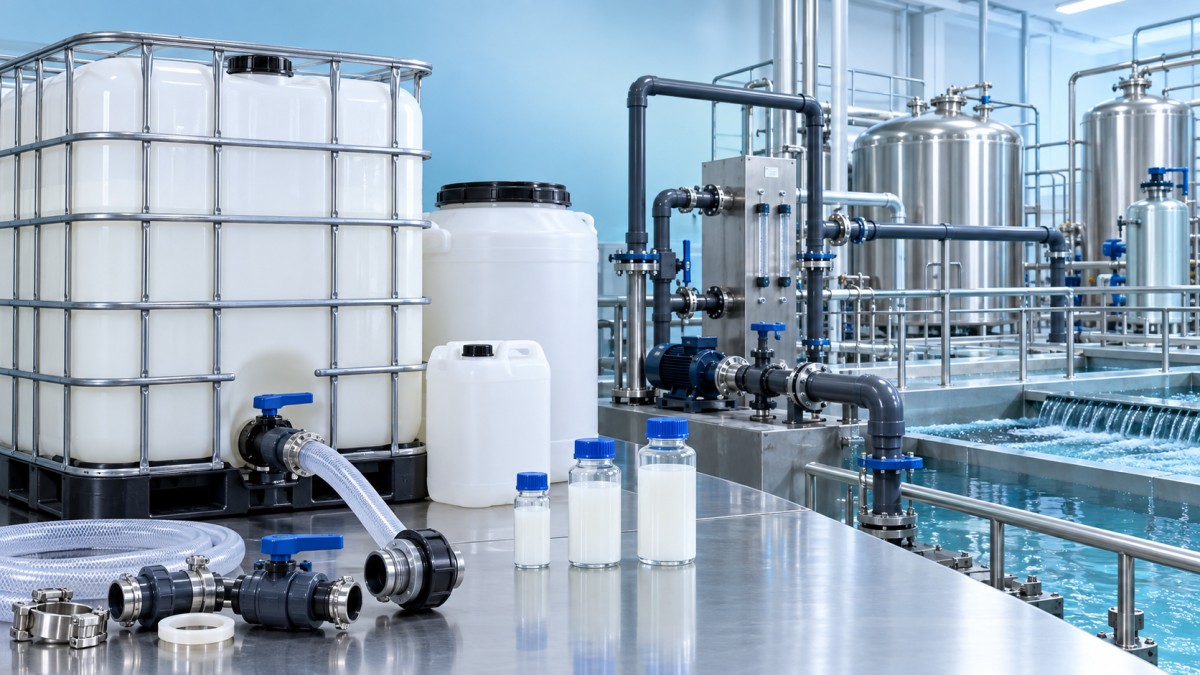
When teams discuss compatibility, they usually focus on whether a defoamer suppresses foam or interferes with another treatment chemical. Packaging deserves the same level of scrutiny. The container, cap, liner, valve, seal and dispensing connection all come into contact with the formulation over storage and transport time. If a packaging material is not suitable for the carrier fluid, silicone content, mineral oil fraction, emulsifier system or solvent component, the risk may not become obvious until the product reaches site.
Common warning signs include softened seals, leaking closures, container distortion, crusting around openings, phase separation after storage, or a change in product viscosity that makes controlled dosing difficult. These are not merely warehouse inconveniences. A leaking IBC valve can create a safety and housekeeping issue; a separated product can result in inconsistent active delivery; and a damaged closure may allow contamination or make the material impractical to use in an automated feed system.
For projects with long transit routes, hot climates, cold-weather storage or infrequent dosing, packaging compatibility becomes even more important. A product that remains stable in a supplier’s short-term internal sample bottle may require different validation in a 25 kg pail, 200 kg drum, or 1,000-plus kg IBC. The scale and storage duration change the risk profile.
Why a defoamer OEM should be involved before procurement is finalized
A capable defoamer OEM does more than quote a standard grade. It should be able to discuss the formulation family, intended application, recommended packaging, storage limits and the practical conditions under which performance can drift. This is especially useful when project specifications are still evolving. A plant may initially plan for normal-temperature wastewater treatment, then later add elevated-temperature recycling, different raw materials or a revised chemical dosing program.
The most useful pre-application test is not a generic foam comparison. It is a small but representative compatibility programme using the customer’s actual water sample wherever possible. The OEM and project team should look at foam knockdown, foam control over time, product dispersion, effect on downstream separation, and interaction with the full treatment package. Packaging observations should be recorded at the same time, particularly if samples will be retained under expected transport or storage conditions.
This approach matters because “works in water” is not enough. A defoamer can suppress foam rapidly but leave hydrophobic residues that are undesirable in some membrane-related applications. Another may disperse well at room temperature but lose consistency after exposure to heat. In biological wastewater treatment, aggressive foam suppression may need to be balanced against effects on oxygen transfer or downstream sludge handling. The right choice depends on the operating constraint, not on the lowest unit price or the fastest initial collapse test.
What a meaningful compatibility test should cover
Project teams do not need an overly complicated test plan, but they do need one that reflects how the material will actually be handled. A practical evaluation normally includes the following questions:
- What is causing the foam: surfactants, biological activity, gas entrainment, high shear, oils, polymers, or a combination of factors?
- What is the process temperature at the dosing point, and how much does it fluctuate during operation?
- Which treatment chemicals are already in the system, including scale inhibitors, dispersants, biocides and flocculants?
- Will the defoamer be dosed manually, through a metering pump, or through an automated control loop?
- Which package format will be used, and how long could the product remain in storage after delivery?
- Are there downstream assets—membranes, filters, heat exchangers, separators or coating processes—that could be sensitive to carryover?
A good OEM will also ask questions that are sometimes missed during early procurement: Is the feed line narrow? Is there a recirculation loop in the day tank? Will the IBC sit outdoors? Does the site need winter-grade handling? These details may sound operational, but they determine whether a technically suitable defoamer remains usable after delivery.
Do not test the defoamer in isolation from the water-treatment programme
In industrial cooling water and boiler-related systems, foam control often sits beside scale and corrosion control. Those chemical programmes must be considered together. For example, a neutral, nitrogen-containing organic polyphosphonate such as Ethylene Diamine Tetra (Methylene Phosphonic Acid) Pentasodium Salt (EDTMP·Na5) may be used in circulating water, boiler water, power-plant cooling water, cyanide-free electroplating or printing and dyeing applications where metal-ion chelation and scale control are required.
Its stated characteristics—including water miscibility, chemical stability and performance under elevated-temperature conditions—make it relevant to programmes where calcium sulfate or barium sulfate scaling is a concern. But the presence of a stable scale inhibitor does not automatically confirm defoamer compatibility. The project team should still test the combined treatment solution at realistic concentration ratios. A defoamer that destabilizes another formulation, separates after mixing, or changes deposit behaviour may solve one visible problem while creating a less obvious one.
This is where suppliers with formulation development, laboratory testing and field technical support can add practical value. The goal is not to sell a larger chemical package. It is to identify a combination that remains stable from storage through dosing and through the process itself.
A short pilot can avoid a long operational problem
For a new installation or a major chemical-programme change, a controlled site trial is usually more informative than extended debate over product datasheets. The pilot should define the dosing point, trial duration, sample frequency, foam observation method and success criteria before starting. It should also record non-foam indicators such as pump behaviour, filter differential pressure, membrane trends where relevant, visual carryover, and any change in water appearance or downstream process stability.
Be cautious about drawing conclusions from the first few hours. Some systems have residual surfactants, accumulated contaminants or changing load patterns that can distort early results. A useful trial observes response across normal operating shifts rather than only during an ideal steady state. If the project has seasonal temperature changes or batch discharge cycles, those conditions should be considered before committing to a long-term bulk order.
Packaging should remain in the pilot review. Inspect retained containers, dispensing points and transfer hoses. Confirm that the chosen package is appropriate for the site’s unloading equipment and storage arrangement. A product that needs repeated manual shaking, special warming or frequent line flushing may still be workable, but those requirements should be known before they become a site-level frustration.
The purchasing decision should include a technical handover
The best outcome is a clear handover between the OEM, procurement team, commissioning engineers and plant operators. It should cover approved package type, storage guidance, shelf-life handling, dosing method, expected consumption basis, compatibility findings and escalation contacts if foam returns under changed conditions. This is particularly important for large or international projects where the person approving the chemical may not be the operator receiving it months later.
Testing packaging compatibility with a defoamer OEM is therefore not an extra administrative step. It is a way to protect process reliability before a chemical becomes embedded in the operating routine. If the supplier can test against actual water conditions, explain formulation limits, support suitable packaging choices and review the full treatment programme, the project has a far better basis for selecting a defoamer that works beyond the first delivery.

ONLINE CONSULTATION
If you have any questions, please contact us and we will contact you as soon as possible.