


How to select a pharmaceutical defoamer for aqueous processing
A pharmaceutical defoamer for aqueous processing should be selected as a controlled process aid, not simply as the fastest foam-breaker in a supplier sample. In water-based pharmaceutical operations, an antifoam can affect filtration, mixing, downstream separation, cleaning, residue control, and sometimes the quality profile of the material being processed. The right choice is the product that controls foam at the lowest reliable addition level while remaining suitable for the process contact conditions and the established quality system.
Start by defining where the defoamer will be used. A material added to utility-side wastewater, a fermentation broth, an extraction vessel, a washing step, and a final product-contact formulation do not face the same acceptance criteria. The closer the addition point is to the active substance or finished dosage form, the more carefully composition, traceability, impurity control, and removability must be assessed.
Define the foam problem before comparing products
“Excessive foam” is not a sufficiently useful specification. Technical evaluation should identify the mechanism creating the foam and the operational consequence. Foam caused by high-shear mixing behaves differently from foam generated by aeration, proteinaceous media, surfactants, cleaning residues, or pump cavitation. A defoamer that collapses surface foam quickly may still perform poorly if agitation or gas sparging continuously creates new foam.
Record the operating window: water quality, pH, temperature, agitation speed, gas flow, batch duration, solids level, surfactant presence, and the point at which the defoamer would be dosed. Also distinguish between transient foam during charging and persistent foam that limits vessel capacity, causes sensor errors, carries material into vents, or disrupts filtration.
This definition prevents a common selection error: choosing an aggressive defoamer to mask a mechanical or formulation problem. If the foam is mainly caused by entrained air from a pump or an unsuitable mixing regime, equipment adjustment may reduce chemical demand more effectively than increasing the antifoam dose.
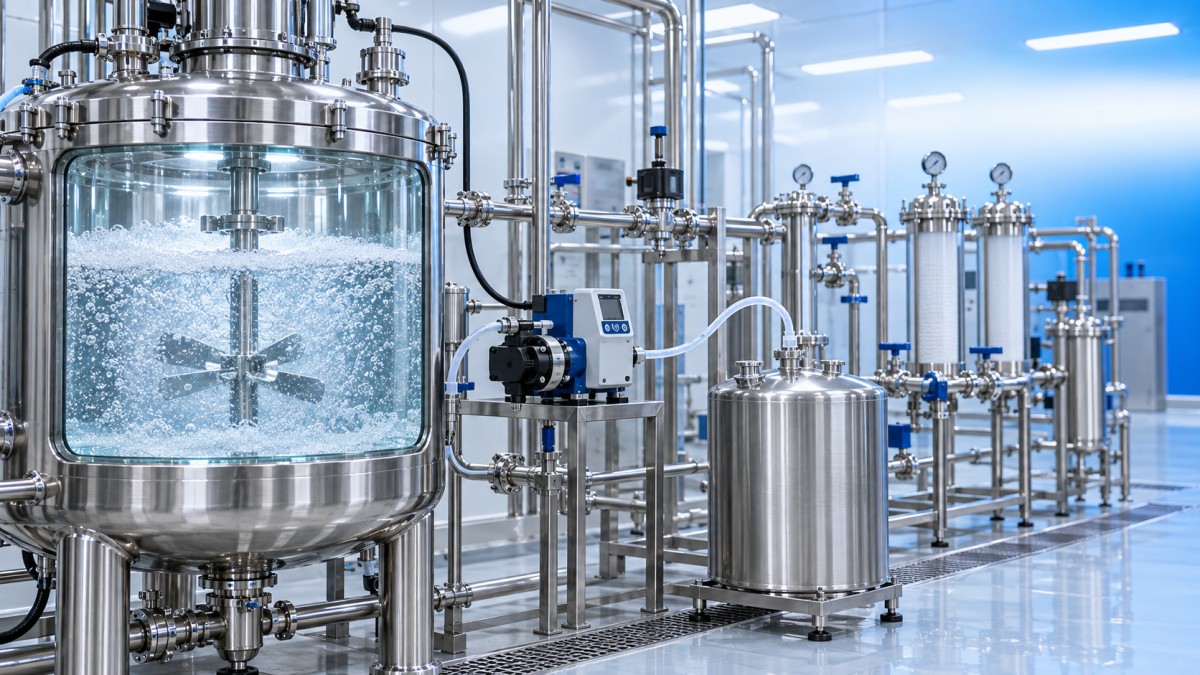
Choose chemistry by process compatibility, not product category alone
Pharmaceutical defoamers used in aqueous systems are often based on silicone, mineral oil, vegetable-derived oils, fatty alcohols, polyethers, or mixed systems. No chemistry is inherently appropriate for every process. The useful question is whether the material can control the specific foam without creating a downstream burden.
Silicone-based materials can be effective at low dosage in difficult foam systems, but their hydrophobic character deserves particular attention where membranes, chromatography media, fine filtration, or sensitive analytical methods are involved. Oil-based systems may be workable in some bulk operations but can be undesirable where residue, oxidation, or purification load is a concern. Polyether-based defoamers may offer better compatibility in certain water-rich systems, although their effectiveness can change with temperature, electrolyte concentration, and surfactant composition.
Do not assume that a water-dispersible product is automatically easy to remove, or that an emulsified antifoam will behave consistently in every batch. Dispersion stability, shear history, and storage conditions all influence how the active defoaming phase reaches the foam interface.
Set an acceptance package for the intended contact level
The phrase “pharmaceutical grade” is too broad to replace a defined technical requirement. The evaluation package should match the material’s use point and the risk of product contact. For direct or near-direct process contact, review the full composition, supplier change-control practices, batch documentation, microbiological suitability where relevant, and the basis for controlling impurities that matter to the process.
For utility-side use, such as treatment of non-product-contact water streams, the decision may focus more heavily on reliable foam control, compatibility with biological or chemical treatment, and discharge-related operating constraints. Even then, the formulation should not introduce an avoidable treatment problem, such as persistent emulsion, reduced oxygen transfer, or interference with separation.
A supplier should be able to identify the product consistently, provide lot-level documentation, describe normal storage conditions, and explain whether raw-material or manufacturing changes are controlled. Technical evaluators should also consider whether the supplier can support repeatability at commercial scale rather than only provide a laboratory sample.
Test in the actual process matrix
Bench screening is necessary, but simple shake tests are not enough for final selection. Test each candidate in representative process liquor, at relevant temperature and agitation conditions. Include the highest expected surfactant or solids load where practical, because a defoamer that works in purified water may fail in the real formulation.
Compare candidates at a dose range rather than a single addition point. The best option is rarely the one with the most dramatic immediate collapse; it is the one that maintains control with a workable dosing margin and does not compromise downstream performance. Evaluate repeated additions as well. A low-cost material can become expensive if it must be added frequently or increases cleaning and purification demands.
Where downstream operations are sensitive, retain samples for checks that reflect the process risk: filterability, membrane flux behavior, phase separation, extraction performance, appearance, and analytical interference. The exact test set depends on the operation, but it should be tied to known process failure modes rather than treated as a generic qualification exercise.
Plan dosing and handling as part of the selection
A suitable pharmaceutical defoamer can still fail in use when it is added at the wrong location. Dose into a zone with enough mixing to disperse the product, but avoid a point where it immediately contacts a filter, sensor, or low-flow dead leg. In aerated systems, controlled incremental dosing is often more stable than a large preventive charge, especially when foam intensity varies across the batch.
Confirm whether the product requires dilution, gentle homogenization before use, or protection from temperature extremes during storage. A concentrated defoamer that separates in storage can produce inconsistent active delivery from one addition to the next. The operating instruction should state the dose point, addition method, normal dose range, escalation limit, and response when foam persists.
Keep utility-water chemistry separate from product-contact antifoam selection
Pharmaceutical sites often manage both aqueous manufacturing steps and supporting systems such as boilers, cooling loops, and reverse-osmosis pretreatment. These systems may all have foam or water-quality issues, but their chemical selection logic is different. A scale inhibitor intended for a boiler or RO system should not be repurposed as a pharmaceutical defoamer.
For example, Sodium Salt of HexaMethylene Diamine Tetra (Methylene Phosphonic Acid) (HDTMPA·Na6) is designed for water-treatment duties including boiler-water treatment and reverse-osmosis scale control. Its role is to help prevent scaling salts under suitable water conditions, not to control foam in product-contact aqueous processing. Keeping these chemical functions separate avoids an avoidable qualification and compatibility error.
A practical selection sequence
- Map the foam source, process step, product-contact status, and consequence of foam failure.
- Define non-negotiable constraints: acceptable composition, downstream compatibility, documentation, residue expectations, and handling requirements.
- Shortlist chemistries based on the real aqueous matrix rather than general descriptions such as “high efficiency.”
- Run comparative trials in representative liquor under realistic agitation, temperature, and aeration conditions.
- Check the chosen dose against downstream filtration, separation, cleaning, and analytical needs.
- Set controlled dosing instructions and qualify the supply arrangement for routine production.
The final decision should be documented as a process fit: which foam it controls, where it is added, how much operational margin it provides, and which downstream conditions it has been shown not to disturb. That approach produces a more dependable outcome than selecting solely on rapid visual foam collapse.

ONLINE CONSULTATION
If you have any questions, please contact us and we will contact you as soon as possible.