


What quality controls matter most in defoamer OEM batch release
For quality and safety managers, batch release is the point at which a defoamer OEM either proves control of its process or transfers uncertainty to the user. A batch can match its appearance and still fail in service because its active balance, dispersion behavior, contamination profile, or storage stability has shifted. The release decision should therefore connect routine laboratory results with the conditions where the defoamer will actually be dosed.
The most important controls are usually raw-material identity and traceability, formulation-critical physical properties, application-relevant foam testing, and a release record that makes deviations visible. A certificate of analysis is useful only when its test items and acceptance limits reflect the intended water system.
Start with raw materials and change control
Many defoamer failures originate before blending. Silicone fluids, hydrophobic particles, mineral oils, emulsifiers, solvents, preservatives, and water can all affect performance. Incoming inspection should verify the identity, lot number, supplier status, appearance, and applicable specification of each critical component. Materials that govern spreading speed, persistence, or emulsion stability deserve tighter control than minor processing aids.
A practical release system also distinguishes between an approved batch and an approved formula. Replacing an emulsifier, changing the source of a silicone intermediate, using a different preservative, or adjusting the order of addition may leave viscosity within range while changing performance in high-salt wastewater, alkaline cleaning liquor, or high-temperature circulation water.
For this reason, an OEM should operate documented change control. Changes to raw materials, manufacturing equipment, mixing time, shear conditions, packaging, or test method should trigger a risk review. Depending on the application, that review may require comparison against a retained reference batch rather than simple conformance to routine numerical limits.
Release tests should identify formula drift
Appearance, pH, density, viscosity, and active content are common release tests because they are fast and useful. They should not be treated as interchangeable indicators. Viscosity may show an emulsion problem; active content may reveal a dosing-strength error; pH may flag hydrolysis risk or an incorrect aqueous phase. None alone confirms defoaming efficiency.
Acceptance ranges should be justified by the formula and the dosing environment. A broad viscosity range may be acceptable for a bulk oil-based defoamer, but it can be too loose for a metering pump application where consistent feed rate matters. For emulsion defoamers, particle size or dispersion uniformity can be equally important where the product must remain pumpable and must distribute rapidly after addition.
Quality teams should also look at result trends rather than only pass-or-fail status. A gradual movement toward a specification limit can signal supplier variation, mixing inconsistency, or emulsion aging. Releasing each batch independently without reviewing the trend often delays detection until plant performance becomes unstable.
Use foam tests that resemble the application
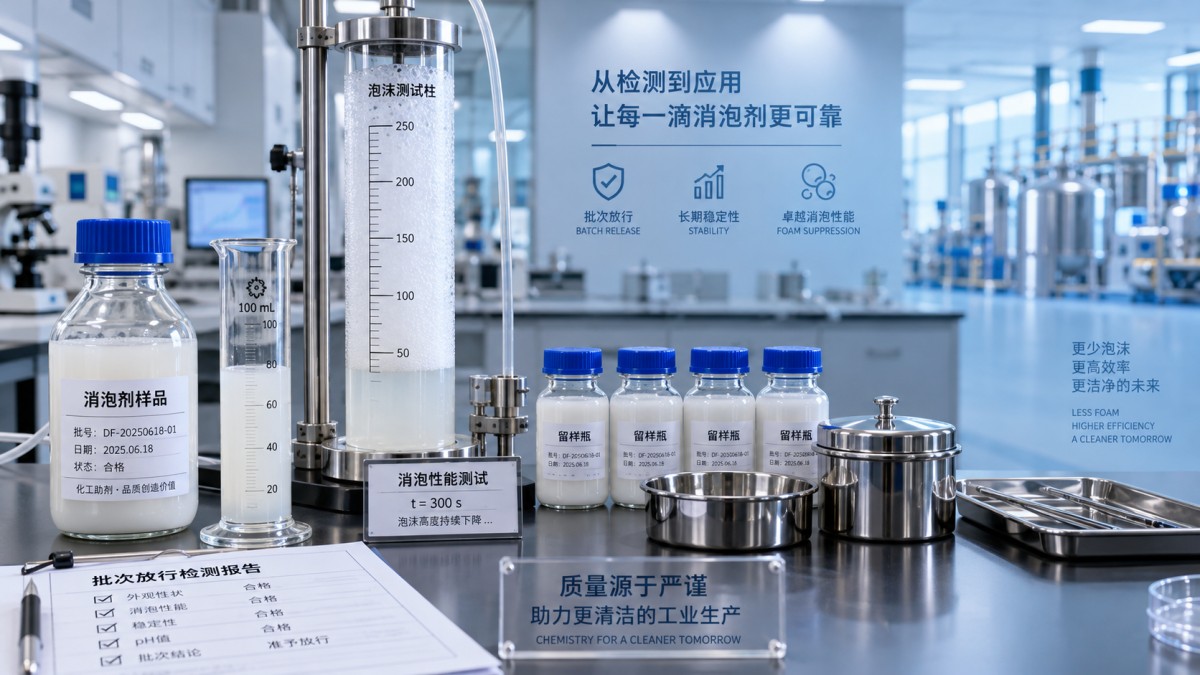
The most meaningful batch-release control is a defined performance test using a representative medium. A generic shake test can be suitable for rapid screening, but it may not predict behavior in a live system with salts, suspended solids, surfactants, temperature cycling, or continuous aeration.
A useful method should state the water matrix, temperature, foam-generation method, defoamer dosage, mixing intensity, observation time, and acceptance criteria. It should assess both knockdown and persistence. A product that collapses foam immediately but allows rapid re-foaming may be unsuitable for wastewater equalization, paper-machine white water, or circulating-water systems with persistent surfactant loading.
- Knockdown: how quickly the batch reduces an established foam layer at the intended dose.
- Persistence: whether suppression remains effective through continued aeration or agitation.
- Compatibility: whether the defoamer causes separation, deposits, turbidity, or loss of function when mixed with the actual process chemistry.
- Overdose response: whether higher dosing introduces oil spots, surface defects, membrane fouling risk, or downstream treatment issues.
Where the end use includes microbial control, compatibility deserves explicit review. For example, systems using Isothiazolinones may contain surfactants and treatment additives that alter defoamer dispersion and foam behavior. The release test does not need to reproduce every site condition, but it should represent the chemical environment that is most likely to expose a formulation weakness.
Stability and contamination checks protect the user after delivery
A batch that passes on the day of manufacture may still separate in storage, lose activity after freeze-thaw exposure, or become difficult to re-disperse. Batch release should include stability controls appropriate to shipping route and storage conditions. These may include accelerated aging, low-temperature observation, centrifugation, heat exposure, and re-dispersion checks. The aim is not to claim an arbitrary shelf life; it is to identify batches that are more likely to separate or change behavior before use.
Contamination control is equally relevant for water-treatment applications. Cross-contamination from previous production campaigns can introduce incompatible oils, surfactants, biocides, or residues. Cleaning verification, line-clearance records, dedicated transfer equipment where justified, and retained samples are more defensible controls than relying on final appearance alone. For safety-managed sites, the release file should also confirm that packaging, labels, safety documentation, and transport classification match the released formulation.
Documentation determines whether a release decision can be defended
A reliable defoamer OEM release package links the finished batch to its raw-material lots, manufacturing record, test results, deviations, rework history, packaging lot, and retained sample. The certificate of analysis should identify the batch clearly and report the properties the buyer has agreed to control. It should not become a generic form that lists values unrelated to the application while omitting the test that predicts field performance.
For buyers, the most useful pre-approval step is to agree on a short, application-specific release specification. Define the critical properties, the performance medium, the test method, sampling frequency, allowable changes, notification requirements, and retain-sample period. This converts “same product name” into a measurable supply standard.
In defoamer procurement, consistency is rarely proven by one impressive foam-collapse result. It is demonstrated when every released batch can be traced, compared, tested under relevant conditions, and investigated quickly when process performance shifts.

ONLINE CONSULTATION
If you have any questions, please contact us and we will contact you as soon as possible.