


When is a phosphorus-free RO antiscalant right for water reuse?
When Is a Phosphorus-Free RO Antiscalant Right for Water Reuse?
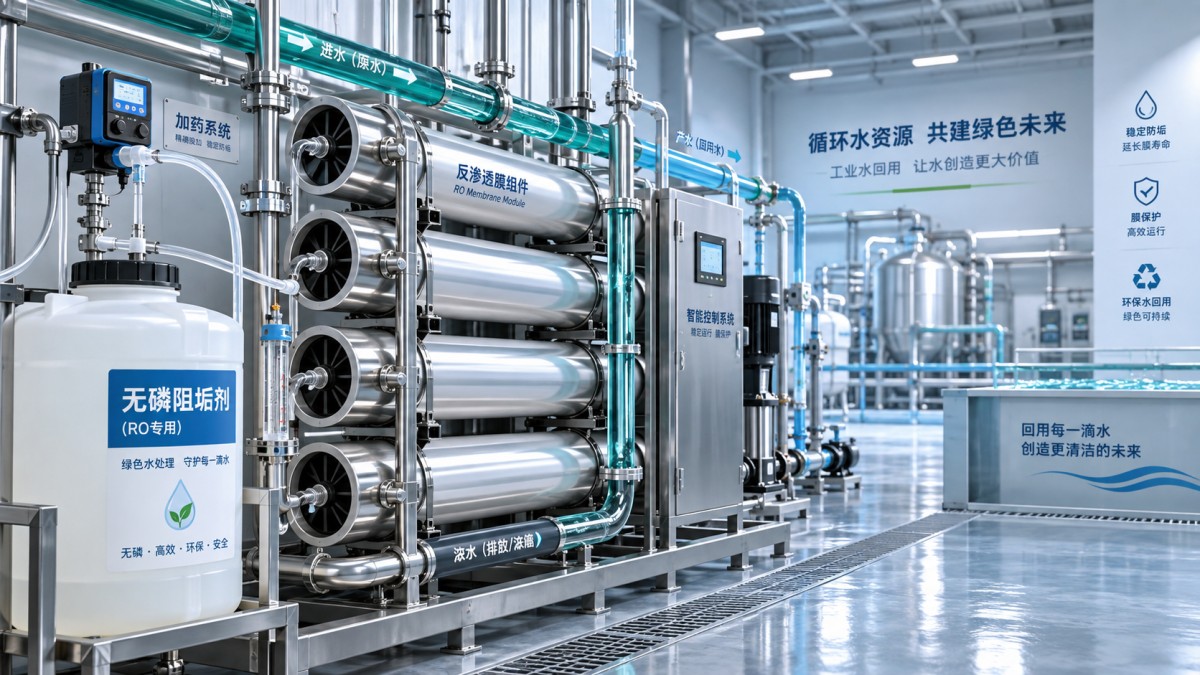
Choosing the right phosphorus-free RO antiscalant can determine whether a water reuse project achieves stable recovery, membrane protection and compliance with discharge requirements. For project managers, the decision is rarely as simple as choosing “green chemistry” over conventional chemistry. The practical question is whether a phosphorus-free program can control the actual scaling risks in a specific RO system without creating new problems in pretreatment, membrane cleaning, concentrate handling or downstream reuse.
This matters most in industrial reuse projects, where feedwater can vary by production cycle, raw-material changes, cleaning discharges, seasonal runoff or upstream treatment performance. A program that looks appropriate on a standard water analysis may fail when silica rises, hardness fluctuates, iron breaks through pretreatment, or recovery is pushed beyond its original operating window.
A phosphorus-free RO antiscalant is therefore not automatically the preferred answer. It is the right answer when phosphorus reduction is a real project constraint and the chemistry has been validated against the site’s likely concentration conditions, membrane type, operating recovery and cleaning strategy.
Why phosphorus becomes a selection issue in water reuse
Traditional RO antiscalant programs often use phosphonate-based chemistry because phosphonates can provide strong threshold inhibition, crystal modification and metal-ion control across difficult water conditions. However, phosphorus entering an industrial water circuit does not disappear at the membrane. It may pass into RO concentrate, enter a downstream wastewater treatment process, affect nutrient loading considerations, or complicate a project’s internal environmental targets.
For a reuse plant discharging concentrate to a biological treatment system, a central wastewater plant, evaporation equipment or a restricted receiving route, even a relatively small added phosphorus contribution can become relevant. The significance depends on local permits, mass balance, existing influent phosphorus and the treatment train. It should not be assumed from product labels alone.
Phosphorus-free chemistry is particularly worth evaluating when the project team needs to minimize nutrient addition at source, has limited tolerance for downstream phosphorus loading, or is designing a reuse scheme around stricter concentrate management. It can also make sense where the customer has adopted internal procurement rules that favor non-phosphorus treatment additives. In each case, the environmental objective needs to remain compatible with membrane protection.
The conditions that favor a phosphorus-free program
The strongest fit is usually a reasonably well-characterized reuse feed with stable pretreatment and a scaling profile that can be managed through non-phosphorus dispersants, carboxylate polymers or other phosphorus-free inhibitor systems. These programs are often considered for calcium carbonate, calcium sulfate, barium sulfate, strontium sulfate and certain metal-oxide fouling risks, but their suitability depends on the saturation level at the membrane concentrate interface rather than the raw feedwater alone.
A project should favor this route when several of the following conditions are present:
- The RO concentrate has a defined phosphorus limit or feeds a downstream process sensitive to nutrient loading.
- Feedwater composition is sufficiently consistent to support a reliable dosing window.
- Pretreatment effectively controls suspended solids, iron, aluminum, oil, residual coagulant and microbiological carryover.
- The required recovery is realistic for the silica, hardness and sulfate concentrations present.
- Membrane supplier requirements, cleaning chemicals and oxidant control have been reviewed together rather than separately.
The last point is often underestimated. An antiscalant does not compensate for poor dechlorination, unstable pH control, inadequate cartridge filtration or a clarification upset. If membrane fouling is mainly organic, colloidal or biological, changing to a phosphorus-free antiscalant may have little effect. It may even distract the team from the actual source of declining normalized permeate flow.
Start with the concentrate, not the product brochure
For project selection, feedwater analysis is only the starting point. The more useful assessment models what happens as salts become concentrated in the final membrane elements. That means reviewing calcium, magnesium, alkalinity, sulfate, barium, strontium, silica, fluoride where relevant, pH, temperature, conductivity and the target recovery. Iron, manganese, aluminum and total organic carbon should also be considered because they may signal fouling mechanisms that are not purely mineral scale.
Silica deserves special attention in reuse systems. It may be present as reactive silica, colloidal silica or silica associated with metal hydroxides and organic matter. A phosphorus-free RO antiscalant that performs well against carbonate or sulfate scale is not automatically suitable for a high-silica concentrate. The same caution applies to difficult mixed-scale conditions, where calcium, sulfate, silica and residual metals interact.
The project team should ask the chemical supplier to evaluate the intended operating envelope, not only a single design point. This envelope should include normal water quality, expected worst-case composition, startup conditions, cleaning recovery, seasonal temperature changes and plausible pretreatment deviations. If the supplier’s recommendation only works under ideal feed conditions, it is not a robust reuse strategy.
A useful decision screen
Where phosphorus-free chemistry may not be the best fit
There are situations in which the phosphorus-free requirement introduces too much operational risk unless the system design is adjusted. High-recovery systems treating complex industrial wastewater are the clearest example. If the concentrate approaches aggressive silica, sulfate or mixed-mineral saturation, the project may need lower recovery, additional softening, pH adjustment, selective removal of troublesome ions or a different membrane configuration. Antiscalant selection alone should not be expected to overcome an unfavorable water balance.
A switch can also be risky when the existing program has been controlling more than scale. Some phosphonate-containing products contribute metal-ion stabilization, corrosion-control synergy or tolerance to particular process upsets. Replacing them without examining the whole water-treatment program may affect equipment outside the RO skid, especially where concentrate is recycled, blended or used in another utility system.
This distinction is important when comparing an RO chemical with low-phosphorus materials used elsewhere in an industrial water plant. For example, 2-Phosphonobutane -1,2,4-Tricarboxylic Acid (PBTCA) is an organophosphorus chemistry rather than a phosphorus-free RO antiscalant. It is used in applications such as circulating cooling water, oilfield water injection and washing systems, where its scale and corrosion inhibition, chlorine oxidation resistance and zinc-salt stabilization can be relevant. Its low phosphorus content does not make it interchangeable with a zero-phosphorus membrane antiscalant. That chemical distinction should remain clear in specifications and tenders.
How to qualify a program before full-scale use
A sound qualification process combines chemistry review with operating discipline. Begin with recent feedwater results rather than historic averages alone. Samples should represent normal operation and known upset conditions. Then confirm the membrane manufacturer’s requirements for antiscalant compatibility, residual oxidant control, pH range and cleaning limitations.
The supplier should be able to state the proposed dose range, assumptions behind the recovery calculation, anticipated scale risks and the parameters that would require a change in dose or recovery. For a reuse project, request clarity on what the formulation does not address as well. A technically credible recommendation identifies uncertainty instead of treating every feedwater as routine.
Where practical, a controlled trial should track normalized permeate flow, normalized salt passage or rejection, differential pressure, feed and concentrate conductivity, recovery, pH, temperature and cleaning frequency. These trends are more useful than judging performance from one day of stable operation. If a conversion is planned, ensure the chemical day tank, dosing line and injection point are cleaned appropriately to avoid carryover or incompatibility with the preceding product.
Supply quality is part of the technical decision
For long-term water reuse assets, the selected chemistry must be reproducible from batch to batch and available when the plant needs it. A project manager should therefore assess more than the performance claim: confirm quality-control documentation, packaging format, storage guidance, lead time, technical response process and the supplier’s ability to support formulation changes if the water source evolves.
Prio New Materials combines water-treatment chemical R&D, production and technical support across RO purification, industrial wastewater treatment, cooling water, boiler makeup, desalination and other demanding water systems. For reuse projects, the useful value of this type of supplier relationship is not simply access to standard additives. It is the ability to review water conditions, compare compatible raw-material options, support customized formulations where justified, and maintain supply continuity from pilot work to larger procurement volumes.
The right phosphorus-free RO antiscalant is therefore one that fits the complete project: discharge constraints, membrane design, concentrate chemistry, pretreatment reliability and operating margin. If the case for phosphorus reduction is strong, it should be tested against those realities early in design. If the water is unusually variable or heavily concentrated, the better decision may be to revise recovery or pretreatment first, then select the chemistry that can protect the membrane under the revised conditions.

ONLINE CONSULTATION
If you have any questions, please contact us and we will contact you as soon as possible.