


Can a phosphorus-free RO antiscalant control silica scaling?
Can a Phosphorus-Free RO Antiscalant Control Silica Scaling?
Yes, a phosphorus-free RO antiscalant can control silica scaling in many reverse osmosis systems—but it is not a universal substitute for every conventional antiscalant program. The practical answer depends on the form of silica in the feedwater, the system recovery target, pH, temperature, concentrations of calcium and magnesium, and the condition of the pretreatment train.
For project managers, silica is often the scale that changes the conversation. Calcium carbonate scaling may be addressed through pH adjustment, softening, or a reasonably well-understood inhibitor program. Silica behaves differently. It can remain dissolved at moderate concentrations, polymerize as concentrate conditions rise, form colloidal deposits, and combine with metal hydroxides or organic foulants into a dense, difficult-to-clean membrane surface layer.
A phosphorus-free RO antiscalant is therefore best viewed as one part of a silica-control strategy rather than a chemical “permission slip” to run any recovery rate. The right product can improve dispersion and delay silica polymerization. It cannot correct poor filtration, unstable feedwater quality, excessive iron carryover, or a recovery target that ignores the actual concentrate chemistry.
Why silica scaling is harder than ordinary mineral scale
Silica in RO feedwater may be present as reactive dissolved silica, colloidal silica, or silica associated with suspended solids. These forms do not create the same operational risk. Reactive silica is the species most often considered in projection calculations because it can become supersaturated in the concentrate stream. Colloidal silica, by contrast, may foul membranes even when calculated dissolved-silica limits appear acceptable.
This distinction matters during commissioning. A system may perform acceptably during a short trial using a fresh well or municipal supply, then begin losing normalized permeate flow after seasonal source-water changes. The root cause is not always “insufficient antiscalant dosage.” It may be a shift in colloidal silica, aluminum, iron, turbidity, or organic matter that allows silica-rich deposits to bind more readily to the membrane.
Silica deposits are also unforgiving once established. A thin initial layer can become a matrix for other foulants. If cleaning is delayed, operators may find that a standard acid clean removes little because the deposit is not mainly carbonate scale. Alkaline cleaning, surfactant selection, cleaning temperature, and membrane manufacturer limits all need to be reviewed rather than assumed.
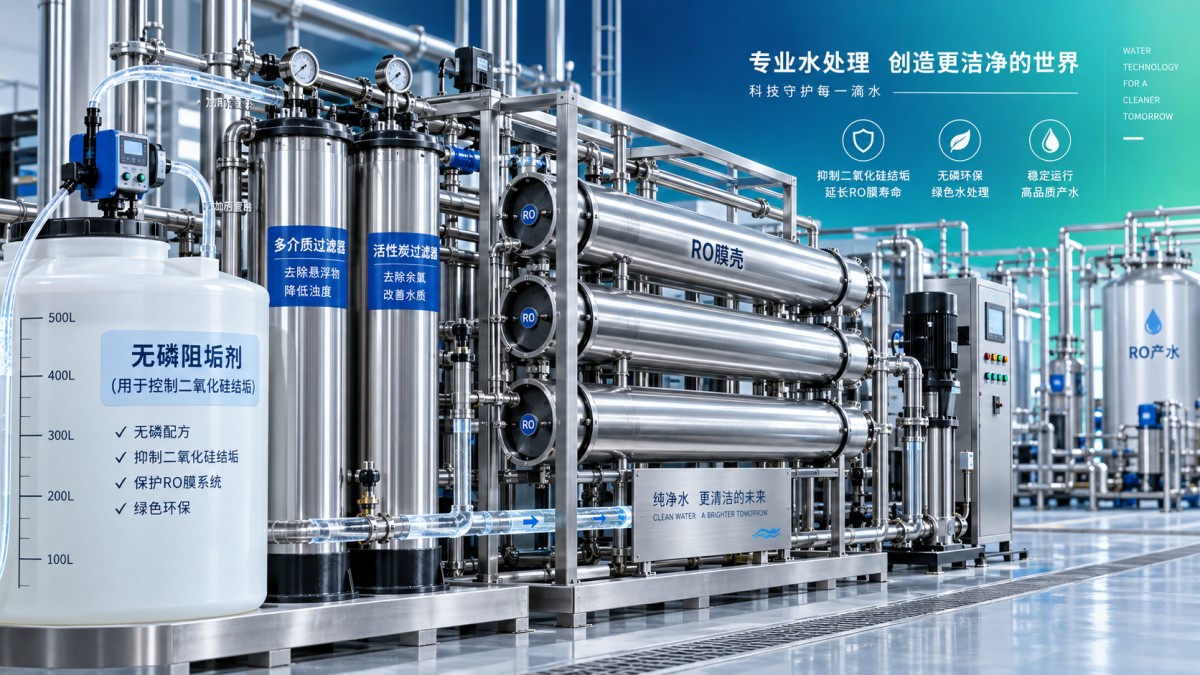
What phosphorus-free chemistry can actually do
Phosphorus-free RO antiscalants are generally developed around polymeric dispersants and threshold-inhibition chemistry that does not introduce phosphorus-containing components into the treatment program. Depending on the formulation, they may help keep certain inorganic particles dispersed, interfere with crystal growth of common mineral salts, and reduce the tendency of silica-containing particles to agglomerate on membrane surfaces.
For silica, the key word is control, not elimination. A suitable formulation may extend the operating window by slowing polymerization or deposition. Its effectiveness is highly formulation-specific and must be judged against the actual feedwater and projected brine composition. Two products described broadly as “phosphorus-free” can behave very differently in high-silica water, high-pH water, or water containing substantial iron and aluminum.
The phosphorus-free requirement itself usually comes from a wider site consideration: discharge restrictions, nutrient-loading concerns, internal sustainability targets, downstream biological treatment sensitivity, or a preference to reduce phosphorus inputs into the overall water-treatment program. Those are valid drivers, but they should not lead a project team to select chemistry based only on a phosphorus declaration. Compatibility and silica performance still decide whether the program will run reliably.
Where phosphorus-free antiscalants work well—and where caution is needed
A phosphorus-free program is often a sound option when feedwater quality is relatively stable, pretreatment consistently controls suspended solids, and the projected silica concentration remains within a formulation supplier’s supported operating range. It can also be attractive where the RO system treats industrial reuse water and the project team needs to minimize added phosphorus before concentrate handling or downstream treatment.
The decision becomes more cautious when the plant is pursuing aggressive recovery from silica-rich groundwater, cooling-tower blowdown, mining wastewater, or variable industrial effluent. In these cases, the concentrate may contain not only elevated silica but also calcium, magnesium, barium, sulfate, iron, residual coagulant metals, and organics. A dispersant that looks adequate in a simple silica test may not remain effective when several fouling mechanisms occur together.
If silica projections are near the limit, the safer technical response may be to lower recovery slightly, improve silica removal upstream, install a second-stage arrangement, or evaluate a different membrane configuration. Chemical treatment should be compared against these alternatives on total operating cost, not dosage cost alone. A lower-cost antiscalant is not economical if it drives more frequent cleaning, shortens membrane life, or creates avoidable downtime.
Do not confuse phosphorus-free RO treatment with phosphonate chemistry
This is a frequent specification mistake. Organophosphonate products are well-established scale and corrosion inhibitors in many industrial water systems, but they are not phosphorus-free. They may be highly appropriate for cooling water, boiler makeup systems, metal cleaning, oilfield water injection, or other applications where phosphorus-containing chemistry is permitted and technically justified.
For example, Mono-sodium of 1-Hydroxy Ethylidene-1,1-Diphosphonic Acid (HEDP·Na) is a phosphonate-based scale and corrosion inhibitor, not a phosphorus-free RO antiscalant. Its supplied specification identifies an HEDP active content of 19.0–21.0%, a pH of 2.3–2.9 for a 1% aqueous solution, and Fe2+ content of no more than 20.0 mg/L. Its chemistry is valued for metal-ion complexation, calcium-scale control, stability under demanding industrial conditions, and compatibility in blended treatment programs.
That distinction is not merely semantic. If a project specification requires a phosphorus-free membrane treatment chemical, substituting a phosphonate product because both are called “antiscalants” can create a compliance issue before membrane performance is even considered. Conversely, eliminating all phosphorus chemistry from a broader plant program without reviewing corrosion control, cleaning chemistry, and discharge pathways can introduce a different set of problems.
A practical selection process for silica-sensitive RO projects
The most reliable approach begins with water analysis, but a single laboratory report is rarely enough. Review representative feedwater data across the operating cycle, including reactive silica, total silica where relevant, pH, conductivity, alkalinity, hardness, iron, manganese, aluminum, sulfate, turbidity, TOC or COD where applicable, and temperature. For reclaimed or industrial water, identify whether upstream coagulants, polymer residues, oxidants, or process contaminants vary by production period.
Then project the concentrate conditions at the intended recovery. This step should account for staging and interstage conditions rather than relying only on average concentrate values. Ask the chemical supplier to state the supported dosage range and silica operating limit for that specific water composition. A credible recommendation should include assumptions, not just a product name and a generic dose.
Before full deployment, confirm that the antiscalant is compatible with the membrane type, cartridge filters, pretreatment polymers, cleaning program, storage period, and injection equipment. A formulation that is chemically effective can still cause operational trouble if it precipitates after dilution, separates under low temperature, or is injected at a point with inadequate mixing.
- Set alarms around normalized permeate flow, normalized salt passage, differential pressure, and antiscalant feed verification.
- Trend feedwater silica and turbidity together; a silica rise without a turbidity change does not mean the fouling risk is unchanged.
- Inspect pretreatment after coagulant changes, filter-media replacement, or source-water switching.
- Define a cleaning trigger before the system enters service, including who reviews the fouling evidence and which cleaning sequence is approved.
The role of raw-material quality and formulation support
For treatment-chemical buyers, formulation consistency is often underestimated. The active chemistry matters, but so do impurities, batch stability, compatibility with other components, and the supplier’s ability to support changes in feedwater conditions. In a large RO project, an inconsistent additive can create troubleshooting work far beyond the apparent cost of the chemical itself.
Prio New Materials supplies functional water-treatment materials across standardized bulk supply, customized formulation development, and technical water-condition support. Its work spans RO water purification as well as circulating cooling systems, oilfield reinjection, boiler makeup, desalination, wastewater treatment, and other industrial settings. For projects balancing phosphorus restrictions with difficult scaling conditions, that broader chemical perspective is useful: the RO antiscalant should be selected alongside pretreatment, corrosion control, defoaming needs, and concentrate-management constraints rather than in isolation.
The operational answer: yes, with defined boundaries
A phosphorus-free RO antiscalant can be an effective tool for silica scaling control when the formulation matches the water chemistry and the system is operated within a validated recovery window. It is especially relevant when phosphorus addition is restricted or undesirable. But silica-prone RO plants should avoid making selection decisions from a product category alone.
The decisive questions are straightforward: What form of silica is present? What will its concentration become in the final concentrate? Are iron, aluminum, organics, or suspended solids contributing to the deposit? Can pretreatment hold those conditions steady? If those answers are clear, a phosphorus-free program can be specified with confidence. If they are not, more chemical dosage is usually the wrong first move.

ONLINE CONSULTATION
If you have any questions, please contact us and we will contact you as soon as possible.