


Can a polyether defoamer reduce coating defects caused by entrained air?
Entrained air can turn an otherwise sound coating project into a costly finishing problem. Tiny bubbles introduced during mixing, pumping, spraying, rolling, or circulation may remain hidden until the film begins to level and cure. Then they appear as pinholes, craters, blisters, orange peel, gloss variation, or weak spots in the protective layer. For project managers responsible for quality, schedule, and material consumption, these defects are rarely “cosmetic only.” They can trigger rework, inspection failures, accelerated corrosion, and disputes between the coating supplier, applicator, and equipment team.
A well-selected polyether defoamer can reduce many air-related coating defects by helping bubbles rise, coalesce, and break before the coating film sets. However, the practical answer is not simply “add more defoamer.” The right result depends on the type of air present, the coating chemistry, the application process, and the compatibility of the additive package. Working with an experienced polyether defoamer manufacturer gives project teams a better chance of solving the actual source of the defect rather than covering up its symptoms.
Why Entrained Air Becomes a Coating Defect
Air enters a coating system more easily than many teams expect. High-speed dispersion can create a vortex that pulls air into the batch. Transfer pumps may draw air through loose fittings, poor suction conditions, or partially empty feed containers. Recirculation lines, filters, spray equipment, and return loops can also generate bubbles through turbulence or pressure changes. In waterborne coatings, surfactants and polymeric dispersants may stabilize those bubbles long enough for them to survive the application stage.
Not all bubbles behave the same way. Large surface foam is visible and usually receives immediate attention. Entrained microbubbles are more troublesome because they are dispersed throughout the liquid and may not become obvious until the applied film begins to dry. As solvent or water evaporates, viscosity rises. A bubble that could once have escaped becomes trapped under a forming skin. If it bursts late, it may leave a pinhole or crater. If it remains intact, it may produce a void that reduces film continuity.
The risk is particularly high in thick-film coatings, high-solids systems, fast-drying formulations, and coatings applied over rough or porous substrates. Protective coatings for tanks, steel structures, industrial floors, pipelines, machinery, and fabricated components may all face this issue. A visually small defect can become a route for moisture, chemicals, or salts to reach the substrate.
Can a Polyether Defoamer Actually Reduce These Defects?
Yes—when the entrained air problem is within the defoamer’s operating range and the formulation is properly balanced. Polyether defoamers are commonly used in waterborne industrial coatings, inks, adhesives, cleaning formulations, and process systems because their molecular structure can be tailored for controlled compatibility and foam-release behavior.
In broad terms, a defoamer works by weakening the liquid film around an air bubble. It spreads at the gas-liquid interface, disrupts the stabilized foam lamella, and encourages smaller bubbles to merge into larger ones. Larger bubbles rise faster and are more likely to rupture at the coating surface before the film reaches a critical viscosity. A suitable polyether-based chemistry can therefore support faster deaeration, lower persistent foam, and a more uniform film appearance.
That said, a defoamer cannot correct every source of coating defects. If a pump is cavitating, if atomizing pressure is excessive, if the substrate is contaminated, or if solvent flashing is too rapid, an additive alone may offer only partial improvement. The most successful projects treat defoaming as part of a complete process-control plan.
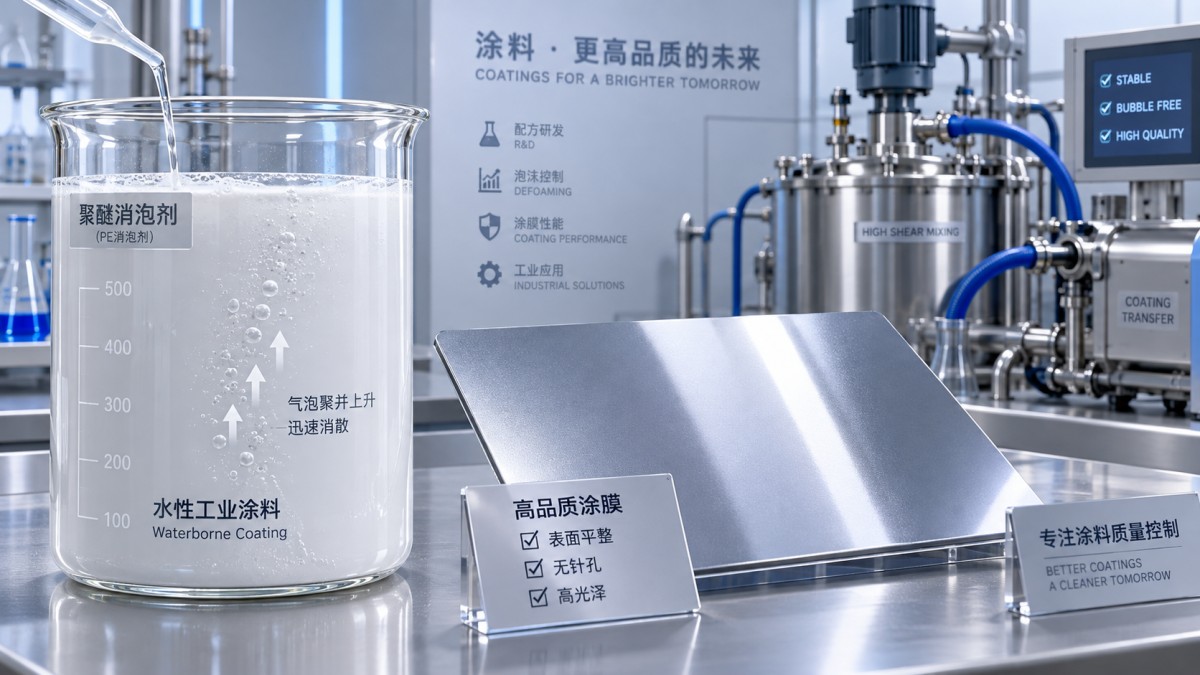
The Difference Between Defoaming and Deaeration Matters
Project teams often use the words interchangeably, but they describe related yet different tasks. Defoaming is primarily the collapse of visible surface foam. Deaeration is the release of air trapped inside the bulk coating. A product that clears foam quickly in a mixing tank may not necessarily remove fine bubbles from a high-viscosity coating film. Conversely, a strong deaerator can sometimes create surface-side effects if it is too incompatible with the system.
This distinction should guide product screening. If the problem occurs during manufacturing and operators see stable foam in the let-down tank, foam knockdown and foam persistence tests are useful. If the coating looks smooth in the pail but develops pinholes after spraying or baking, the evaluation needs to focus on entrained-air release, wet-film appearance, leveling, and cured-panel defects.
A capable polyether defoamer manufacturer should ask where the bubbles are generated, not only what coating is being produced. This practical conversation often reveals whether the main driver is mixing shear, pigment dispersion, pump design, filtration, spray application, or drying conditions.
What Project Managers Should Check Before Selecting a Defoamer
For an engineering or procurement lead, the challenge is to avoid approving an additive based only on a quick visual test. A defoamer that looks excellent in a laboratory beaker may behave differently in a production batch, after storage, or on a large sprayed surface. The following questions help turn an unclear quality complaint into a manageable selection process.
1. What is the coating system?
Waterborne acrylic, polyurethane dispersion, epoxy, alkyd emulsion, vinyl, and hybrid coatings have different surface tensions, solvent balances, resin polarities, and curing profiles. Pigment volume concentration also changes bubble stability. The defoamer must be compatible enough to distribute through the coating, but not so soluble that it loses its bubble-breaking activity.
For this reason, one universal “best defoamer” is rarely realistic. A highly compatible product may be gentle and stable but insufficient for severe entrained air. A more active, less compatible material may release air effectively while increasing the chance of craters, haze, poor recoating, or gloss irregularity if overdosed.
2. When and where will it be added?
Addition timing affects performance. In many formulations, a portion of defoamer is introduced during the grind stage to control foam created by high-shear dispersion. A second, smaller portion may be added during let-down to improve final deaeration and application behavior. This split-addition approach can be more reliable than adding the full amount at one point.
Late addition should be mixed sufficiently to ensure uniform distribution, but excessive shear after addition can introduce a new load of air. The practical target is controlled incorporation rather than maximum agitation.
3. Is the coating applied by spray, roller, brush, dip, or curtain?
Application method changes the defect mechanism. Airless and air-assisted spray operations can create turbulent flow and rapid film formation. Roller application may create microfoam through mechanical agitation. Brush coatings need good release without sacrificing open time. Dip and circulation systems may suffer from continuous air entry through return lines or tank agitation.
A good evaluation therefore uses the actual application route whenever possible. A drawdown panel may identify basic incompatibility, but it cannot fully simulate spray shear, atomization, film build, and flash-off behavior on a live project.
4. What does “success” look like in measurable terms?
“Less foam” is not enough for a project acceptance standard. Define the result in terms that production and quality teams can observe: fewer pinholes per panel, reduced crater frequency, acceptable gloss, stable viscosity after storage, no separation, no adverse recoating effect, and consistent appearance at the specified dry-film thickness. Establishing these criteria early prevents a trial from becoming an argument based on impressions.
A Practical Trial Sequence for Air-Related Defects
When a coating line is already experiencing defects, avoid changing several variables at once. Start by documenting the existing formula, batch order, agitation speed, temperature, pump settings, filter condition, substrate preparation, application parameters, wet-film thickness, and cure schedule. Defect photographs should be linked to batch and application records where possible.
Then screen a small number of candidate defoamers at controlled dosage levels. Include a blank control sample. Observe both immediate foam collapse and delayed foam return. Prepare coated panels at the intended film build and inspect them after the relevant flash, bake, or ambient cure period. If possible, check appearance after 24 hours as well as immediately after application, since some incompatibility issues develop over time.
Once a promising candidate is identified, move to a pilot batch. This is where hidden concerns often emerge: interaction with thickeners, pigment dispersions, wetting agents, corrosion inhibitors, biocides, or crosslinkers; changes in viscosity; and differences caused by production-scale shear. A staged validation process costs less than discovering a surface defect after a large coating run has reached the job site.
Common Mistakes That Make the Problem Worse
Increasing dosage until the foam disappears. Overuse may solve visible foam while causing craters, reduced gloss, poor intercoat adhesion, or surface contamination. Follow the supplier’s recommended starting range, then optimize through testing.
Ignoring mechanical air entry. A defoamer should not be expected to compensate indefinitely for a leaking suction line, a worn pump seal, poor tank geometry, or an over-aggressive disperser. If air is continuously generated faster than it can be released, surface defects will remain unstable from batch to batch.
Testing only fresh material. Some systems look acceptable immediately after manufacture but develop foam sensitivity after storage, transport, freeze-thaw exposure, or temperature cycling. Retained samples and accelerated stability checks are valuable, especially for projects with long supply chains.
Choosing solely by initial cost. A low-cost additive can become expensive if it raises rework rates, consumes operator time, or causes a rejection at final inspection. The right comparison is total applied cost, including dosage, production reliability, finish quality, and the risk of field failure.
Compatibility Is the Real Balancing Act
Polyether defoamers are valued because their structures can be designed to work across a range of aqueous and industrial systems. Still, compatibility must be proven in the specific coating. The ideal product releases trapped air without creating its own defect signature. This requires balance: enough interfacial activity to destabilize bubbles, sufficient persistence to remain effective through application, and suitable compatibility with the resin and additive package.
For project managers, that balance is why supplier technical support matters. It is useful to provide the resin type, solvent or water content, pigment package, pH range, viscosity, processing temperature, application method, target film thickness, and photos of the defect. Even if the full formulation is confidential, these details allow a supplier to recommend a more relevant starting point for laboratory evaluation.
Prio New Materials supports industrial chemical users with standardized bulk supply, tailored formulation development, laboratory evaluation, and condition-specific technical guidance. Its broader portfolio also includes water-treatment raw materials used in demanding industrial environments. For example, 2-Phosphonobutane -1,2,4-Tricarboxylic Acid (PBTCA) is an organophosphorus scale and corrosion inhibitor used in circulating cooling water, oilfield injection water, and washing applications. While it is not a coating defoamer, this type of portfolio reflects the importance of controlling process-water quality, scaling, corrosion, and foam across interconnected industrial operations.
When the Defect May Not Be Entrained Air
Pinholes and craters are often blamed on bubbles, but they can have other causes. Craters may result from silicone contamination, oil, dust, substrate residue, or surface-tension imbalance. Pinholes can also arise from solvent popping, moisture in the substrate, excessive wet-film thickness, or rapid heating during cure. Blisters may indicate osmotic pressure, trapped moisture, or inadequate surface preparation rather than a foam problem.
A useful diagnostic clue is timing. Defects visible immediately in the wet film often point toward air release or contamination. Defects that emerge during oven cure may suggest solvent pop or rapid skin formation. Defects appearing after service exposure require a wider investigation of substrate condition, coating continuity, and environmental loading.
Making the Decision With Less Risk
A polyether defoamer can meaningfully reduce coating defects caused by entrained air, but it performs best as part of a controlled system. Select it against the real coating chemistry and application process, test for deaeration as well as surface foam collapse, and verify that the cure film remains smooth, uniform, and free from additive-related side effects.
For a project manager, the most dependable path is straightforward: identify where air enters the process, set visible quality criteria, compare candidates under realistic conditions, and scale up only after pilot confirmation. That approach protects more than the appearance of a finished coating. It helps protect schedule certainty, material efficiency, inspection outcomes, and the long-term performance expected from the coated asset.

ONLINE CONSULTATION
If you have any questions, please contact us and we will contact you as soon as possible.