


When defoamer OEM production makes sense for private label chemicals
Private-label chemical brands should consider defoamer OEM production when the commercial opportunity is clear but owning a formulation and manufacturing operation would add more cost, delay, and technical risk than value. This is especially true when customers need a dependable industrial antifoam product for a defined application, yet the brand needs flexibility in packaging, positioning, supply volume, or formula adjustments.
The decision is not simply “make or buy.” A private-label defoamer is part of a customer’s process control program. If it separates, loses activity in storage, interferes with downstream treatment, or works in the laboratory but fails in a high-shear system, the private-label brand carries the commercial consequence. OEM production makes sense when the partner can control those variables while the brand retains ownership of the market relationship.
Situations where OEM production is the practical choice
OEM is usually the stronger option when market entry speed matters. Developing a defoamer from raw materials requires more than selecting a silicone, mineral oil, fatty alcohol, polyether, or emulsion system. The manufacturer must establish addition order, dispersion stability, viscosity control, preservative compatibility, storage behavior, and batch-to-batch quality limits. For industrial water treatment or wastewater applications, the formula may also need to remain effective across changes in pH, temperature, dissolved solids, surfactants, and contaminant load.
A private-label company with a defined customer base, but without a dedicated laboratory and production line, can use an OEM partner to shorten this path. This is particularly relevant for distributors expanding into branded chemical programs, water treatment service companies adding proprietary products, and equipment suppliers that want a matched antifoam chemical for their installed systems.
OEM also makes sense when demand is variable. Launch volumes may be modest, while a successful tender, seasonal wastewater load, or new industrial account can quickly increase consumption. A qualified producer with established production capacity can support smaller initial orders and a more predictable route to larger repeat volumes. Building internal capability for uncertain demand often ties up capital in tanks, mixing equipment, filling lines, quality control, raw-material inventory, and compliance management before the brand has validated its sales channel.
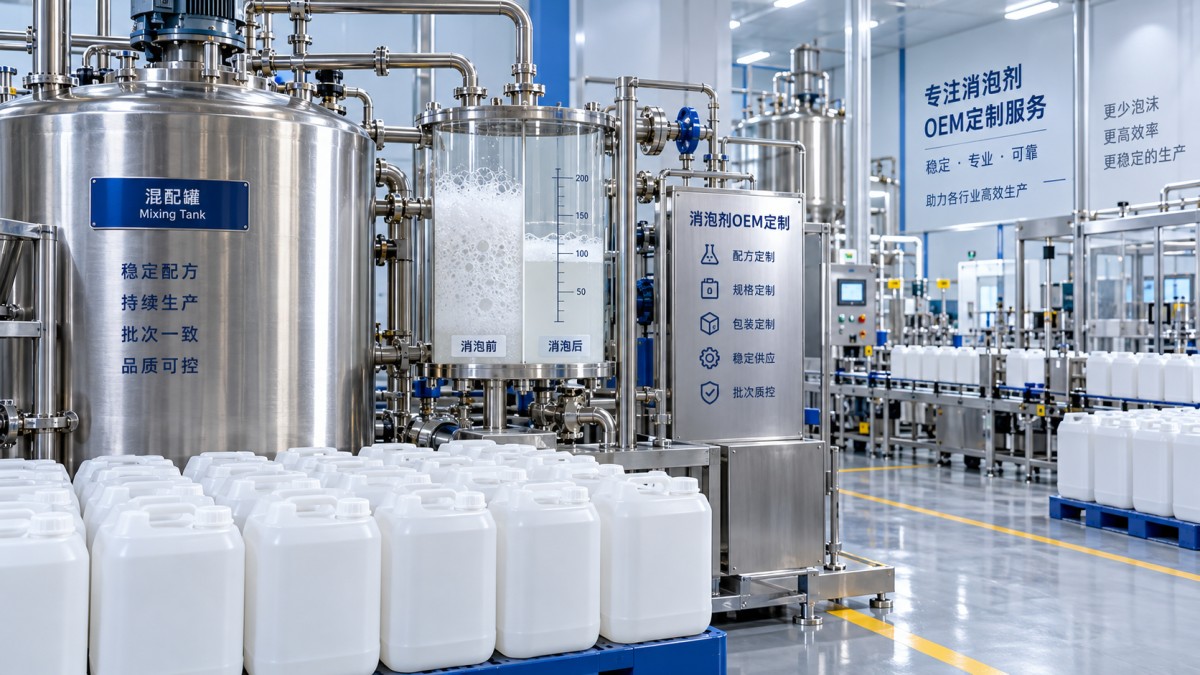
Performance matters more than a generic “defoaming strength” claim
The most common purchasing error is comparing private-label defoamers only by unit price, active content, or how quickly foam collapses in a sample jar. Those indicators can be useful, but they do not describe the full process result.
A defoamer must both knock down existing foam and prevent excessive re-foaming at the required dosage. The balance differs by application. A wastewater plant may need rapid surface foam control without disrupting biological treatment. A paper or textile process may require persistent foam suppression while avoiding surface defects. Oilfield, desulfurization, and high-salinity water systems can impose conditions that destabilize a standard emulsion. In membrane-related treatment, compatibility with the broader chemical program is often more important than an aggressive initial foam break.
For this reason, an OEM brief should define the actual system rather than request “an industrial defoamer.” It should include the source of foam, water chemistry, operating temperature, pH range, agitation or aeration intensity, residence time, dosing point, target dosage range, downstream equipment, and restrictions on silicone, oil, or residue. The more accurately these conditions are described, the more meaningful a customized formula and trial plan can be.
When a standard formula is enough, and when customization is justified
Private-label brands do not always need a new formula. A standardized product with private packaging may be the right commercial answer when the application is broad, the system conditions are relatively stable, and customers accept an established performance profile. This approach reduces development time and makes inventory planning easier.
Customization is justified when the brand serves a narrow process where a generic product repeatedly underperforms. Examples include persistent foam caused by a specific surfactant package, high-temperature process water, systems with high salt content, applications sensitive to silicone contamination, or customers that need a product compatible with an existing scale inhibitor, corrosion inhibitor, coagulant, or biocide program.
In water treatment, defoamer selection should not be isolated from the rest of the formulation. A brand that supplies circulating-water or boiler-water programs may also need compatible scale and corrosion control chemicals. For example, Ethylene Diamine Tetra (Methylene Phosphonic Acid) Pentasodium Salt (EDTMP·Na5) is used in circulating water, boiler water, power plant cooling water, printing and dyeing, and cyanide-free electroplating as a scale and corrosion inhibitor or complexing agent. It is not a defoamer, but it illustrates why an OEM partner should evaluate the full chemical environment rather than optimize foam control in isolation.
What to evaluate before appointing a defoamer OEM partner
The supplier’s sample is only the beginning. Decision-makers should assess whether the OEM can reproduce the approved product at commercial scale and maintain the same behavior over time. A useful evaluation covers the following areas:
- Technical fit: Can the producer recommend a formula based on real operating conditions and explain likely compatibility limits?
- Validation method: Is there a defined process for comparing candidates in representative water or process liquor, rather than relying only on appearance?
- Quality consistency: Are incoming materials, mixing, filling, retained samples, and release checks controlled well enough to protect repeat performance?
- Supply resilience: Can the manufacturer support forecasted volumes, packaging formats, export handling where required, and reasonable lead times?
- Change control: Will the brand be notified and involved if a raw material, process condition, or specification must change?
- Commercial clarity: Are formula ownership, confidentiality, label responsibility, minimum order quantities, and acceptance criteria agreed before launch?
Private-label branding should never obscure traceability. A practical arrangement identifies the product code, approved specification, batch reference, packaging configuration, storage conditions, and complaint-handling route. These details are routine until a customer reports a performance deviation; then they determine whether the issue can be isolated quickly.
Cases where OEM is not the right answer
OEM production may be premature when the intended application is still unclear. If sales teams are offering one defoamer to wastewater plants, coatings users, paper mills, and metalworking operations without separate performance requirements, the product portfolio has not yet been defined well enough for a reliable private-label launch.
It can also be unsuitable where the brand needs complete control of proprietary chemistry, has stable high volumes that justify dedicated assets, and already has formulation, analytical, regulatory, and production expertise. In that situation, toll manufacturing or internal production may provide greater control. The point is not to avoid OEM; it is to avoid using it as a substitute for a missing product strategy.
Another warning sign is a request for a “universal” product with no trial plan. Foam is a symptom generated by a particular process. A formula that performs well in one system can create residue, instability, or insufficient persistence in another. A disciplined OEM program starts with a defined use case and expands only after performance has been demonstrated under comparable conditions.
Make the first order a controlled commercial test
The strongest launch sequence is usually to choose one or two priority applications, agree a written product specification, validate samples in representative conditions, and place an initial production order with controlled labeling and batch documentation. Customer feedback should distinguish foam collapse, re-foaming, dosage, handling, storage behavior, and any downstream effect. “It works” is not enough information to improve a formula or protect the next batch.
For a private-label chemical business, the value of defoamer OEM lies in combining manufacturing discipline with market responsiveness. Choose OEM when the partner can help turn a clearly defined process need into a repeatable, traceable product, while leaving the brand free to focus on technical sales, customer service, and growth in the applications it understands best.

ONLINE CONSULTATION
If you have any questions, please contact us and we will contact you as soon as possible.