


What minimum order volume should you expect from a defoamer OEM
For a standard industrial defoamer, the practical minimum order volume is often set by the smallest production batch, the available packaging, and whether the material is already in stock. A ready-made silicone, polyether, mineral-oil, or ester-based defoamer can sometimes be supplied in small packaged quantities for evaluation. Once the requirement moves to a dedicated formulation, a specific active-content range, or a plant-specific compatibility target, the minimum commonly rises to the volume needed to run, homogenize, test, and fill a full batch without creating off-spec residual material.
The useful question is therefore not simply “What is the MOQ?” Ask whether the quoted minimum applies to an existing grade, a modified version of that grade, or a formula made exclusively for one water system. These are different commercial and technical situations, even where the product descriptions appear similar.
Where the minimum order volume comes from
Defoamer production involves more than combining ingredients. The base fluid, active antifoam component, emulsifiers, dispersants, preservatives, and any performance modifiers must be mixed under controlled conditions. A water-based emulsion may require a defined mixing sequence and shear level to obtain stable droplet size. Silicone-containing products also need uniform distribution of the active phase. A batch that is too small for the vessel, pump, or filling line can give inconsistent results from one drum to the next.
That production constraint is why a supplier may accept a small first order from stock but require a larger volume after formula adjustment. The adjustment can be minor, such as changing viscosity or package size, yet it can still introduce new raw-material handling, cleaning, sampling, and release work.
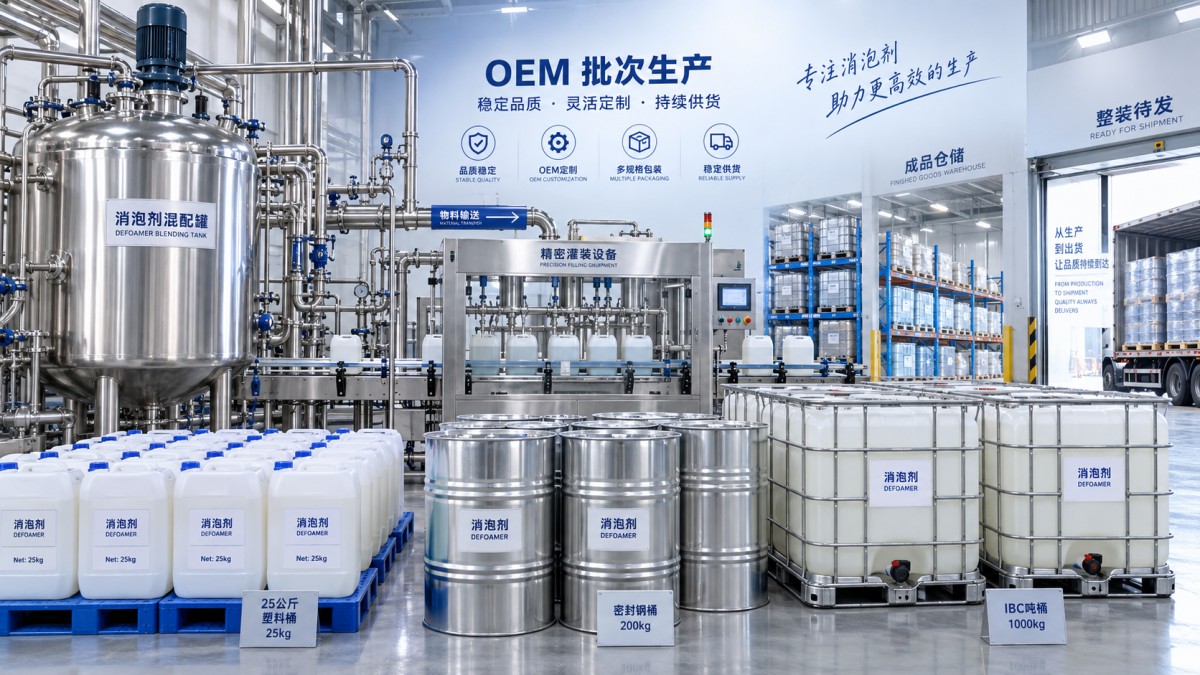
A quoted MOQ should also be read together with the unit of sale. Twenty-five-kilogram pails are suitable for controlled screening, but they are not automatically economical for a continuing treatment program. Drums reduce packaging cost per kilogram and simplify scheduled deliveries. IBC tanks may be appropriate when consumption is stable, storage is suitable, and the site can transfer liquid without contamination or freezing risk. The lowest nominal MOQ is not necessarily the lowest usable inventory cost.
Formula requirements change the answer quickly
A defoamer selected for wastewater treatment may fail in a cooling-water circuit even if it initially collapses foam in a beaker test. Circulating water systems can expose the product to repeated pump shear, elevated temperature, oxidizing biocides, antiscalants, corrosion inhibitors, and high dissolved solids. In biological wastewater treatment, excessive silicone carryover or poor dispersion can create downstream concerns that a simple foam-break test will not reveal. Oilfield reinjection water, pulp processing, detergent effluent, and membrane-related streams each place different demands on persistence, dispersibility, and deposit control.
These conditions determine whether an existing product can be used unchanged. If the requested performance requires a new carrier, a different active component, better alkali tolerance, lower oil content, or improved compatibility with a treatment package, the MOQ generally follows the custom formulation route. A request for “the same defoamer, but stronger” is especially prone to misunderstanding. Higher active content can alter viscosity, dispersion behavior, dosing accuracy, and transport stability. It should not be treated as a simple concentration increase.
Compatibility needs to be reviewed across the whole water-treatment program. For example, scale-control chemistry may be present alongside the defoamer in cooling or oilfield water. Materials such as Hepta sodium salt of Diethylene Triamine Penta (Methylene Phosphonic Acid) (DTPMP·Na7) are used as chelating and scale-inhibiting components in applications including cooling water and oilfield scale inhibition. Their concentration, water hardness, pH, and dosing point can affect how a defoamer disperses or persists. The objective is not merely to eliminate visible foam; it is to avoid destabilizing the broader chemical program.
Separate trial volume from production volume
Small trial orders are valuable when they answer a defined technical question. A trial should establish the water source, operating temperature, pH, conductivity or salinity where relevant, foam source, current chemical treatment, dosing point, expected residence time, and the observable failure condition. Without these details, a low-volume evaluation can produce a misleading result: foam disappears immediately in a sample, then returns after recirculation, or the product performs well in raw water but separates after contact with the process additives.
Trial quantity should cover repeat testing rather than one demonstration. It needs enough material for dose-ranging work, a retained reference sample, and a meaningful run under operating conditions. A very small sample is useful for preliminary compatibility screening, but it cannot establish consumption rate, seasonal stability, or batch-to-batch behavior. Treating a sample as proof of full-scale suitability often leads to a second round of testing and delays the first production order.
For ongoing supply, determine monthly usage from the expected dose and actual water throughput, then compare that demand with package size, storage limit, and delivery lead time. A site using intermittent batch treatment should not estimate demand from peak foam events alone. Conversely, a continuous process needs a buffer stock sized around realistic delivery variability, not just average consumption. The right production MOQ is often the quantity that covers a workable replenishment cycle without aging stock beyond its recommended storage period.
Questions that expose an unrealistic quote
- Is the quantity tied to a stocked grade, a manufacturing batch, or a custom raw-material purchase? “MOQ” can describe any of these, and the distinction changes the negotiation.
- Does the quoted volume include only product, or also special pails, drum markings, pallet configuration, export packing, and documentation?
- Will the formula be held constant after approval? If raw materials are substituted later, equivalent foam knockdown alone is not enough; emulsion stability and compatibility also require confirmation.
- Which release tests apply to each batch? Appearance, density, viscosity, active-content control where applicable, pH, stability, and a defined foam-performance method are more useful than an undefined statement of conformity.
- Can leftover material from a custom batch be reserved for later orders? This is only workable when shelf life, storage conditions, batch segregation, and formula ownership are clearly agreed.
Low MOQ offers can conceal practical constraints. A supplier may be able to fill a few containers, but the material may come from an old batch, use a substitute package, or lack a repeatable route for future supply. The opposite problem also occurs: a large stated minimum may reflect a default commercial policy rather than a real processing limit. Where the requested product is close to an established grade, the minimum can sometimes be reduced by retaining standard packaging, accepting the existing concentration, or scheduling the order alongside a regular production run.
Before accepting a custom-volume commitment, record the approved sample identification, target physical properties, application water conditions, test method, packaging, and change-control expectation. These details turn MOQ negotiation into a supply decision based on usable product rather than a single quantity on a quotation.

ONLINE CONSULTATION
If you have any questions, please contact us and we will contact you as soon as possible.