


Does a higher calcium scale inhibitor dose always reduce scale risk
No. A higher calcium scale inhibitor dose does not automatically produce lower scale risk. Once the active chemistry is sufficient to control the relevant precipitation mechanism, additional product may deliver little extra benefit. In some systems, overdosing can complicate downstream treatment, increase chemical cost, or create misleading confidence while the real cause of scaling remains untreated.
For a technical evaluation, the useful question is not “How much inhibitor can be added?” It is “What dose keeps the system within an acceptable scaling margin under its actual operating conditions?” That answer depends on water composition, concentration cycles or recovery, temperature, pH, residence time, flow conditions, and the way the inhibitor is fed and retained in the system.
Why scale risk does not decline in a straight line
Calcium scale forms when dissolved calcium combines with anions such as carbonate, sulfate, phosphate, or silicate and the local water conditions exceed the salt's practical solubility limit. A scale inhibitor does not necessarily remove all calcium from the water. Depending on its chemistry, it can interfere with crystal growth, distort crystal structure, disperse fine particles, or chelate selected metal ions.
These mechanisms have a working range. At too low a dose, there may be insufficient active material at the points where supersaturation is highest. At an appropriate dose, deposition is controlled and surfaces remain cleaner. Above that range, the response often plateaus: more chemical is present, but the limiting factor is no longer inhibitor concentration.
For example, a heat exchanger can still scale when its bulk-water analysis appears acceptable if the heat-transfer surface creates a much higher local temperature. Similarly, an RO system may foul because recovery, concentrate-side saturation, membrane flux, or pretreatment performance has changed. Increasing dosage without addressing these conditions can mask the diagnosis rather than solve the problem.
Check the water condition before changing the dose
A dose adjustment should begin with a current water balance, not a historical setpoint. The analysis needs to reflect the water actually reaching the critical equipment, especially after concentration, blending, softening, pH adjustment, or recycle.
- Calcium hardness and alkalinity: These are central to calcium carbonate risk, but their effect changes with pH, temperature, and concentration ratio.
- Sulfate, phosphate, silica, and dissolved metals: These can shift the likely scale species or promote deposits with mixed composition.
- pH and temperature: Small operational changes can materially alter carbonate scaling tendency and inhibitor performance.
- Cycles of concentration or RO recovery: The feed-water analysis alone is not enough; the concentrated stream defines the higher-risk condition.
- Iron, suspended solids, and biological material: A deposit may be interpreted as calcium scale even when particulate fouling or corrosion products are the main binder.
Deposit analysis is particularly useful when a system has already failed. A calcium-rich deposit may contain iron oxides, silica, phosphate, organic matter, or corrosion products. Treating it as pure calcium carbonate and simply increasing the calcium scale inhibitor dose can be an expensive misdiagnosis.
When a higher dose can be justified
An increase can be reasonable when water chemistry or operating severity has genuinely changed. Examples include higher feed hardness, increased cooling-water cycles, elevated operating temperature, higher RO recovery, or a new contamination source that increases dissolved iron or solids. The change should be linked to measured conditions and followed by a defined verification period.
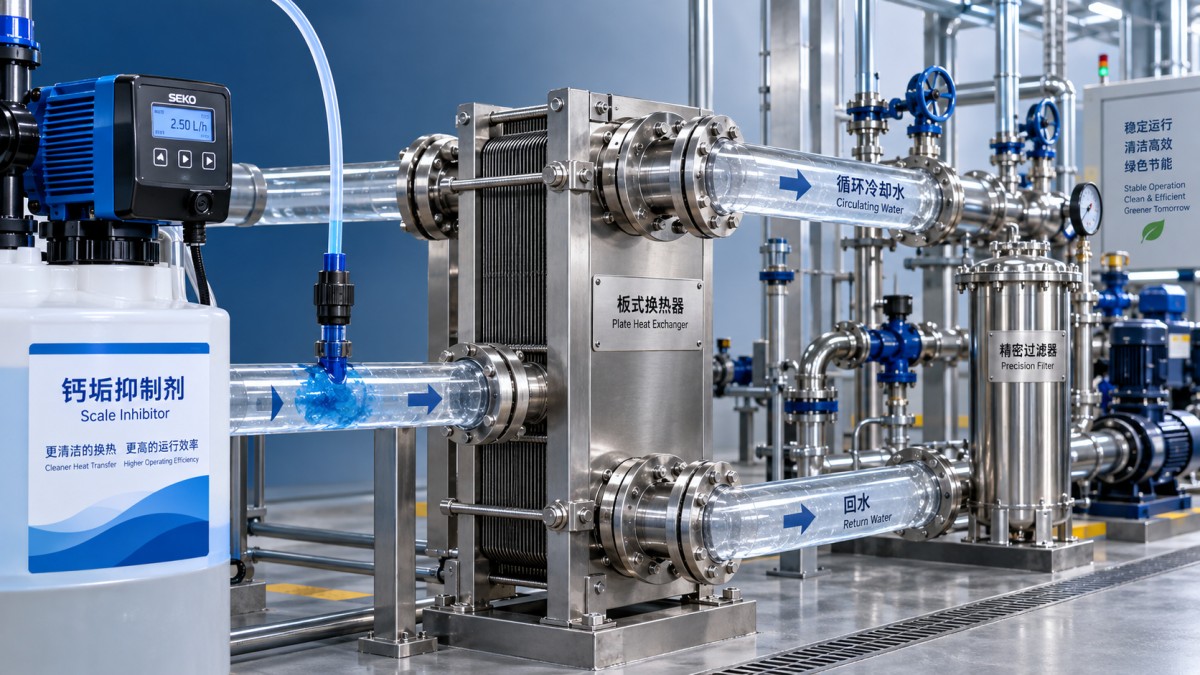
It may also be justified when the existing product has suitable chemistry but the feed point is poor. In a cooling system, product added too far downstream from make-up entry may not protect the location where concentration first occurs. In an RO plant, inadequate mixing before the membrane array can cause uneven protection. Before raising the target dose, confirm pump calibration, day-tank dilution, injection continuity, and the time available for mixing.
When more inhibitor is the wrong response
Overdosing cannot compensate for uncontrolled pH, a malfunctioning softener, poor blowdown control, excessive RO recovery, or a heat-transfer surface operating above its intended condition. It may also be unsuitable where residual phosphorus-containing chemistry affects wastewater treatment objectives or where the water is discharged to a process sensitive to the additive.
Compatibility matters as much as dosage. A formulation may need to work alongside corrosion inhibitors, dispersants, biocides, coagulants, defoamers, or metal-treatment additives. Incompatible treatment programs can produce turbidity, deposits, reduced dispersancy, or poor downstream separation. Technical evaluators should assess the complete chemical program rather than approve an inhibitor on calcium control alone.
In high-calcium water that also contains dissolved iron, a chelating and scale-control component can be useful within a broader formulation. Hydroxyethylamino-Di(Methylene Phosphonic Acid) (HEMPA) is an organophosphorus material used for chelation, scale inhibition, and corrosion inhibition, with relevance in oilfield, metal-treatment, and related systems. Its suitability still depends on the deposit chemistry, system pH, companion chemicals, and discharge requirements; it is not a universal substitute for proper water-condition control.
A practical way to establish an effective dose
- Define the failure mechanism. Identify whether the concern is calcium carbonate, calcium sulfate, calcium phosphate, silica-associated scaling, mixed deposits, or particulate fouling.
- Use worst-case operating water. Evaluate the highest expected temperature, concentration ratio, recovery, and pH rather than normal average conditions.
- Screen the chemistry at several dose levels. The purpose is to find the lowest stable effective range, not the highest apparent inhibition result.
- Confirm compatibility. Test the candidate with the intended corrosion-control, dispersant, biocide, or process chemicals under representative conditions.
- Verify in operation. Track relevant water chemistry, pressure drop, heat-transfer behavior, membrane performance, or deposit formation alongside actual active-product consumption.
This approach separates a true dosage limitation from a system-control problem. It also avoids selecting a dose based solely on product feed rate, which can be misleading when dilution, product strength, or pump performance differs between sites.
Evaluate the result as a control window, not a single number
A robust treatment program usually has an operating window: a lower limit below which scale control becomes unreliable and an upper limit beyond which cost or compatibility concerns rise without useful additional protection. The width of that window depends on how stable the water source and operating conditions are. Systems with frequent feed-water variation need more frequent review than systems with tightly controlled make-up water.
The final decision should therefore connect dosage to measurable process outcomes. If raising the dose does not improve deposition indicators, pressure differential, heat-transfer performance, or the relevant water chemistry trend, investigate pH control, concentration management, pretreatment, feed location, and deposit composition before increasing it again. The best treatment level is the one that controls the identified scale mechanism consistently while remaining compatible with the full process.

ONLINE CONSULTATION
If you have any questions, please contact us and we will contact you as soon as possible.