


When calcium scale inhibitor cannot stop deposits in membrane systems
A membrane train can show stable recovery and acceptable feedwater quality for weeks, then suddenly develop higher differential pressure, lower permeate flow, or a shorter interval between cleanings. When a calcium scale inhibitor cannot stop deposits in membrane systems, the first conclusion should not be that the chemical has “failed.” In most cases, the treatment program no longer matches the actual concentration conditions at the membrane surface.
The practical response is to verify the deposit type, recalculate saturation at the current recovery, confirm the real dose reaching the feed line, and review pretreatment performance before changing products. Calcium carbonate is a frequent cause, but calcium sulfate, barium sulfate, silica-associated deposits, iron contamination, biofilm, and mixed foulants can produce similar operating symptoms. Increasing inhibitor dosage without identifying the deposit can raise cost while leaving the underlying condition unchanged.
Start with the operating pattern, not the product label
Project managers often first see the problem in trend data: normalized permeate flow declines, feed-to-concentrate pressure increases, or the final pressure vessel performs worse than the first. These patterns can help separate scaling from other fouling mechanisms.
- Rapid pressure-drop growth in later stages may indicate precipitation as salts concentrate along the membrane array.
- A gradual decline in normalized flow with limited pressure change may point to organic fouling, colloidal loading, or biofouling rather than a mineral scale problem.
- White, hard deposits on removed elements or piping often suggest carbonate or sulfate scale, but laboratory identification is still preferable.
- Localized deposits near chemical injection points can indicate inadequate mixing, incompatible chemicals, or an improperly positioned injection quill.
A calcium scale inhibitor is selected to interfere with crystal growth, threshold precipitation, and particle dispersion. It does not remove large solids already entering the RO system, correct excessive recovery, or compensate for a failed softener, unstable pH control, or poor cartridge filtration. The membrane system must therefore be evaluated as a complete process rather than as an inhibitor dosing point.
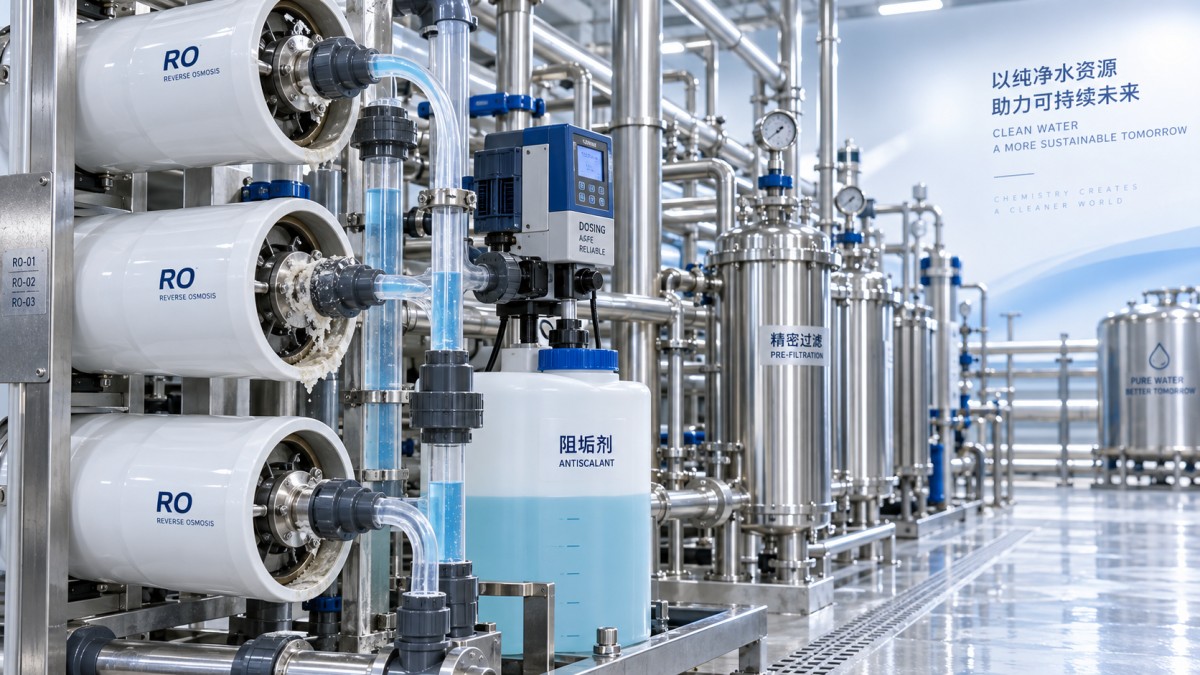
Why scale control changes after commissioning
Feedwater chemistry is rarely constant. A source-water switch, seasonal temperature change, regeneration issue in upstream softening, altered blend ratio, or higher recovery target can move the concentrate stream beyond the original design basis. The important chemistry is not only the feedwater analysis. It is the ionic concentration, pH, temperature, and alkalinity at the highest-concentration point in the membrane system.
Calcium carbonate risk commonly rises when pH or alkalinity increases. Acid dosing errors, depleted acid supply, poor calibration of a pH probe, or delayed response in the control loop can make a formerly acceptable antiscalant program inadequate. Sulfate scales behave differently: calcium sulfate, barium sulfate, and strontium sulfate may remain problematic even when pH is reduced. Their control depends more heavily on ion concentrations, recovery, temperature, residence time, and the inhibitor’s specific dispersancy and chelation behavior.
Iron is another frequent complication. Dissolved iron may oxidize and form particles downstream; iron can also bind with organic matter and create sticky deposits that trap mineral solids. A formulation that works in relatively clean water may not perform the same way when iron carryover increases. This is why feedwater samples should be taken both before and after relevant pretreatment stages rather than relying solely on an older source-water report.
Check the dose that reaches the membranes
A correct product selection cannot overcome an incorrect delivered dose. Dosing pumps may lose prime, stroke settings may be changed during maintenance, suction strainers can partially block, and chemical lines can crystallize or become restricted. A pump running on a control panel is not proof that the intended mass of active chemical is entering the feedwater.
Verify the dosage by measuring actual pump output over a known time period and comparing it with the current feed flow. Then confirm product concentration in the day tank, especially where dilution is prepared on site. Incorrect dilution water, incomplete mixing, or a calculation based on nominal rather than actual flow can produce a substantial dose deviation.
Injection location matters as well. The inhibitor should have sufficient mixing time before the first membrane element, without entering a point where it may react with another treatment chemical. Acid and antiscalant injection arrangements should be reviewed together. A poorly mixed injection can create short-lived local chemistry that encourages precipitation before the chemical has dispersed through the feed stream.
Questions that expose a dosing problem
- Has the feed flow or recovery changed since the dosage was set?
- Is the pump output verified by test, rather than inferred from its setting?
- Has the solution concentration changed after tank cleaning, delivery, or dilution?
- Are injection lines, non-return valves, and quills clear and leak-free?
- Does the injection point provide turbulent mixing before cartridge filters or membranes?
Do not assume every white deposit is calcium carbonate
A field observation may suggest mineral scale, but cleaning behavior and deposit analysis provide a more reliable direction. Carbonate deposits often respond to an appropriate acidic cleaning sequence. Sulfate scales can be much more difficult to dissolve. Silica-rich deposits may require a different cleaning approach, while a deposit containing iron, aluminum, organic material, and calcium can need a staged procedure. Applying the wrong cleaner repeatedly can reduce membrane life without restoring performance.
Where possible, collect a representative deposit sample during element replacement, autopsy, or cleaning. Compare its composition with the feed and concentrate analyses. This distinction affects the treatment decision: a carbonate-focused calcium scale inhibitor may be insufficient where sulfate saturation dominates, while high colloidal loading may require pretreatment correction instead of a higher antiscalant dose.
Match the chemistry to the real scaling risk
For systems dealing with calcium carbonate risk, iron interference, elevated temperature, or complex industrial water, treatment chemicals may need both threshold inhibition and strong metal-ion control. [N-(2-hydroxyethyl) ethlenediamine-1,1,2-tri (methylene phosphonic acid) (HEDTMP) is an organophosphonic acid used as a multipurpose scale and corrosion inhibitor and strong chelating component. It has good calcium and iron tolerance and resistance to high temperature, which can be relevant in circulating cooling water systems and oilfield water applications.
In membrane pretreatment or associated water circuits, HEDTMP should not be treated as a universal substitute for a membrane-specific antiscalant formulation. It is often formulated with other organophosphonic acids, polycarboxylic acids, or their salts to obtain the needed inhibition and dispersancy profile. The decision should be based on the target salts, membrane supplier limits, pH window, feedwater contaminants, and the expected concentration factor. Compatibility with coagulants, biocides, reducing agents, and cleaning chemicals also needs review.
Stabilize the system before judging the revised program
Once the cause is identified, correct the process condition first. This may mean restoring softener performance, reducing recovery, improving upstream filtration, adjusting acid control, changing the inhibitor chemistry, or repairing the dosing system. Existing scale may still require a membrane cleaning procedure before normalized performance can be assessed. A new chemical program should be judged on stable operating trends after the system has been cleaned and returned to controlled conditions, not on performance while old deposits remain in place.
Keep records of feed conductivity, calcium hardness, alkalinity, sulfate, silica, iron, pH, temperature, recovery, differential pressure, normalized flow, and actual chemical consumption. These records make it easier to identify whether a future deposit event followed a water-quality shift, a mechanical dosing fault, or an operating change. When scale continues despite verified chemistry and dosing, a fresh water analysis and deposit characterization are warranted before committing to higher chemical consumption or more frequent cleaning.

ONLINE CONSULTATION
If you have any questions, please contact us and we will contact you as soon as possible.