


How calcium scale inhibitor performance changes at high recovery rates
How Calcium Scale Inhibitor Performance Changes at High Recovery Rates
At high recovery rates, a calcium scale inhibitor must control increasingly concentrated hardness ions, alkalinity and silica without compromising membrane flux or system stability. For technical evaluators, the key issue is not whether an inhibitor performs in a standard beaker test. It is whether the chemistry remains soluble, active and compatible as the water approaches its practical concentration limit.
This becomes especially relevant in reverse osmosis (RO), high-cycle cooling systems, boiler makeup pretreatment, oilfield reinjection and industrial wastewater reuse. Raising recovery reduces blowdown or concentrate volume, but it also intensifies the conditions that drive calcium carbonate, calcium sulfate, calcium phosphate and mixed mineral deposits. A dosage that appears adequate at moderate recovery may become unreliable after only a modest increase in concentration factor.
Recovery changes the water chemistry, not just the water balance
Recovery rate is often treated as an operating target, yet it is also a chemistry multiplier. As permeate is removed in an RO train, or as water evaporates from a cooling system, dissolved salts remain behind. Calcium, magnesium, bicarbonate, sulfate, phosphate, silica and dissolved metals may all increase together, though not necessarily at the same effective rate because pH shifts, precipitation and ion interactions change the system along the way.
For calcium carbonate, the risk commonly rises when calcium hardness, alkalinity and pH move upward at the same time. In cooling water, heat-transfer surfaces create local temperature gradients that can push the boundary layer beyond the bulk-water saturation condition. In RO, concentration polarization means the membrane surface can experience a higher salt concentration than the calculated concentrate stream. That distinction matters: a scale inhibitor selected only from bulk-water calculations may be tested below the actual risk level.
At elevated recovery, a calcium scale inhibitor has to do more than delay crystal formation. It must tolerate a higher calcium concentration without forming insoluble inhibitor-calcium complexes, keep early microcrystals dispersed, and continue working in the presence of other treatment chemicals. The margin for formulation errors becomes narrower.
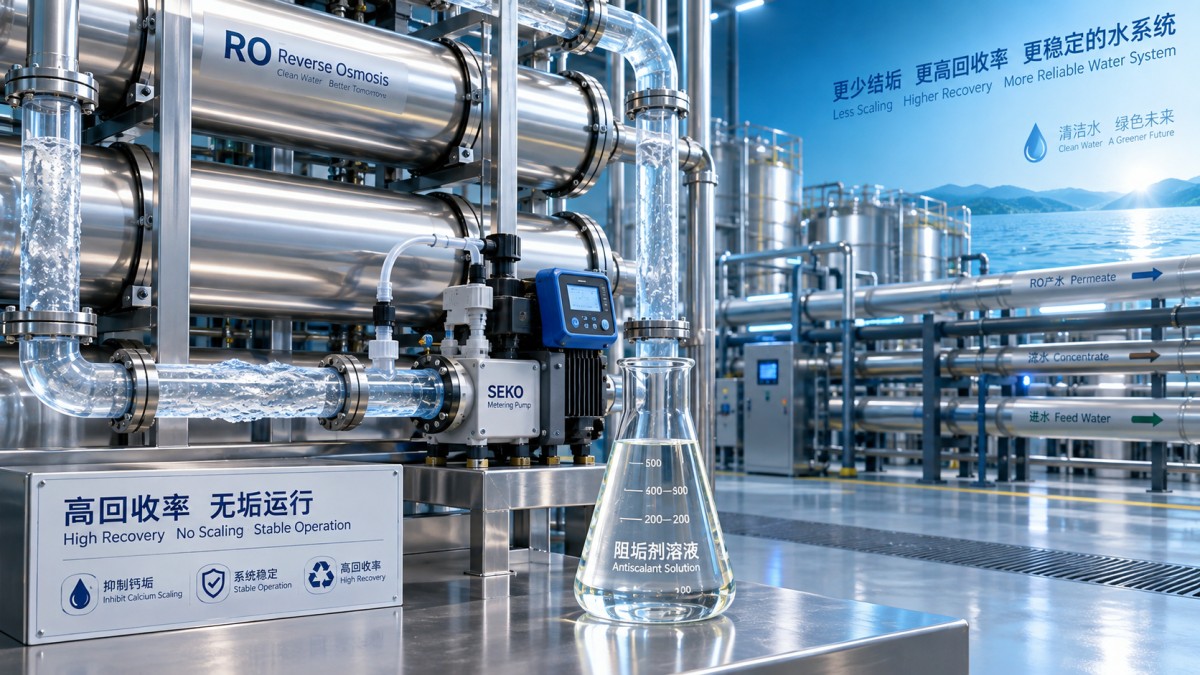
Why inhibitor response can become non-linear
Scale control does not usually weaken in a smooth, predictable line as recovery rises. A system may run cleanly for an extended period and then show a rapid increase in differential pressure, heat-transfer loss or deposit formation after a change in source-water quality, pH control or operating temperature. This apparent “cliff” is one reason high-recovery programs should not be judged solely by average feedwater analysis.
Several mechanisms contribute. Crystal threshold inhibition is concentration-sensitive: once supersaturation becomes too high, the inhibitor may no longer delay nucleation sufficiently. Dispersion can also be overwhelmed when suspended corrosion products, clay, biological debris or iron oxide provide surfaces on which mineral deposits can anchor. Meanwhile, high alkalinity may require closer acidification control, but lower pH alone is not a complete solution where sulfate, silica, phosphate or metal contamination is involved.
The inhibitor’s own calcium tolerance is equally important. Some chemistries can lose solubility when calcium is elevated, particularly when combined with unsuitable pH conditions or incompatible cationic materials. The result may look like scale failure, although part of the deposit is treatment chemical precipitate. A useful evaluation therefore separates mineral scaling tendency from inhibitor stability in the actual chemical environment.
The operating variables that deserve closer scrutiny
A high-recovery assessment should use complete water data rather than a single hardness number. Calcium hardness, total alkalinity, pH, conductivity, sulfate, chloride, silica, phosphate, iron, manganese, suspended solids and temperature can all affect the outcome. For reuse streams and industrial wastewater, variability over time is often as important as the average value. A short upset involving alkaline cleaning carryover, coagulant residual, oxidized iron or a source-water change can create conditions that routine dosing was never designed to cover.
The practical questions are straightforward:
- What is the projected concentrate chemistry at the intended maximum recovery, including membrane-surface or hot-surface effects where relevant?
- Which scale species is most limiting: carbonate, sulfate, phosphate, silica, or a mixed deposit?
- Does the proposed program remain compatible with corrosion inhibitors, biocides, coagulant carryover, zinc salts, phosphonates and cleaning procedures?
- Can the dosing point and feed system deliver a stable dose under variable flow and conductivity?
- Which operating indicators will identify loss of control before irreversible fouling develops?
These questions also prevent a common mistake: increasing dosage automatically whenever recovery rises. More active material may improve the safety margin in some cases, but overdosing can be uneconomical and may introduce compatibility concerns. The appropriate dose depends on water composition, temperature, retention time, target recovery and the specific inhibitor blend—not on recovery alone.
Selecting chemistry for difficult calcium conditions
At demanding concentration factors, technical evaluators often look for a balance of threshold inhibition, crystal modification and dispersancy. Polycarboxylate-based materials can be valuable where suspended solids and metal oxides accompany calcium scale risk, while organophosphorus chemistries may be incorporated where chelation or corrosion-program compatibility is needed. The final choice should reflect the full treatment package rather than treating the calcium scale inhibitor as an isolated additive.
For example, acrylic acid-sulfonate-acrylamino copolymers are commonly considered in high-temperature, high-pH, high-hardness and high-alkalinity systems because their dispersing function can help control both mineral particles and iron oxide deposits. Acrylic Acid-Sulfonate-Acylamino Copolymers PR-615 is designed as a scale inhibitor and dispersant for applications including industrial circulating cooling water, oilfield water injection, boiler water treatment and turbid recirculating dust-removal water. Its stated compatibility with polyphosphates, zinc salts and organophosphonates is relevant where a multi-component program is already in place.
Its normal stated application range is 2–40 mg/L, while iron oxide dispersion may require 80–100 mg/L. Those figures are useful starting references, not a substitute for system-specific confirmation. In a high-recovery system, bench screening should reproduce the expected concentration factor, pH, temperature and treatment package as closely as practical. Where feedwater fluctuates, testing should include adverse but credible water conditions rather than only the design average.
RO and cooling water need different evidence
In RO service, a calcium scale inhibitor should be assessed alongside membrane manufacturer guidance, antiscalant compatibility, cartridge filtration performance and cleaning strategy. A formulation that is effective in a bulk precipitation test may still be unsuitable if it contributes to membrane fouling, reacts with pretreatment residuals or loses performance at the membrane interface. Tracking normalized permeate flow, salt passage, differential pressure and cleaning frequency gives a more useful operational picture than watching feed conductivity alone.
Cooling water places different demands on the chemistry. Localized boiling tendencies, hot surfaces, corrosion products, air ingress and biological solids can create mixed deposits that are not represented by calcium carbonate calculations alone. Here, dispersancy and compatibility with corrosion control chemistry may carry as much weight as carbonate inhibition. Turbid systems also require attention to solids loading; a deposit can be partly mineral scale and partly particulate fouling, with very different corrective actions.
Move from a dosage decision to a control strategy
The most reliable high-recovery programs link chemical selection to monitoring and response limits. Establish a water-analysis baseline, calculate expected concentrate conditions, verify the inhibitor under representative conditions, then define action points for pH, conductivity, hardness leakage, differential pressure or heat-transfer performance. Calibration of dosing pumps and verification of the actual injection rate are basic tasks, but they are frequently where otherwise sound programs lose consistency.
Prio New Materials supports this type of evaluation with water treatment raw materials, customized formulation development, laboratory testing and technical guidance for circulating cooling water, RO purification, oilfield reinjection, desalination and complex industrial wastewater systems. For projects moving toward higher recovery, the useful next step is to review current water analyses, peak operating conditions, existing treatment chemicals and the deposit history together. That process identifies whether the limiting factor is calcium carbonate control, inhibitor compatibility, solids dispersion, pretreatment stability—or a combination of all four.

ONLINE CONSULTATION
If you have any questions, please contact us and we will contact you as soon as possible.