


Choosing a calcium scale inhibitor for hard industrial water
Hard industrial water does not create the same scaling problem in every system. A calcium scale inhibitor that performs adequately in a low-temperature, moderate-cycle cooling loop may fail when alkalinity rises, heat-transfer surfaces run hotter, or phosphate is introduced through another treatment program. For technical evaluators, the selection should begin with the precipitation risk in the operating system, then move to polymer chemistry, dosage window, compatibility, and control strategy.
The first decision is whether the dominant risk is calcium carbonate, calcium phosphate, calcium sulfate, or a mixed deposit containing suspended solids, iron, silica, or process contamination. A single “hardness” result is not enough to make that call. Calcium concentration matters, but so do pH, alkalinity, temperature, concentration cycles, conductivity, residence time, and local conditions at heat-transfer surfaces. The chosen calcium scale inhibitor must remain effective under the point-of-use conditions where supersaturation is highest, not merely in a room-temperature sample of bulk water.
Start with the saturation conditions, not the product label
In circulating cooling water, calcium carbonate commonly becomes more difficult to control as pH, alkalinity, temperature, and concentration cycles increase. High bulk-water pH can be manageable while deposits still form on hot exchanger surfaces, where carbon dioxide release and local temperature effects change the precipitation tendency. A program selected only by comparing active content or purchase price can therefore look economical at the feed point but create costly losses in heat transfer, cleaning frequency, and water use.
Calcium phosphate deserves separate attention. It may be introduced intentionally as part of a corrosion-control program, yet calcium, orthophosphate, pH, and operating temperature can combine to create a narrow treatment window. A product with strong calcium carbonate inhibition alone may not provide sufficient control if calcium phosphate precipitation is the limiting condition. Where phosphates, zinc salts, dispersants, or oxidizing biocides are part of the chemistry, the inhibitor must be assessed as part of the full treatment formulation.
Before choosing a chemistry, assemble a working water profile that includes:
- Calcium hardness, magnesium hardness, total alkalinity, pH, conductivity, chloride, sulfate, silica, iron, manganese, and suspended solids.
- Makeup-water variability, including seasonal source changes, blending, reclaimed-water contribution, and intermittent process contamination.
- Operating temperature, heat flux, cycles of concentration, retention time, blowdown practice, and expected periods of reduced load or stagnant flow.
- Existing corrosion inhibitors, biocides, coagulants, antifoams, cleaning products, and any process chemicals that can enter the water circuit.
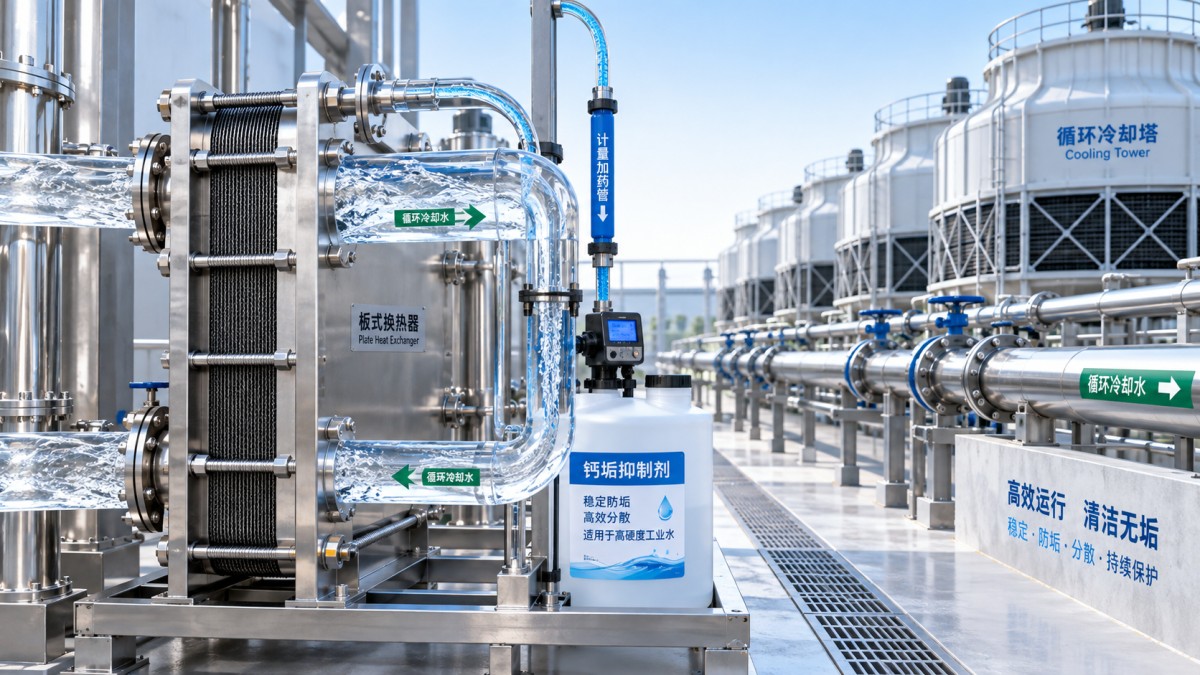
- System metallurgy and equipment locations where deposits cause the greatest operational consequence, such as plate exchangers, tower fill, strainers, or narrow-passage exchangers.
This profile does not need to become a large report before screening begins. It does need to distinguish an ordinary carbonate-control requirement from a high-stress mixed-deposit problem. That distinction prevents a common error: raising inhibitor dosage repeatedly when the underlying issue is incompatible chemistry, poor solids removal, excessive cycles, or a sudden change in makeup quality.
Match inhibitor chemistry to the deposit and operating window
For hard industrial water, threshold inhibition is only one part of the job. A calcium scale inhibitor may delay crystal formation, alter crystal habit, keep fine precipitates dispersed, or support the performance of corrosion inhibitors. The practical value depends on which of these functions the system needs most.
Organophosphorus chemistries are often considered where strong calcium-ion control and scale inhibition are needed, especially under challenging carbonate conditions. Polycarboxylate dispersants are useful when suspended solids, corrosion products, or fine mineral particles must remain mobile and leave through blowdown or filtration. Copolymers that combine carboxylate, phosphonic acid, and sulfonate functionality can be useful in cooling-water programs where calcium carbonate and calcium phosphate risk overlap and compatibility with other common treatment agents matters.
For example, Acrylic Acid/Acrylate/Phosphonic Acid/Sulfosalt Tetra-copolymer (PR-241) is positioned for circulating cooling-water systems as a scale inhibitor and dispersant, with stated inhibition performance against calcium carbonate and calcium phosphate scale. Its value should be judged against the specific water analysis and treatment package rather than assumed from the product family alone. In a program using phosphate-based corrosion control, the ability to manage calcium phosphate risk and maintain compatibility can be more important than selecting the lowest-cost polymer on a delivered-product basis.
Do not confuse solids content with field performance
Solids content helps procurement teams compare shipping concentration and feed logistics, but it does not establish performance at a given dosage. Polymer composition, molecular-weight distribution, functional-group balance, active stability, and interaction with other chemicals all affect results. A more concentrated product may reduce freight and storage volume, while a different chemistry at a lower concentration may give better control at the system’s actual pH, temperature, and cycles.
Technical evaluation should therefore compare products on an active-dose and treatment-result basis. Ask for the recommended dosage range under defined water conditions, then test the range against the relevant precipitation risk. A useful screening exercise should include the expected normal condition and at least one credible upset condition, such as higher hardness, increased conductivity, elevated pH, or higher phosphate carryover.
Compatibility can decide whether a good inhibitor becomes a weak program
Scale inhibitors are rarely fed alone. A cooling-water program may include corrosion inhibitors, oxidizing and non-oxidizing biocides, biodispersants, supplemental polymer, acid or alkali adjustment, and occasional cleaning chemicals. Incompatibility can appear as haze, floc, precipitate, viscosity change, loss of active performance, or reduced corrosion protection. Some interactions become visible immediately in a jar test; others emerge only at operating temperature or after residence time in the system.
Compatibility screening should focus on the actual feed sequence and local concentration near injection points. Two products can be compatible after dilution in the basin while producing a concentrated reaction when injected through the same line or mixed in a day tank. Separate feed points, dilution water, injection quills, and timing can solve a handling issue without changing the selected inhibitor.
System metallurgy also belongs in this review. The scale-control program changes water chemistry, and that can influence corrosion behavior on carbon steel, copper alloys, stainless steel, galvanized components, and aluminum. A higher pH or higher cycle target may improve water efficiency but narrow the margin for deposit control and alter corrosion-inhibitor performance. Selection should be made against the whole operating envelope, not against scale formation alone.
Use testing to establish a control margin
A bench test is most useful when it supports a decision rather than merely confirms that an inhibitor has some activity. Test water should represent the operating makeup and concentration factor as closely as possible. Where the system runs hot, include temperature in the evaluation. Where process leakage or reclaimed water is possible, include the relevant contaminants in a stress condition. Compare blank water, the incumbent program if applicable, and candidate treatments at several active dosages.
For a circulating cooling-water application, the evaluation should consider calcium remaining in solution, visible turbidity or precipitate, deposit tendency, dispersancy in the presence of iron or suspended solids where relevant, and compatibility with the intended corrosion inhibitor. For membrane or boiler-related applications, the test design changes because membrane-surface conditions and boiler heat flux create different constraints. A cooling-water polymer should not be transferred automatically to those duties simply because it inhibits calcium scale in a generic test.
The objective is to identify a dosage range with operating tolerance. A product that works only at one tightly controlled water condition may be less suitable than one that provides a wider margin during hardness fluctuations, short-term pH drift, or changing load. That margin has direct operational value because industrial water systems do not hold every variable constant.
Turn selection into an operating decision
Once a candidate has passed chemistry and compatibility screening, define how it will be controlled in service. Feed can be proportional to makeup, linked to conductivity, adjusted by system load, or managed through a blended approach. The preferred method depends on how quickly water quality and concentration cycles change. A stable makeup source may support simple feed control; variable reclaimed-water contribution may require tighter monitoring and more frequent adjustment.
Set operational indicators before commissioning. These commonly include conductivity, pH, calcium hardness, alkalinity, phosphate where used, inhibitor residual where an applicable method exists, corrosion monitoring, exchanger temperature approach, and inspection findings at known high-risk locations. A sudden rise in dosage demand should trigger investigation rather than automatic escalation. The cause may be a softened-water bypass, acid-feed failure, loss of blowdown control, process contamination, or solids accumulation.
For hard industrial water, the best calcium scale inhibitor is the one that fits the deposit mechanism, remains compatible with the complete program, and provides enough treatment margin for the system’s normal variation. That is a narrower and more useful selection standard than choosing by product category, solids content, or headline price alone.

ONLINE CONSULTATION
If you have any questions, please contact us and we will contact you as soon as possible.