


What to verify when selecting a polyether defoamer manufacturer
The lowest quoted price for a polyether defoamer rarely identifies the lowest operating cost. Foam-control failures can cause overflow, poor separation, unstable circulation, coating defects, filtration losses, false level readings, and unplanned chemical adjustments. A manufacturer should therefore be assessed not only on the stated defoaming performance, but on whether it can repeatedly supply a compatible product with controlled composition, traceable batches, and technical accountability when water conditions change.
The key verification question is simple: can the supplier demonstrate that its defoamer will remain effective in the buyer’s actual system, at an economically realistic dosage, without creating a new process problem? A convincing answer requires more than a standard technical data sheet. It requires a clear match between formulation, operating conditions, quality controls, packaging, logistics, and the supplier’s response capability.
Start with the operating conditions, not the product label
“Polyether defoamer” describes a broad family of products rather than a single chemistry with uniform performance. Products may differ in polyether structure, molecular weight distribution, cloud point behavior, carrier system, active content, dispersibility, and their tendency to persist or separate in water. Two samples described by the same generic label can behave very differently in circulating cooling water, wastewater treatment, paper processing, fermentation-related effluent, oilfield water, coating systems, or alkaline cleaning solutions.
Before evaluating a polyether defoamer manufacturer, define the operating envelope that matters to the process. The minimum information should include:
- foam source, such as surfactants, polymers, proteins, oils, salts, detergents, or gas entrainment;
- water temperature and its expected range;
- pH, conductivity, hardness, suspended solids, and oil content where relevant;
- tank residence time, agitation intensity, recirculation rate, and air entrainment conditions;
- the point of addition and whether the product must disperse rapidly in cold or high-salinity water;
- downstream constraints, including membranes, biological treatment, filtration, product surface quality, or discharge requirements;
- current defoamer dosage, failure pattern, and the cost attached to foam excursions.
This information changes the supplier assessment. A defoamer that gives an immediate foam break in a beaker can be unsuitable if it loses activity after circulation, separates during storage, interferes with membrane treatment, or causes deposits in a heat-transfer system. Conversely, a product with a less dramatic initial knockdown may offer better long-term suppression and lower total consumption.
Separate knockdown performance from foam-control persistence
Many purchasing comparisons focus on the visible speed at which foam collapses after a defoamer is added. This is useful, but it is not enough. Foam management has at least two distinct performance requirements: initial knockdown and continued control under process stress.
Initial knockdown matters where foam threatens overflow, blocks sensors, or disrupts a batch operation. Persistence matters where foaming is continuously regenerated by pumping, aeration, detergents, or chemical reactions. A product that disperses quickly may solve an immediate problem but require frequent re-dosing. Another may take longer to distribute but maintain control over a longer circulation period. The relevant commercial comparison is therefore cost per unit of stable operating time, not cost per kilogram or even cost per percentage point of active material.
Ask each prospective manufacturer to specify how it evaluates both effects. A useful test protocol should reproduce the relevant water matrix, temperature, agitation or aeration level, and chemical program as closely as practical. The supplier should clarify the initial dosage range, additions required over time, test duration, observation criteria, and whether results are based on the supplied product as received or after dilution.
Be cautious when performance claims are presented without a defined foam system. Statements such as “strong defoaming,” “excellent compatibility,” or “low dosage” have little purchasing value unless tied to conditions. Foam generated by an anionic surfactant at ambient temperature is not equivalent to foam from high-temperature alkaline wastewater, oil-contaminated effluent, or a circulating system containing dispersants and corrosion inhibitors.
Verify active content, but do not treat it as a stand-alone quality indicator
Active content affects freight efficiency, storage volume, dosing calculations, and apparent unit price. It should be controlled, reported in the certificate of analysis, and checked against the agreed specification. However, an active-content comparison can be misleading when different formulations use different polyether architectures or carriers.
A higher active-content product is not automatically more economical. It may be more viscous, harder to disperse, more sensitive to low temperature, or less compatible with the process liquid. A lower-active emulsion may deliver more practical dosing accuracy or faster distribution. The commercial calculation should compare the delivered cost of achieving the required foam-control outcome, including dilution water, dosing equipment limitations, storage handling, consumption rate, and any downstream cost caused by incompatibility.
Specifications should therefore cover more than active matter. Depending on the system, the purchase specification may need to include appearance, density, viscosity, pH, water content, cloud point or low-temperature behavior, dispersibility, stability after storage, and permitted variation between batches. For applications sensitive to contamination, controls on insolubles, mineral oil, silicone content, volatile components, or ionic impurities may also be appropriate. Not every parameter is necessary for every purchase, but every listed parameter should have a process reason behind it.
Look beyond the sample: assess batch-to-batch control
A laboratory sample can be selected, freshly prepared, and transported under ideal conditions. Routine supply is a different test. The main quality risk in industrial defoamers is not always an obviously defective batch; it may be gradual variation in raw material ratios, polymer distribution, emulsification quality, or dilution consistency that shifts field performance enough to increase dosage.
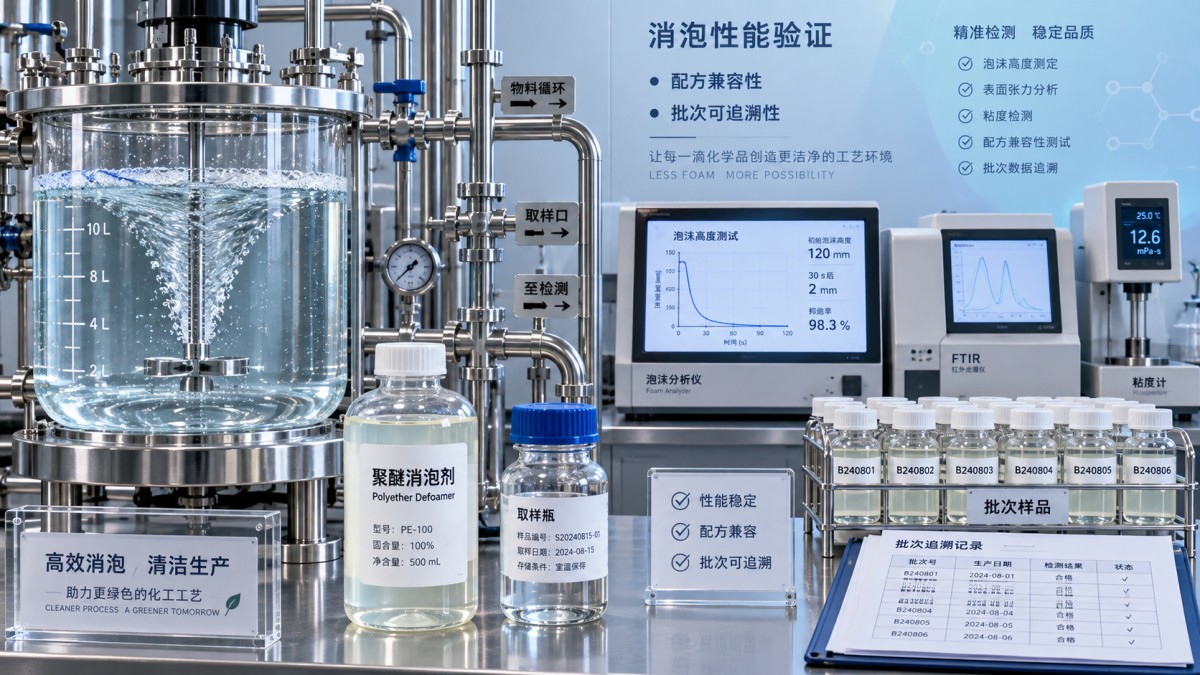
A capable manufacturer should be able to explain how it controls critical inputs and finished-product release. Useful verification points include documented incoming-material checks, batch records, retention samples, defined test methods, equipment cleaning controls, and procedures for handling nonconforming material. The buyer does not need access to proprietary formulation details to request evidence that the manufacturing process is controlled.
Certificates of analysis should be meaningful rather than decorative. Confirm which values are measured for each lot, which limits are contractual, and whether the test methods are consistently applied. If the product is purchased through a trading company, establish who actually manufactures it, who issues the certificate, and whether the stated data correspond to the production lot being shipped.
For an approved supplier, retain a reference sample from the first successful commercial lot and compare later deliveries when operating behavior changes. This is especially useful where the system is sensitive and on-site analytical tools cannot directly identify formulation drift. A simple retained-sample procedure can shorten discussions when a complaint arises and prevents the process team from having to rely on memory or subjective observations.
Compatibility is where nominally good defoamers fail
In water treatment and process-water applications, a defoamer is rarely used alone. It enters a chemical program that may contain scale inhibitors, dispersants, corrosion inhibitors, biocides, coagulants, flocculants, cleaning agents, or pH-adjustment chemicals. The defoamer must not destabilize these materials, reduce their function, or create deposits and separation problems.
This issue is particularly important in recirculating systems and wastewater operations, where the same water may pass through several treatment stages. A supplier should be asked to assess compatibility with the actual chemical program, not merely with clean water. The test should examine visible separation, haze, sediment, changes in foam behavior, and any effect on filtration, clarification, membrane performance, or surface quality.
Where scale and corrosion control agents are part of the program, procurement should avoid evaluating chemical inputs as isolated line items. For example, Tetra Sodium Salt of 1-Hydroxy Ethylidene-1,1-Diphosphonic Acid (HEDP·Na4) is used in applications such as circulating water and low- to medium-pressure boiler treatment for scale and corrosion control. Its relevance in a defoamer review is not that it replaces foam control, but that the overall formulation package must remain stable and functional when products are dosed into the same system. Compatibility checks should reflect the actual concentration, order of addition, and temperature of use.
Some incompatibilities emerge only after time, heat exposure, or repeated recirculation. This is why a short shake test is a screening tool rather than final proof. For a critical application, a trial should run long enough to expose changes in foam regeneration, product separation, deposit formation, and downstream treatment behavior.
Confirm the manufacturer’s technical role before approving a source
The distinction between a producer, a formulation company, and a reseller affects supply risk. A manufacturer may have better control over production scheduling, formulation adjustment, and technical investigation. A reseller can still provide value, but the buyer should understand who controls the chemistry, who owns the quality system, and who can authorize changes.
Questions worth asking include whether the supplier operates its own production lines, whether it has laboratory capacity for application testing, how it manages raw-material substitutions, and whether formula changes require customer approval. A supplier should also state how technical complaints are investigated: whether it reviews retained samples, requests system-water data, conducts comparative testing, and provides a documented corrective response.
Customization capacity is relevant only when the standard grade does not fit the application. It should not be treated as a generic advantage. A customized polyether defoamer may be justified where temperature, salt load, surfactant profile, biological sensitivity, or downstream equipment imposes unusual constraints. But custom supply can increase minimum-order requirements, approval time, and dependency on one formulation. The purchase agreement should clearly identify the approved grade, its control limits, the change-notification process, and ownership of application data.
Calculate total cost under realistic supply conditions
Unit price comparisons often overlook the cost of using the product. A meaningful cost model should include delivered price, concentration, expected dosage, re-dose frequency, packaging format, storage loss, pumping behavior, disposal of damaged or expired material, and the operational consequence of inadequate foam control.
Packaging can materially affect cost and risk. Small drums may be suitable for trial quantities or low-volume use, but they increase handling and empty-container management. IBC delivery may reduce packaging intensity for stable, high-volume consumption, provided the site has compatible unloading, storage, and return or disposal arrangements. For cold-weather routes, verify whether the product remains pumpable and homogeneous at the expected transport and warehouse temperatures. A defoamer that separates after freezing or prolonged storage can create dosage inconsistency even when its original specification was acceptable.
Lead time, Incoterms, export documentation, dangerous-goods classification where applicable, and contingency inventory should be evaluated before price negotiation is finalized. The supply plan should also identify the manufacturer’s production location, normal dispatch point, lot traceability, shelf-life basis, and procedure for replacing material that fails incoming inspection. These points matter most when a plant has limited storage or a foam-control interruption can quickly affect output.
Use a staged approval process rather than a single comparison test
The most reliable selection process moves from document review to controlled validation. Begin by screening the technical data sheet, safety documentation, product specification, manufacturing identity, packaging options, and commercial terms. Eliminate products that clearly do not meet temperature, compatibility, regulatory, or handling requirements.
Then compare samples under representative conditions. The sample evaluation should include not only foam height reduction but also dosage, persistence, dispersibility, impact on the wider treatment chemistry, and downstream observations. If the system is sensitive, use water from the operating process rather than a simplified laboratory substitute. Agree in advance on what result qualifies as acceptable, because a trial without defined acceptance criteria often produces ambiguous decisions.
Commercial approval should follow a monitored production-lot trial. This confirms that the product supplied at scale performs like the evaluated sample and that packaging, delivery, dosing, and storage work under normal operating conditions. It also establishes a baseline dosage and operating record for later cost reviews.
A reliable polyether defoamer manufacturer is ultimately one that makes foam control predictable: the same defined product, supported by traceable quality data, compatible with the treatment program, delivered in a usable condition, and backed by technical investigation when process conditions shift. That level of verification takes more effort than comparing quotations, but it reduces the far more expensive risk of discovering formulation or supply weaknesses after the product enters a live system.

ONLINE CONSULTATION
If you have any questions, please contact us and we will contact you as soon as possible.