


What makes a polyether defoamer suitable for high-temperature mixing?
What Makes a Polyether Defoamer Suitable for High-Temperature Mixing?
High-temperature mixing can quickly destabilize conventional antifoam systems, causing persistent foam, reduced processing efficiency, inconsistent product quality, and avoidable operating risks across industrial production lines.
A reliable polyether defoamer manufacturer understands that thermal resistance, fast foam knockdown, and compatibility with demanding formulations are essential for maintaining predictable, cost-effective production under severe conditions.
For project managers, the right answer is not simply selecting a product labeled “high-temperature.” It is verifying whether the defoamer remains effective throughout heating, mixing, pumping, holding, and downstream treatment.
A suitable polyether defoamer should maintain controlled solubility, resist thermal separation, suppress both surface foam and entrained air, and avoid disrupting formulation performance or wastewater-treatment operations.
Start with Thermal Stability, Not Initial Foam Knockdown
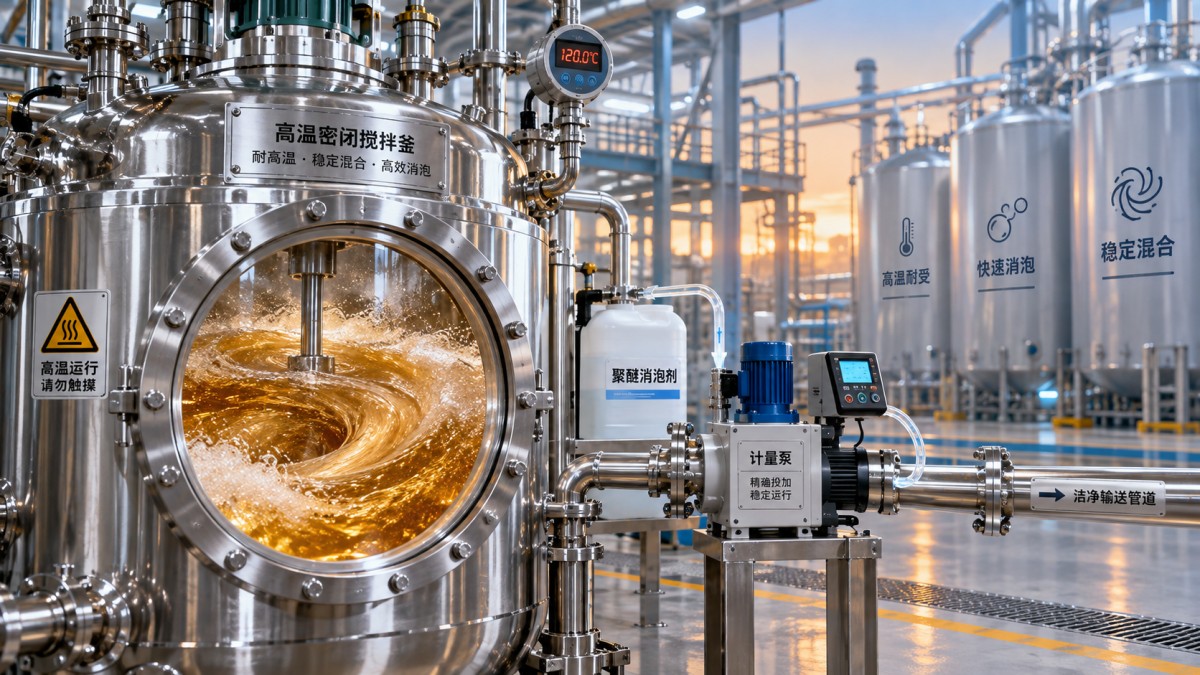
Many defoamers look effective during a short room-temperature test. High-temperature mixing creates a different challenge because heat changes viscosity, surface tension, gas release, and ingredient compatibility simultaneously.
Thermal stability means the active defoaming components retain their structure and distribution after exposure to actual operating temperatures, shear rates, residence times, and formulation chemistry.
A polyether defoamer typically contains hydrophilic and hydrophobic segments designed to spread rapidly at the foam interface. Their balance determines whether performance survives elevated processing temperatures.
If the polyether chain becomes too soluble when heated, the defoamer may disperse completely into the liquid phase. It then loses the controlled incompatibility needed to rupture foam films.
If the defoamer becomes excessively insoluble, it can separate, float, form deposits, or create localized dosage variations. These issues make foam control unpredictable during long production campaigns.
Project leaders should ask suppliers for performance data after thermal aging, rather than accepting only initial antifoam measurements. Heat exposure should reflect the actual process temperature and duration.
A meaningful evaluation compares foam height, collapse time, residual foam, and product appearance before and after aging. It should also assess whether the defoamer remains easy to disperse.
Stable performance after repeated heating cycles is especially important in batch operations, recirculating systems, reactors, evaporators, coating preparation, and industrial water-treatment formulations.
Why Cloud Point and Solubility Behavior Matter
Polyether defoamers do not work by being universally soluble. Their effectiveness depends on achieving a controlled level of incompatibility that lets active droplets enter and weaken foam films.
Cloud point behavior provides a useful indication of how a polyether system may respond to temperature. However, cloud point alone does not guarantee performance in a complex industrial formulation.
Salts, surfactants, solvents, polymers, alkaline agents, suspended solids, and dissolved organics can shift the defoamer’s apparent solubility and change its spreading behavior substantially.
In high-temperature mixing, project teams should test the defoamer in the complete formulation whenever possible. A simplified water test may overlook critical interactions with production ingredients.
A well-designed product remains sufficiently dispersed for uniform distribution, while retaining enough hydrophobic character to migrate toward foam lamellae and destabilize the trapped gas-liquid structure.
This balance helps the defoamer prevent foam rebound after mixing. Rebound is often more costly than visible initial foam because it can appear later in filling, transfer, filtration, or treatment.
Process teams should evaluate both immediate knockdown and sustained suppression. The best product is not necessarily the fastest at the first minute, but the most reliable over the full process cycle.
Fast Entry into Foam Films Supports Production Throughput
High-temperature mixing often generates foam faster than operators can respond manually. Mechanical agitation, gas entrainment, circulation pumps, and chemical reactions can create dense, persistent foam layers within minutes.
An effective polyether defoamer must enter the foam film quickly. This requires favorable spreading characteristics, appropriate droplet size, and sufficient mobility at the process temperature.
Once inside the lamella, the defoamer disrupts the film’s elasticity and drainage balance. The foam becomes less stable, liquid drains from bubble walls, and bubbles coalesce or collapse.
Fast action has direct business value because it reduces mixer overflow, vessel downtime, material loss, cleanup labor, and delays caused by unstable liquid-level readings.
For project managers, the relevant measurement is often not “does it defoam?” but “how quickly does it restore usable vessel capacity under normal production conditions?”
Ask for a test method that records foam volume over time after controlled dosing. The test should include the same agitation intensity and temperature range used in the plant.
Where foam generation is continuous, intermittent shock dosing may be inefficient. A metered low-dose addition strategy can provide more stable control and lower total chemical consumption.
Supplier recommendations should distinguish between initial startup dosing, routine maintenance dosing, and emergency foam-control dosing. Treating every operating condition as identical usually increases cost and variability.
High Shear Resistance Prevents Loss of Control During Mixing
Temperature is only one part of the challenge. High-speed dispersers, homogenizers, circulation pumps, and static mixers can break defoamer droplets into sizes that alter their effectiveness.
Excessive shear may distribute a defoamer too finely throughout the liquid, making it less able to escape the bulk phase and attack foam at the surface.
Conversely, a product with poor dispersion may enter the system unevenly and create localized defects. The goal is controlled dispersion, not maximum emulsification.
A capable polyether defoamer manufacturer should understand where the product is introduced and whether it encounters high shear before reaching the foam-prone zone.
Injection point selection can be as important as product selection. Adding defoamer upstream of an aggressive pump may reduce performance compared with dosing directly into the mixing vessel.
Projects should include a practical injection review covering feed-line length, pump type, dilution water quality, dosing frequency, and the opportunity for defoamer settling before use.
For large-scale installations, trial protocols should use plant-representative mixing equipment. Bench tests remain useful, but they cannot always reproduce real circulation paths or shear exposure.
This approach reduces the risk of approving a product that performs well in a laboratory beaker yet fails after full-scale commissioning under real operating stress.
Compatibility Is the Main Protection Against Product Defects
Foam control cannot be evaluated separately from final-product quality. A defoamer may collapse foam effectively while causing coating defects, filtration problems, separation, turbidity, or reduced treatment efficiency.
Compatibility requirements vary by system. Waterborne formulations may be sensitive to surface defects, while water-treatment applications may prioritize low residue, stable dispersibility, and downstream biological compatibility.
High-temperature processing can intensify incompatibility because dissolved polymers, surfactants, and salts behave differently as viscosity and molecular interactions change during heating.
Therefore, product qualification should include visual inspection, viscosity checks, phase stability, filtration behavior, surface quality, and any process-specific performance indicators after defoamer addition.
For industrial water-treatment projects, compatibility should also include scale-control agents, corrosion inhibitors, dispersants, biocides, and any coagulants used later in the treatment sequence.
For example, a boiler or membrane-water program may use Potassium Salt of HexaMethyleneDiamineTetra (MethylenePhosphonic Acid) (HDTMPA·K6) for scale inhibition under alkaline conditions.
When defoamers and phosphonate-based water-treatment chemicals share a process, the combined formulation should be assessed for clarity, storage stability, dosage compatibility, and operational performance.
A supplier that offers laboratory testing and application support can help isolate whether foam comes from the base chemistry, contamination, overdosing, equipment conditions, or an unsuitable defoamer.
Low Dosage Efficiency Improves the Project Economics
High-temperature defoaming decisions should be based on total operating cost rather than unit price per kilogram. A low-priced product can become expensive when it requires repeated high-dose additions.
Dosage efficiency reflects how much defoamer is needed to achieve stable control over time. It should be measured against production volume, foam intensity, and the duration of protection.
Projects should calculate the full impact of foam, including lost capacity, reduced yield, cleaning, wastewater load, labor intervention, delayed transfer, rejected batches, and unplanned maintenance.
An efficient polyether defoamer can lower these hidden costs by keeping levels stable and preventing foam from entering vents, instruments, filters, and downstream pumps.
However, extremely low recommended doses should be verified carefully. Small changes in feed accuracy may become significant when a formulation operates near its minimum effective concentration.
Automated dosing systems should be calibrated for the product’s viscosity and storage conditions. Temperature changes in the storage area can affect pumping accuracy and dosing consistency.
For procurement comparisons, request cost-per-treated-ton estimates at realistic operating conditions. Include the expected dose range, trial results, packaging, logistics, and technical-service support in the analysis.
This comparison gives project decision-makers a clearer basis for selecting a supplier than evaluating drum price alone, particularly for long-term industrial operating contracts.
Storage Stability and Handling Affect Real-World Performance
A defoamer can have excellent laboratory performance but still create problems if it separates during storage, freezes, thickens, or becomes difficult to pump in the field.
High-temperature process suitability begins before dosing. The product must arrive consistently, remain stable in warehouse conditions, and be manageable through the site’s existing transfer equipment.
Project specifications should define acceptable storage temperature, shelf life, mixing requirements, container options, and whether the material requires recirculation before it enters automated dosing systems.
For multinational projects, transport time and climate exposure should also be considered. A product shipped across varying temperatures requires packaging and quality controls that preserve usable performance.
Clear handling guidance reduces operator uncertainty. It should explain whether dilution is appropriate, what water quality is suitable, how to mix the product, and how to prevent line blockage.
Site teams should avoid assuming that more defoamer always solves a problem. Overdosing can create residual surface issues, increase organic load, impair separation, and obscure the actual source of foaming.
A structured troubleshooting process is more effective: verify foam source, confirm operating conditions, inspect contamination, review dosage history, then adjust product selection or feed strategy.
How to Qualify a Polyether Defoamer Before Full-Scale Use
A disciplined qualification program protects schedule, budget, and product quality. It converts a broad supplier claim into evidence that the defoamer can support a specific high-temperature process.
First, define the operating envelope: normal and peak temperature, pH, mixing speed, gas introduction, production volume, residence time, raw materials, and downstream quality requirements.
Second, establish measurable acceptance criteria. These may include maximum foam height, collapse time, residual foam after a set period, dosage ceiling, appearance, filtration rate, and equipment cleanliness.
Third, compare candidates under identical conditions. Testing multiple products at inconsistent temperatures or agitation speeds produces misleading conclusions and makes cost comparisons unreliable.
Fourth, conduct thermal-aging and recirculation tests before plant trials. A product should be evaluated after realistic exposure, not only immediately after preparation in a fresh sample.
Fifth, run a controlled production trial with defined observation points. Record dosing, foam behavior, pump performance, level stability, product quality, and any effects in downstream treatment.
Finally, review the result with operations, quality, engineering, procurement, and the supplier. A good decision considers technical fit, supply reliability, application support, and total cost.
For complex water-treatment programs, test results should also confirm that foam control does not compromise scale inhibition, corrosion control, membrane protection, or wastewater discharge requirements.
Questions Project Managers Should Ask a Polyether Defoamer Manufacturer
Before approving a product, ask what temperature range has been validated and whether the supplier can provide evidence from formulations similar to your actual process conditions.
Ask how the defoamer responds to high shear, alkaline conditions, dissolved salts, surfactants, polymers, and temperature cycling. These factors frequently determine whether performance remains stable.
Request guidance on the preferred injection point, normal dosage range, dilution procedure, and whether continuous dosing is recommended for sustained foam generation during mixing.
Ask what compatibility tests the supplier performs. The response should address final-product quality as well as defoaming performance, especially where downstream membranes, filters, or coatings are involved.
Confirm batch consistency, quality-control parameters, packaging formats, lead times, documentation, and technical support availability. Supply disruptions can quickly become production risks in continuous operations.
It is also reasonable to ask how the supplier will support troubleshooting after commissioning. Foam behavior often changes when raw-material sources, seasonal water quality, or process loading changes.
A technically credible supplier will discuss limitations openly. No single defoamer is universally optimal, and realistic recommendations are more valuable than broad claims of universal compatibility.
Conclusion
A polyether defoamer is suitable for high-temperature mixing when it maintains controlled insolubility, thermal stability, fast foam-film entry, shear tolerance, and compatibility with the complete process formulation.
For project managers, selection should focus on sustained operating performance rather than a single visual demonstration. Thermal aging, plant-representative testing, dosage economics, and handling practicality are decisive factors.
The most reliable choice combines proven chemistry with a supplier capable of evaluating actual water quality, mixing conditions, formulation interactions, and downstream requirements before full-scale implementation.
By qualifying defoamer performance against measurable production risks, industrial teams can reduce foam-related interruptions, protect product consistency, and maintain more predictable throughput at elevated temperatures.

ONLINE CONSULTATION
If you have any questions, please contact us and we will contact you as soon as possible.