


When inconsistent batches point to a polyether defoamer supplier issue
A sudden loss of foam control should be treated as a batch-comparability problem until the operating record proves otherwise. When the same application, dose point and process conditions produce different foam behavior after a new delivery, the variation may originate in the defoamer itself: its active composition, emulsion structure, solids level, viscosity, particle distribution or stability during storage and transport.
Polyether defoamers are commonly selected because they can spread rapidly at a gas-liquid interface and disrupt stable foam films. Their performance, however, depends on a balance between hydrophobic segments, hydrophilic segments, carrier phase and any emulsification package. A small formulation shift can leave the product visually acceptable while changing its entry rate into foam, its resistance to washout, or its compatibility with treatment chemicals. This is why a simple pass/fail bottle test is often insufficient when inconsistent batches are suspected.
Separate a supplier-related shift from a process upset
Foam is highly responsive to process changes. Increased surfactant loading, fluctuating pH, altered temperature, air ingress, biological activity, oil contamination and changes in recirculation rate can all make a previously effective defoamer appear weak. Before assigning the cause to a polyether defoamer manufacturer, compare the affected period with a stable period using the same operating basis.
The most useful comparison is not merely the nominal dosage. Record the actual feed rate, dilution water source, injection location, tank level, mixing condition, solution temperature and retention time between injection and the foaming zone. A drum delivered during cold weather may have higher apparent viscosity and require more thorough homogenization than one stored at moderate temperature. Conversely, aggressive circulation or a high-shear transfer pump can damage a sensitive emulsion, creating a performance change after the material has entered the site.
A supplier investigation becomes more credible when the process record is stable while the product lot changes. Strong warning patterns include a repeated need for a higher dose from one lot, slower foam knockdown with the same initial dose, greater foam rebound after an apparently successful knockdown, or new deposits around injection hardware. Changes that follow lot boundaries across more than one treated system deserve particular attention.
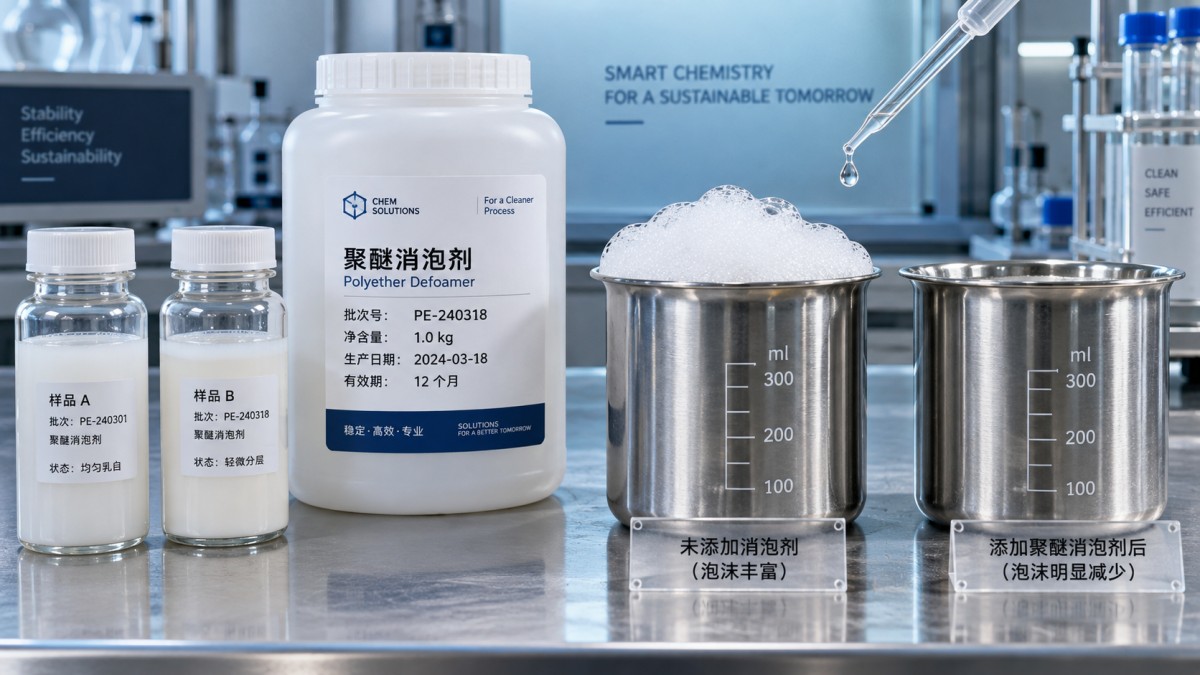
Symptoms that carry different meanings
“The defoamer stopped working” groups together several failure modes that should be distinguished. Fast collapse followed by rapid foam return often points to poor persistence, inadequate dose distribution, or a formulation that is being stripped from the liquid phase. No visible initial collapse is different: it can indicate poor dispersion, incompatibility with the foaming liquor, severe dilution at the injection point, or a material whose active phase is no longer entering the foam film effectively.
Surface oiling, floating droplets or a ring on tank walls may suggest phase separation, but the observation needs context. Some water-insoluble defoamers naturally show a dispersed oil phase after addition. The concern is an obvious difference from retained reference material after comparable agitation and dilution. A batch that rapidly separates in its unopened package, forms a sediment that cannot be readily reincorporated, or shows a distinct top and bottom layer after normal inversion requires quarantine pending evaluation.
Color alone is a weak release criterion. Light color variation can result from raw-material variation or storage without affecting control performance. Yet color change combined with odor change, viscosity drift or unexpected separation is stronger evidence of a compositional or stability issue. The same principle applies to density: a compliant density result does not confirm that the active polyether ratio or emulsion particle structure is unchanged.
What to retain and compare before the evidence disappears
Keep sealed retains from the last known good lot and the suspect lot. Samples should be identified by lot number, receipt date, container position and storage history. If the material was transferred to a day tank, retain a sample from both the original container and the point-of-use tank. This distinction matters because a good incoming product can be altered by incompatible residue, inadequate mixing, a contaminated transfer hose or prolonged circulation in a heated tank.
Start with a controlled side-by-side screen using actual process water or a representative foaming sample whenever practical. Equalize sample temperature, mixing energy, sample volume and defoamer addition method. Compare the dose needed to suppress foam, time to collapse, height after a fixed observation period, and rebound after controlled agitation. A sample that works in deionized water but fails in process water may be reacting to hardness, oil, polymer, solids, dispersant or surfactant content rather than showing a universal quality defect.
Basic incoming comparisons can include appearance, odor, density, pH where relevant, viscosity, nonvolatile content and dilution behavior. These values must be interpreted against the agreed product specification and historical lot range, not against an assumed universal target. For an emulsion-type product, microscopy or particle-size measurement may expose coalescence that bulk density will miss. For a solution-type polyether defoamer, a cloud-point change or altered solubility behavior can reveal a meaningful shift in the hydrophilic-hydrophobic balance.
Do not confuse active content with effective activity
Two batches can have similar nonvolatile content yet behave differently because the active components are distributed differently, the carrier has changed, or the emulsifier package has altered the release of the active phase. A higher solids result is not automatically better; excessive hydrophobicity may produce surface oiling or interfere with downstream separation. A lower viscosity result is also not automatically evidence of dilution, since temperature and the molecular architecture of the polyether influence flow behavior.
Request the manufacturer’s batch-specific certificate of analysis, but do not limit the review to values printed on it. Ask which parameters are release-critical for the grade, whether raw-material sources or processing conditions changed, and whether retained samples from the production batch were evaluated against a control. A meaningful response connects the lot to its formulation controls and test method rather than only restating a specification range.
Where formulation control can break down
Polyether defoamer consistency begins upstream. Variability in initiator quality, alkylene oxide ratio, molecular-weight distribution, terminal-group profile or carrier material can shift dispersibility and foam-entry behavior. During finishing, insufficient homogenization, a changed addition sequence, water-quality variation, poorly controlled temperature or an unstable emulsification step can create lot-to-lot differences without obvious packaging defects.
Traceability is especially important when a defoamer is used alongside scale inhibitors, corrosion inhibitors, biocides, coagulants or polymers. The defoamer may be chemically intact but poorly compatible with a modified treatment program. In water containing elevated dissolved iron and calcium, the interaction between chelants, dispersants, solids and defoamer droplets can change the apparent foam-control result. For example, a program containing Hydroxyethylamino-Di(Methylene Phosphonic Acid) (HEMPA) should be evaluated as part of the complete treatment mixture, because its chelating and scale-control functions may affect the water chemistry surrounding the defoamer test.
The question is not whether the two chemicals are broadly “compatible” in a static sample. The relevant question is whether the actual concentrate ratios, dilution sequence, local concentration at injection, water composition and operating temperature preserve defoamer performance. Combining concentrates in a shared day tank without documented compatibility data can create a failure that resembles a poor incoming batch.
Transport and storage can create a false supplier signal
A sound batch can become unreliable before use. Long exposure to high temperature can destabilize some emulsified products, while low temperature can increase viscosity, create reversible crystallization or slow redispersion. Storage near steam lines, direct sunlight, repeated freeze-thaw exposure and extended residence in a partly filled tank all increase uncertainty. Water evaporation from a vented system may also concentrate a product and change its flow characteristics.
Inspection should include the physical path from receiving dock to feed pump. Confirm whether containers were mixed using the method specified for that grade; excessive aeration during mixing can create its own foam problem. Examine suction strainers, transfer hoses, pump seals and day tanks for deposits or traces of incompatible chemicals. A partially blocked injection quill can deliver an intermittent dose that is easily mistaken for poor defoamer quality.
When only the final portion of a drum performs poorly, investigate settling, phase stratification, inadequate rehomogenization and container contamination before concluding that the full lot was defective. When every container from a lot behaves differently from prior material immediately after receipt, with controlled testing supporting the result, the supplier-side hypothesis becomes much stronger.
Build a corrective path that produces an answer
Quarantine the suspect lot when foam control affects equipment operation, downstream separation, wastewater discharge stability or process safety. Continue with a verified reference lot where available, while avoiding uncontrolled dose escalation. Increasing dose until foam disappears can hide the diagnostic signal and may introduce carryover, surface films, filtration problems or downstream contamination.
Send the supplier a concise evidence package: lot identifiers, product condition on receipt, storage record, process comparison, photos of any separation, retained-sample results and the controlled foam test method. Ask for a comparison of retained production samples, release data, manufacturing deviations, raw-material traceability and shipment history. The investigation should produce a documented disposition for the lot, not an informal assurance that the specification was met.
For future receipts, establish acceptance criteria that reflect the application rather than relying entirely on generic physical properties. A short comparative foam test against an approved retained lot can be useful for critical systems, provided the method is repeatable and the pass criteria are linked to operational performance. Periodically review the test method when water chemistry, treatment chemistry or injection hardware changes; otherwise, the method may continue to pass material while losing relevance to the real process.
Persistent batch inconsistency is a control-system issue. The resolution comes from preserving samples, comparing like-for-like operating conditions, testing the complete chemical environment and requiring lot-level traceability. That approach identifies whether the corrective action belongs in formulation control, shipping and storage, injection practice or the water-treatment program itself.

ONLINE CONSULTATION
If you have any questions, please contact us and we will contact you as soon as possible.