


How MA/AA dispersants affect deposit control in cooling circuits
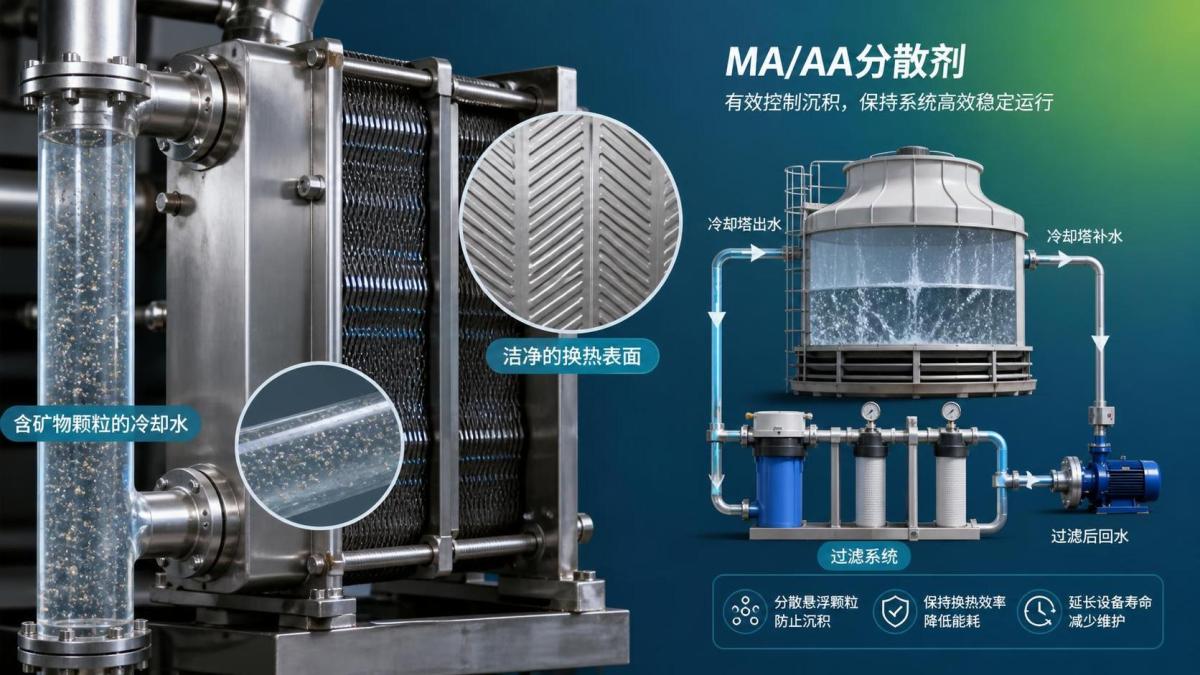
MA/AA dispersants can materially improve deposit control in open recirculating cooling circuits, but their value is often misunderstood. They do not remove hardness from the water or dissolve an established scale layer on their own. Their main contribution is to keep precipitated mineral particles, corrosion products and other suspended solids small, dispersed and transportable so they are less likely to settle in low-flow zones or attach to heat-transfer surfaces.
For a technical evaluator, the practical question is therefore not whether MA/AA is “a good dispersant” in isolation. It is whether the polymer has sufficient tolerance, molecular design and compatibility to control the deposit risks created by a specific cooling-water chemistry, operating temperature and treatment program.
How MA/AA works in a cooling-water program
MA/AA generally refers to copolymers based on maleic acid and acrylic acid. The carboxyl-containing polymer chain interacts with fine inorganic particles and crystal surfaces. In a cooling circuit, this can interrupt the early stages of particle agglomeration and reduce the tendency of precipitates to form dense, adherent deposits.
Its performance is especially relevant where concentration cycles raise the saturation pressure for calcium carbonate, calcium phosphate, zinc-containing solids, iron oxides or mixed deposits containing process contamination. Once these particles form, a dispersant helps maintain separation between them. The resulting solids are more likely to remain in circulation until they are discharged through blowdown or removed by side-stream filtration.
This mechanism explains an important limitation: MA/AA is not a substitute for water-balance control. If alkalinity, calcium hardness, pH, phosphate residual, iron loading or concentration cycles move far beyond the program’s operating window, the volume and rate of precipitation can exceed the polymer’s dispersing capacity. Deposit control depends on the entire treatment balance, including inhibitor chemistry, feed accuracy, blowdown, filtration and mechanical system condition.
Where deposit control benefits are most visible
Heat-transfer surfaces are vulnerable because local temperature elevation can make the water at the metal interface more scale-forming than the bulk circulating water. A deposit only a small distance thick can reduce heat transfer, increase energy demand and create under-deposit conditions that complicate corrosion control. MA/AA is commonly used to reduce the probability that incipient particles become attached deposits in these high-stress areas.
The polymer can also assist in systems where corrosion by-products create a fouling component. Iron oxides and hydroxides may enter the circuit through corrosion, makeup-water contamination, construction debris or process ingress. These solids can combine with mineral scale and microbiological material, producing deposits that are harder to classify and harder to control than a simple calcium carbonate scale. A dispersant that keeps fine iron-containing solids mobile can support cleaner surfaces, though the source of iron still needs to be addressed.
Low-flow branches, dead legs, cooling-tower basins, strainers and exchanger channels require separate attention. Chemical dispersion cannot fully compensate for poor hydraulics or accumulated sludge. In such areas, particle settling is driven as much by residence time and flow pattern as by polymer selection.
Conditions that determine whether MA/AA will perform well
Water analysis provides the starting point, but a single makeup-water result is rarely enough for evaluation. The circulating-water composition at the intended cycles of concentration is more useful because that is where scale pressure and particle loading develop. Technical review should consider calcium and magnesium hardness, alkalinity, pH, conductivity, silica, phosphate or phosphonate residuals, iron, suspended solids and any known process contaminants.
Temperature deserves equal weight. A polymer that performs acceptably in a cooling-tower basin may face a more severe challenge inside a high-temperature heat exchanger. Evaluators should distinguish between bulk water temperature and estimated tube-wall or process-side surface temperature, particularly where exchangers operate near their thermal limit.
The following questions usually reveal more than a generic product comparison:
- What deposit is expected or has been observed: carbonate scale, phosphate scale, iron-rich sludge, silica-containing material, biological foulant, or a mixed deposit?
- What saturation conditions occur at maximum operating cycles and at the hottest heat-transfer surfaces?
- How much suspended material enters through makeup water, air ingress, corrosion or process leakage?
- Which inhibitor, phosphonate, biocide, oxidant and tracer chemistries will be present with the polymer?
- How will the system remove dispersed solids through blowdown, filtration, cleaning or basin management?
MA/AA is often selected because carboxylate polymers can offer useful calcium tolerance and particle-dispersion behavior. That advantage should still be verified against the intended formulation. The polymer’s molecular weight distribution, monomer ratio, active content, pH, storage stability and interaction with other formulation components can influence field performance. Two materials described by the same broad chemistry may not behave identically under high hardness, high alkalinity or high suspended-solids loading.
Do not confuse dispersancy with threshold inhibition
Cooling-water formulations often combine several functions: threshold scale inhibition, crystal modification, chelation, corrosion inhibition and dispersion. MA/AA may contribute to more than one of these effects, but its strongest role is usually keeping formed particles from agglomerating and depositing. A program designed around that role should not assume that higher polymer dosage will correct an insufficient scale-inhibitor package or an uncontrolled pH excursion.
This distinction matters when reviewing laboratory results. A static inhibition test can indicate whether a formulation delays precipitation under a defined water chemistry. It does not automatically predict how well the program will handle iron transport, suspended solids, turbulent flow, thermal gradients or intermittent contamination in an operating circuit. Deposit-control assessment should include both precipitation behavior and solids-handling behavior.
What to evaluate before approving a material
A technically defensible evaluation normally combines product quality checks with application-specific testing. Confirm the supplied material’s active concentration, appearance, pH range and density against its specification, then assess its stability after storage under expected handling conditions. For formulated products, compatibility with corrosion inhibitors, oxidizing and non-oxidizing biocides, phosphonate components and makeup-water constituents should be reviewed before scale-up.
Bench testing is most useful when it reproduces the actual limiting conditions rather than using only standard synthetic water. Testing can compare turbidity retention, particle settling, filtration behavior, calcium tolerance and deposit formation under representative concentration cycles. Where a circuit has a known deposit history, analysis of removed material is particularly valuable. Treating a silica-iron-phosphate deposit as though it were pure carbonate scale can lead to a misleading chemical choice.
Field validation should rely on operating indicators that relate to deposits: exchanger approach temperature, pressure drop, filter differential pressure, corrosion-product trends, suspended-solids behavior, inspection findings and blowdown stability. Changes in any one indicator need interpretation alongside load, weather, production rate and system operating conditions.
Foam and ancillary additive compatibility
Foam is not normally the primary deposit-control concern, but it can complicate chemical feed, tower operation and water-level control when surfactants, process contamination or certain treatment components are involved. Any antifoam used alongside a dispersant program should be checked for compatibility, because overdosing or poorly dispersed silicone materials can interfere with downstream filtration or create handling issues.
For water-treatment applications requiring foam suppression, a chemically inert, water-dispersible option such as Silicon liquid defoamer may be evaluated as a separate adjunct to the cooling-water formulation. The decision should remain tied to the actual foaming mechanism and to compatibility testing with the complete treatment program, rather than treating defoaming as a direct substitute for solids control.
Practical limits and operating implications
An MA/AA dispersant works best when the circuit has a credible route for rejecting the particles it keeps dispersed. If blowdown is inadequate, side-stream filtration is undersized, basin sludge is left unmanaged or dead-leg flow is unresolved, maintaining more solids in suspension can simply shift where deposits accumulate. The program must be judged as a solids-management system, not only as a chemical-feed system.
It is also prudent to investigate sudden deposit changes before increasing dosage. A rise in iron may indicate corrosion or makeup contamination. A change in calcium or alkalinity can reflect makeup-water variation. Loss of inhibitor residual may point to feed-equipment problems. Process leaks can introduce hydrocarbons, fibers, salts or suspended matter that alter deposition behavior. Increasing the dispersant feed without identifying these changes can obscure the root cause while adding treatment cost.
MA/AA is therefore most useful when selected as part of a defined operating envelope: known water chemistry, controlled concentration cycles, compatible inhibitors, adequate solids removal and monitoring tied to the circuit’s dominant fouling mechanism. Under those conditions, it can help preserve cleaner heat-transfer surfaces and make deposit control more resilient. Outside them, its limitations become visible quickly, particularly in systems where chemistry excursions and solids accumulation are left unmanaged.

ONLINE CONSULTATION
If you have any questions, please contact us and we will contact you as soon as possible.