


Can a defoamer OEM replicate performance after a raw material change
A raw-material substitution does not automatically prevent a defoamer OEM from reproducing an existing product’s field performance. It does, however, make a simple “same specification” claim inadequate. A defoamer can match active content, viscosity, density, and appearance while behaving differently in a wastewater system, cooling-water loop, paper machine, or membrane-related process.
The practical question is not whether the replacement formula looks similar in a drum. It is whether it suppresses foam at the required dosage, disperses correctly in the process water, remains stable during storage and dosing, and does not disrupt the rest of the treatment program. Replication is possible when those requirements are defined and verified against the actual application conditions.
Why matching routine specifications is not enough
Industrial defoamers are often multi-component systems. Depending on the chemistry, performance may depend on the balance between hydrophobic active ingredients, carrier oil or water, emulsifiers, dispersants, stabilizers, and sometimes particulate hydrophobes. Changing one raw material can alter this balance even when the finished product still meets the original viscosity and solids targets.
For example, an alternative silicone fluid may have a different molecular distribution or surface activity. A different emulsifier may maintain acceptable appearance in storage but release the active ingredient too slowly after dosing. A substitute mineral oil, fatty alcohol, or polymeric carrier can change spreading behavior at the air-liquid interface. These shifts may show up as slower foam knockdown, weaker foam prevention, more dosage sensitivity, or separation after dilution.
This is why a defoamer OEM should not define equivalence solely through a certificate of analysis. Basic physical tests are useful for batch control, but they are screening tools, not proof of application equivalence.
Start by defining the performance that must be replicated
Before approving a replacement raw material, identify what the incumbent defoamer is expected to do in the operating system. “Controls foam” is too broad to become a reliable acceptance criterion. The relevant target may be rapid collapse of an existing foam layer, prevention of foam generation under agitation, control of persistent surfactant foam, or stable performance after repeated recirculation.
The definition should also include the process window. Water chemistry, temperature, pH, shear, aeration rate, residence time, and the presence of contaminants can each change a defoamer’s behavior. A formula that works in a beaker test with clean water may fail in wastewater containing detergents, dispersants, oils, salts, or biological solids.
- Is the product expected to eliminate foam immediately, prevent it from returning, or do both?
- What are the normal and worst-case temperature, pH, and conductivity conditions?
- Which surfactants, polymers, corrosion inhibitors, biocides, coagulants, or scale inhibitors are already present?
- Will the defoamer be added neat, pre-diluted, continuously metered, or applied intermittently?
- Can residual defoamer affect filtration, membrane operation, coating quality, oxygen transfer, or downstream separation?
These questions distinguish a credible replication project from a formulation exercise based mainly on cost or availability.
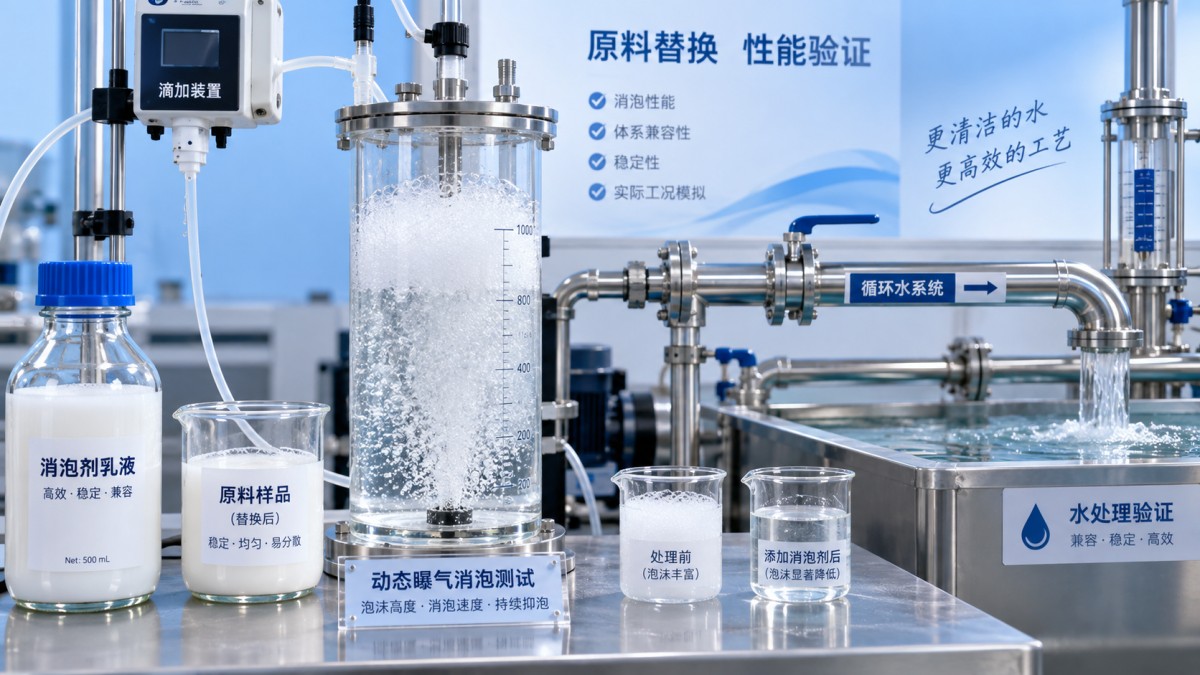
Test the replacement in layers, not with one foam test
A sensible validation sequence moves from formulation screening to process-relevant verification. The first layer confirms that the replacement material can produce a stable finished emulsion or dispersion. Check appearance, homogeneity, viscosity trend, freeze-thaw tolerance where relevant, heat stability, and behavior after storage. A formula that separates in the package or in the day tank cannot be considered equivalent even if its initial foam test is satisfactory.
The next layer evaluates foam-control performance in representative process liquor. Test both initial knockdown and foam persistence after continued agitation or aeration. Where the system is variable, use more than one sample condition: a typical sample, a high-surfactant or high-solids condition, and a condition reflecting elevated temperature or changed pH. The goal is to expose dosage sensitivity and compatibility limits before a plant trial.
Finally, evaluate the product under the intended dosing method. Some defoamers perform well when added directly but lose effectiveness after dilution. Others need adequate mixing to distribute, while overly high shear can damage an emulsion or reduce its practical efficiency. The validation should mirror the actual dilution water, feed line, pump type, injection point, and contact time as closely as possible.
Compatibility is usually the decisive risk
In water treatment, a defoamer is rarely used alone. It enters a chemical environment that may include dispersants, chelants, antiscalants, coagulants, flocculants, oxidizing or non-oxidizing biocides, and process-specific additives. A raw-material change can affect compatibility with any of them.
For circulating cooling water, boiler makeup water, or industrial wastewater, evaluate the defoamer alongside the actual treatment package rather than against water alone. A change in emulsion behavior can create turbidity, deposits, oiling-out, reduced dispersant performance, or inconsistent foam control. In membrane-related applications, the compatibility review should also consider whether the defoamer increases fouling risk or interferes with downstream cleaning.
Scale-control chemistry deserves particular attention because it is designed to remain active and well dispersed in water. For systems using polymeric dispersants, products such as Copolymer of Maleic and Acylic Acid (MA/AA) may be part of a broader water-treatment program for controlling carbonate dispersion and scale formation. The point is not that one chemistry determines defoamer choice; it is that the finished defoamer must be evaluated in the full chemical program, at the actual use concentration, rather than in isolation.
What quality documentation should a defoamer OEM provide?
A capable supplier should be able to connect the raw-material change to a controlled change-management process. That normally includes identification of the substituted material, its intended function in the formula, incoming-material acceptance criteria, retained reference samples, and a comparison plan for the existing and revised products.
For a critical change, ask for more than the final batch specification. Useful documentation includes the revised formulation control record, raw-material qualification criteria, production batch traceability, stability observations, and application-test methods with defined acceptance limits. The methods matter because two suppliers can report “passed foam testing” while using entirely different water, surfactant loads, temperatures, agitation conditions, and dosage ranges.
Batch-to-batch consistency also deserves attention after initial approval. A substitute material may be technically acceptable but more variable than the original source. If its critical properties fluctuate, the finished defoamer can become less predictable even when every batch remains within broad routine specifications. The OEM should identify which raw-material attributes are functionally critical and control them accordingly.
When replication should be rejected or treated as a reformulation
Some substitutions are too significant to be described as straightforward replication. This is especially true when the active defoaming chemistry changes, when an oil-based system becomes water-based, when a silicone system changes to a non-silicone system, or when the product will be used in a process with strict downstream sensitivity.
A revised product should also be treated as a new formulation when it needs a materially different dose to achieve control, requires a different injection point, performs only under narrow water conditions, or introduces a new downstream risk. In these cases, transparent reformulation is more useful than claiming identical performance. It allows the operating team to assess dosage, handling, compatibility, and total process impact on the correct basis.
A practical approval path
Approve the change in stages: compare the original and revised formulas in controlled laboratory tests, confirm stability and compatibility in representative process samples, then run a monitored field trial with agreed operating limits. During the trial, track foam behavior, dosage response, product handling, and any effect on water clarity, filtration, separation, or downstream equipment.
Prio New Materials supports industrial water-treatment programs through standardized supply, customized formulations, laboratory evaluation, and application-oriented technical support. For a raw-material substitution, the useful deliverable is not simply a replacement sample. It is a documented basis for deciding whether the formulation remains equivalent for the conditions in which it will actually operate.
The final approval should therefore be tied to the defined process window, not just to a matching data sheet. When the change is controlled this way, a defoamer OEM can often reproduce the required foam-control result. When the operating chemistry and verification method are ignored, even a visually similar product can create an avoidable process problem.

ONLINE CONSULTATION
If you have any questions, please contact us and we will contact you as soon as possible.