


What calcium scale inhibitor data supports cooling water approval
Cooling water approval should be based on a package of evidence, not on a supplier statement that a calcium scale inhibitor “controls hardness.” For quality control and safety managers, the approval question is practical: can the treatment keep calcium salts from depositing under the site’s actual water chemistry, operating temperature, concentration cycle, and chemical programme without creating corrosion, compatibility, handling, or discharge problems?
A product may show strong calcium chelation in a simple laboratory result and still perform poorly in a recirculating system where alkalinity, pH, suspended solids, oxidizing biocides, iron contamination, and heat-transfer surfaces all affect deposit formation. Approval data therefore needs to connect chemical quality, performance testing, system compatibility, and safe use conditions.
Start with the water conditions the inhibitor must tolerate
Calcium carbonate is often the first scaling concern in open recirculating cooling systems, but it is not the only one. Calcium phosphate, calcium sulfate, silica-containing deposits, iron-rich fouling, and mixed mineral-organic deposits can alter the treatment requirement. A calcium scale inhibitor should be evaluated against the deposits that are chemically credible for the specific makeup water and operating regime.
The approval file should define the conditions used in performance testing. At minimum, this includes calcium hardness, total alkalinity, pH, conductivity or concentration ratio, temperature, and the presence of phosphate, sulfate, silica, magnesium, iron, and suspended matter. If these details are absent, a reported inhibition percentage has limited value because there is no way to tell whether the test represents the cooling system.
Temperature deserves particular attention. Bulk circulating water may be moderate in temperature while tube-wall or plate-surface temperatures are much higher. Scale begins where the local solubility conditions become unfavorable, not necessarily where the bulk-water sample is taken. A result generated only at ambient temperature is weak support for approval of a system with high heat flux, elevated return temperature, or restricted-flow equipment.
The same issue applies to concentration cycles. A formulation that controls calcium at three cycles may not provide sufficient margin at six cycles, especially when makeup-water alkalinity and calcium are already high. Approval should identify the intended operating envelope rather than treating a single dose result as universally valid.
Performance evidence should show more than chelation capacity
Calcium chelation value is useful incoming-quality information, particularly for phosphonate-based raw materials, but it is not a complete cooling-water performance test. Scale inhibition can involve threshold inhibition, crystal distortion, dispersion, and interaction with other programme components. The relevant question is whether the treatment prevents deposits at the selected dose under stressed conditions.
A credible data package normally includes a scale inhibition test with a stated method, defined water composition, temperature, residence time, dosage, and untreated control. The report should clearly state what was measured: residual dissolved calcium, precipitated solids, turbidity, deposit mass, or another defined endpoint. A high inhibition claim without a control, endpoint, or test conditions cannot be meaningfully compared with another supplier’s result.
Where the site has a history of exchanger fouling, dynamic or heat-transfer-surface testing provides stronger approval support than a static beaker test alone. Static testing can screen chemicals efficiently, but it may not represent evaporation, thermal gradients, local supersaturation, shear, or deposit adhesion. Dynamic results do not eliminate the need for field control, yet they provide a more relevant basis for assessing risk in demanding cooling duties.
For a raw-material approval, ask whether the data supports the intended formula rather than an unrelated finished product. Dose-response information is especially valuable. It helps formulators see whether the inhibitor has a usable operating range or whether performance falls sharply when feed rate varies. A narrow response range increases the importance of feed-pump reliability, online monitoring, and corrective-action limits.
A phosphonate such as 1-Hydroxy Ethylidene-1,1-Diphosphonic Acid (HEDP) can be relevant where calcium control, metal-ion complexation, and high-pH stability are required. Its material specification should still be reviewed alongside system testing. Active content, phosphorous acid and orthophosphate impurities, chloride, iron, density, and calcium chelation value can affect formulation consistency and the risk profile of the final programme. Material compliance with GB/T 26324-2010 or HG/T 3537-2010 may support incoming-quality control, but it does not by itself establish suitability for a particular cooling-water system.
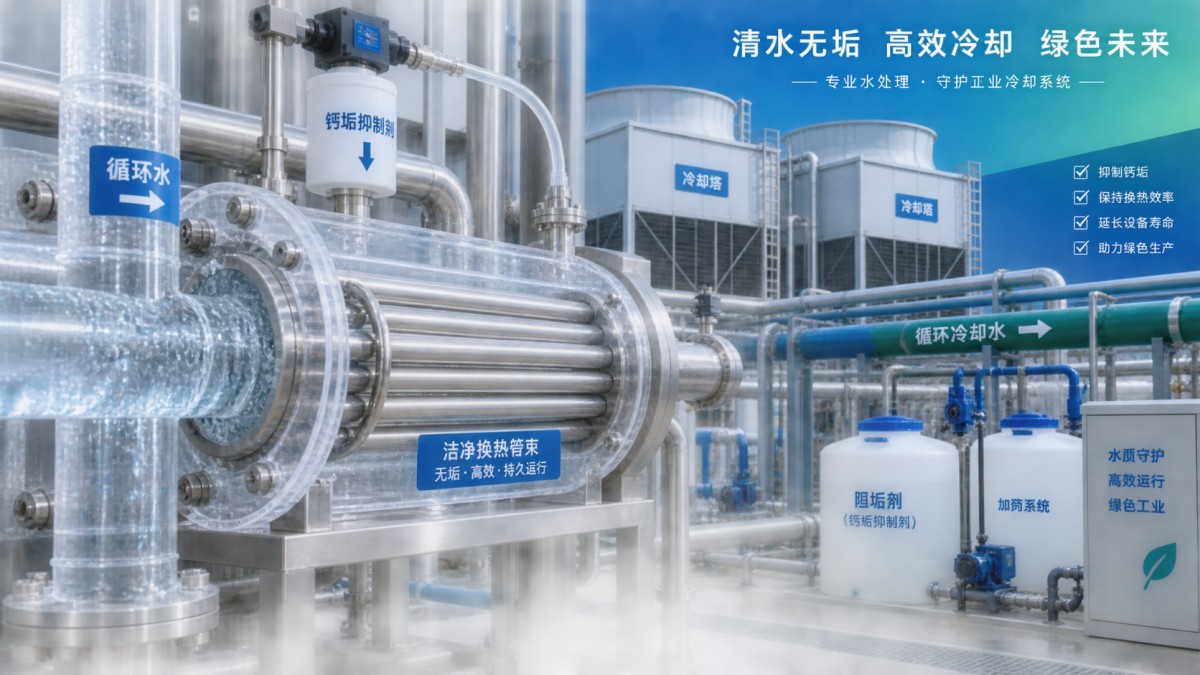
Compatibility data often decides whether a promising inhibitor can be approved
Scale control cannot be reviewed in isolation from corrosion control and microbiological treatment. A calcium scale inhibitor may be combined with zinc salts, molybdate, polymers, dispersants, azoles, oxidizing biocides, non-oxidizing biocides, and pH-adjustment chemicals. The approval review should identify known interaction risks and verify the proposed mixing sequence and feed points.
For example, a treatment may prevent calcium carbonate deposition but become less effective when exposed to a strong oxidant, or form insoluble material when concentrated chemicals contact each other at the injection point. Compatibility testing should therefore examine the actual stock solution and dilution conditions, not only separately stable ingredients. Visual observations such as haze, sediment, phase separation, or viscosity change are useful early warnings, but chemical assay and performance retention are more reliable indicators when available.
Corrosion evidence also matters. Some calcium-control programmes permit higher cycles by holding minerals in solution, but higher cycles can increase chloride, sulfate, dissolved solids, and microbiological risk. The inhibitor should be considered within the corrosion-control limits of the metallurgy, water chemistry, and operating practice. Coupon testing, corrosion probe trends, and inspection history may be used as operational evidence, provided the conditions and treatment programme are documented.
Quality managers should also distinguish between a raw material’s stability and the stability of the finished formulation. A material can be stable under ordinary storage while the blended programme becomes sensitive to low temperature, long storage, contamination, or high electrolyte content. Batch retention samples, shelf-life criteria, and re-test procedures should be part of the approval record where the product will be stored or blended on site.
Safety and environmental documentation must match the intended use
Safety approval begins with a current safety data sheet, but the review should go beyond reading the hazard classification. The receiving site needs instructions consistent with the delivered concentration and packaging: required personal protective equipment, spill containment, incompatible materials, first-aid arrangements, storage temperature limits, and measures for transfer or dilution. Acidic phosphonate products, for instance, can require controls for splash exposure and for contact with incompatible alkaline materials during handling.
Product identification and batch traceability are equally important. The certificate of analysis should link each delivered batch to agreed acceptance limits, including active component concentration and relevant impurities. For a calcium scale inhibitor, an unexplained shift in active content or impurity profile can change formulation dosage, phosphorus loading, stability, or compatibility with other treatment chemicals.
Environmental review should focus on the actual discharge route. Cooling tower blowdown may enter an onsite wastewater treatment system, a municipal connection, or a permitted discharge route with specific limits. The treatment team should assess whether the inhibitor adds phosphorus or other constituents that affect discharge controls, treatment performance, sludge generation, or monitoring obligations. A chemical being effective at low dose does not remove the need to account for its contribution at the selected concentration cycles and blowdown rate.
What an approval package should allow the site to decide
The final approval record should make three decisions possible: whether the product meets incoming specification, whether it performs within the intended cooling-water envelope, and what operating controls are required to keep it within that envelope. It should not merely collect brochures, generic laboratory claims, and a safety data sheet.
- A defined product specification with active content, critical impurities, physical properties, test methods, and certificate-of-analysis requirements.
- Scale performance data tied to calcium hardness, alkalinity, pH, temperature, concentration cycles, dosage, test duration, and a clear untreated comparison.
- Compatibility evidence for the planned corrosion inhibitors, dispersants, biocides, pH-control chemicals, and feed-point arrangement.
- Storage, handling, spill-response, and waste or blowdown controls appropriate to the delivered material and site procedures.
- An operating plan covering dosage control, routine water analysis, scale indicators, corrosion monitoring, inspection triggers, and corrective action when water chemistry moves outside limits.
Approval is strongest when the evidence defines both capability and boundaries. A calcium scale inhibitor does not need to be proven effective under every possible condition; it needs to be shown to work reliably within the conditions the cooling system is expected to operate, with clear controls for the conditions where its performance margin may be reduced.

ONLINE CONSULTATION
If you have any questions, please contact us and we will contact you as soon as possible.