


How to diagnose calcium scaling after an inhibitor dosage change
A calcium deposit that appears shortly after an inhibitor dosage change should be treated as a process-control deviation, not immediate proof that the chemical has failed. The first question is whether the change reduced the active inhibitor reaching the water, altered its feed consistency, or coincided with a shift in calcium, alkalinity, pH, temperature, concentration cycles, or membrane recovery. In cooling loops, boilers, RO systems, and transfer pipelines, even a short period of inadequate protection can create nucleation sites that continue to grow after the feed rate is restored.
The practical response is to freeze further nonessential changes, verify the actual delivered dose, compare water data from before and after the adjustment, and identify the scale composition before choosing a correction. Raising the feed rate without this sequence can increase chemical consumption while missing a pump fault, a dilution error, incompatible treatment chemistry, or an operating-condition change.
Start by confirming that the deposit is calcium scale
White, off-white, or hard deposits are often assumed to be calcium carbonate, but field appearance alone is not enough. Calcium sulfate, calcium phosphate, silica-containing deposits, corrosion products, and biological material mixed with mineral solids can look similar. The deposit location provides useful clues: hard deposits on hot heat-transfer surfaces often indicate temperature-driven precipitation; scaling at RO concentrate outlets may point to elevated recovery or poor antiscalant control; deposits around chemical injection points can suggest localized incompatibility or poor mixing.
Collect a representative sample before cleaning wherever possible. A laboratory deposit analysis can distinguish carbonate, sulfate, phosphate, iron, silica, and mixed deposits. This matters because a calcium scale inhibitor may be correctly selected for one scale tendency but insufficient for another condition. For example, a high calcium and high alkalinity system may behave differently from a calcium sulfate-limited system, even when total hardness appears unchanged.
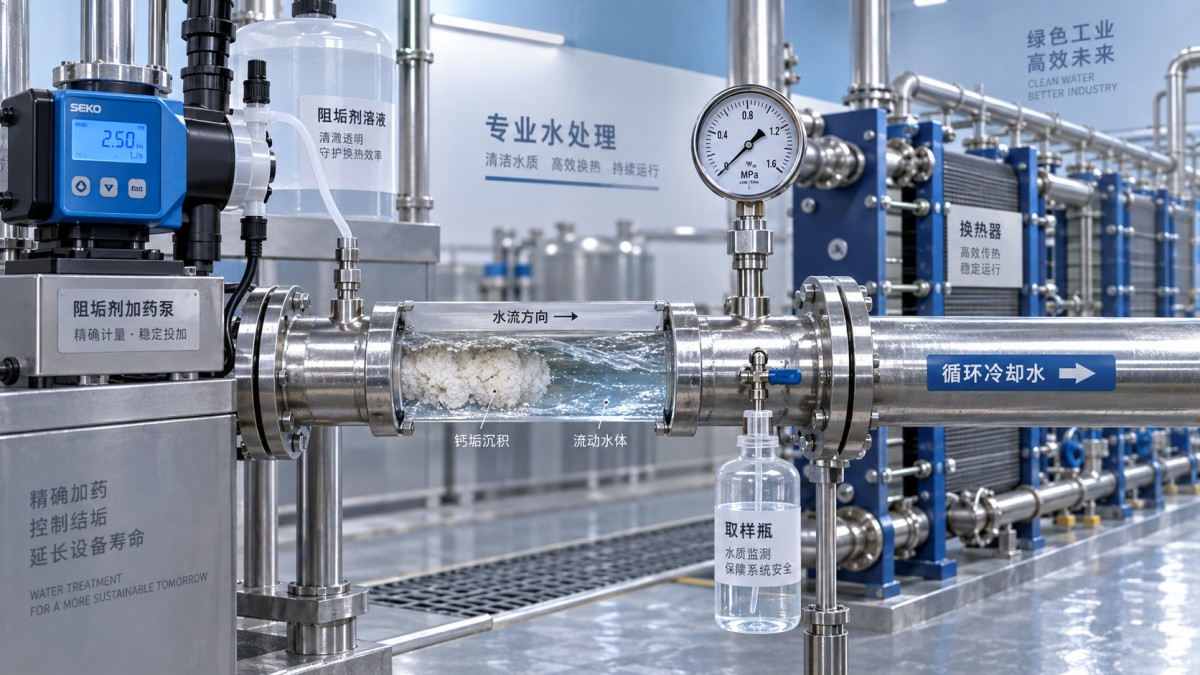
Reconstruct the dosage change instead of relying on the setpoint
The controller setpoint, pump stroke, and nominal product dose are not the same as the active dose delivered into the system. Begin with the exact date and time of the dosage change, then compare it against operating logs, water analyses, make-up water volumes, blowdown records, RO recovery, and cleaning observations. The goal is to determine whether scaling started after a real reduction in active chemistry or merely after an unrelated process shift.
Review the following points in sequence:
- Product identity: Confirm that the product drum, bulk tank, and dosing line contained the intended formulation. A product substitution, an incorrect transfer, or residual material in a tank may change treatment performance.
- Concentration after dilution: Check whether the inhibitor was diluted more than planned, prepared with unsuitable water, or mixed at an incorrect ratio. A feed pump can run normally while delivering a weak solution.
- Actual pump output: Perform a timed calibration using the installed pump and normal suction/discharge conditions. Pump stroke alone does not confirm output where viscosity, backpressure, check-valve condition, air ingress, or suction restrictions have changed.
- Injection location and mixing: Verify that the chemical enters a flowing stream with adequate turbulence. Feeding into a stagnant branch, a poorly mixed tank, or downstream of a critical separation point can leave part of the system unprotected.
- Feed interruptions: Inspect level alarms, suction strainers, injection quills, tubing, check valves, and automation records. Short interruptions may be enough to initiate deposition in high-saturation conditions.
A useful calculation is to convert all records to active chemical mass per unit of make-up water or treated-water volume. This avoids comparing an old product dose with a new dose expressed in a different concentration basis. When a calcium scale inhibitor dosage has changed, the relevant comparison is the active phosphonate or polymer contribution at the point of treatment, not only litres per hour.
Compare the water chemistry on both sides of the change
Scaling is driven by supersaturation, so the inhibitor dose must be interpreted alongside the water chemistry and operating conditions it is expected to control. Use samples taken as close as possible to the problem period. A single current sample may not represent the conditions that caused an older deposit.
In RO service, also compare feed conductivity, recovery, concentrate flow, differential pressure, reject quality, and upstream pretreatment performance. Scaling after an inhibitor adjustment may actually begin with increased recovery, lower concentrate flow, antiscalant underfeed, or a softener upset. In boiler-related service, review hardness leakage, phosphate control where applicable, condensate contamination, feedwater temperature, and any variation in blowdown practice.
Separate underdosing from incompatibility and poor control
Underdosing is likely when the active feed rate dropped, pump calibration is low, chemical feed was interrupted, or water chemistry remained stable while scale appeared shortly afterward. However, simply increasing the dose is not the correct answer when the system has changed outside its original operating window.
Compatibility should be investigated when deposits are concentrated near injection points, when cloudiness develops after blending treatment products, or when a new coagulant, biocide, alkali, corrosion inhibitor, or cleaning chemical was introduced. Certain combinations can form insoluble materials, reduce dispersant performance, or create localized high-pH conditions. Jar testing or controlled compatibility testing is more reliable than judging compatibility from product appearance in a storage container.
Another frequent issue is treating scale control as a single-chemical problem. A calcium scale inhibitor can delay crystal growth and disperse forming solids, but it cannot compensate indefinitely for severe hardness leakage, excessive cycles, uncontrolled pH, or insufficient mixing. Once deposits have formed, restoring the correct treatment program may stop further growth but will not necessarily remove existing scale. Cleaning decisions should be based on deposit analysis, equipment metallurgy, membrane or heat-exchanger limitations, and the cleaning procedure already approved for the system.
Check whether the selected inhibitor still fits the condition
The treatment program should be reassessed when raw water, concentration ratio, pH, or equipment duty changes materially. Phosphonate-based chemistries are often considered where calcium control is needed under demanding water conditions, but selection still depends on the full formulation and operating limits. For high-alkalinity or higher-pH applications, one option used in boiler water treatment and RO membrane scale control is Potassium Salt of HexaMethyleneDiamineTetra (MethylenePhosphonic Acid) (HDTMPA·K6). Its high solubility can be relevant where concentrated treatment solutions or alkaline conditions make handling and feed stability important.
That does not mean a single ingredient should be substituted without evaluating the program. Confirm the active-content basis, expected calcium salt challenge, total phosphorus limits within the operating program, compatibility with other additives, and the required feed point. Where a formulation is changed, retain representative samples and document the conversion calculation so that future investigations can distinguish chemistry selection from a dosing error.
Use the deposit pattern to guide immediate action
When scale is still light and recent, stabilize the feed, correct the cause of supersaturation, and increase monitoring frequency before deciding whether cleaning is necessary. Watch for rising exchanger approach temperature, reduced flow, increased pressure drop, RO differential-pressure changes, declining permeate flow, or abnormal pump power. These indicators often reveal operational impact before deposits become visually obvious.
Where deposits are hard, widespread, or associated with loss of heat transfer or restricted flow, isolate the affected equipment according to site procedures and assess cleaning compatibility. Avoid aggressive acid cleaning based only on the assumption of calcium carbonate. Mixed calcium, iron, silica, or phosphate deposits can respond differently, and an unsuitable cleaner may damage membranes, seals, coatings, or metal surfaces.
To prevent recurrence, maintain a change record that links inhibitor batch, active concentration, feed calibration, water analyses, operating conditions, and observed deposition. This record gives the next investigation a usable baseline and makes it easier to determine whether the issue came from dosage, chemistry, equipment operation, or incoming-water variability.

ONLINE CONSULTATION
If you have any questions, please contact us and we will contact you as soon as possible.