


Selecting geothermal water scale inhibitor for carbonate-rich brines
Selecting a geothermal water scale inhibitor for carbonate-rich brines requires more than comparing standard dosage rates. High temperature, elevated alkalinity, calcium and magnesium concentrations, dissolved gases, and changing pressure conditions can accelerate deposition and compromise heat-transfer efficiency. In a geothermal loop, scale is rarely just a housekeeping issue: a thin mineral layer can restrict flow, reduce reinjection capacity, increase pumping demand, and turn planned maintenance into an unplanned outage.
For technical evaluators, the key question is not simply “Which inhibitor prevents calcium carbonate?” It is: Which chemistry remains effective in this specific brine, at this temperature profile, under this pressure path, without creating downstream compatibility problems? The answer comes from a structured selection process that begins with water chemistry and ends with field verification.
Why carbonate-rich geothermal brines are difficult to control
Many geothermal waters carry calcium, bicarbonate, magnesium, silica, iron, and trace metals in a relatively stable underground equilibrium. Once the fluid rises, flashes, cools, degasses, or encounters a pressure drop, that equilibrium changes quickly. Carbon dioxide may be released, pH may rise, and calcium carbonate can become supersaturated. The resulting deposition often appears at separators, heat exchangers, valves, production tubing, flash vessels, and reinjection equipment.
Carbonate scale is not always pure calcite. Depending on the source water and process route, deposits may include aragonite, magnesium-containing carbonate, iron oxides, silica, sulfates, or organic debris. An inhibitor selected only against a clean laboratory calcium carbonate system may therefore underperform in the field.
The most reliable selection work treats scaling as a dynamic process. It considers where supersaturation occurs, how long the brine remains at each condition, and whether suspended solids or corrosion products are available as crystal-growth sites.
Start with the brine profile, not the product list
A representative water analysis is the starting point for geothermal inhibitor selection. For a meaningful assessment, testing should include total hardness, calcium, magnesium, alkalinity, bicarbonate, chloride, sulfate, silica, iron, manganese, pH, conductivity, total dissolved solids, and temperature. Where relevant, dissolved carbon dioxide and hydrogen sulfide should also be reviewed because gas release can materially change carbonate precipitation behavior.
One sample is often not enough. Geothermal systems can vary with well production rate, seasonal cooling demand, reinjection blending, and operating changes. Collecting samples from both production and reinjection sides, and reviewing historical cleaning records, can reveal whether the main issue is carbonate scaling, mixed mineral fouling, iron deposition, or a combination of all three.
- High calcium and alkalinity: usually indicate strong calcium carbonate scaling potential after pressure or temperature changes.
- Elevated magnesium: may alter crystal morphology and increase the complexity of deposit control.
- Iron in the system: can form particulate deposits and provide surfaces for mineral attachment.
- Silica or sulfate presence: may require a broader dispersancy strategy than a carbonate-focused treatment alone.
- Large temperature and pressure shifts: make static saturation calculations less representative of actual risk.
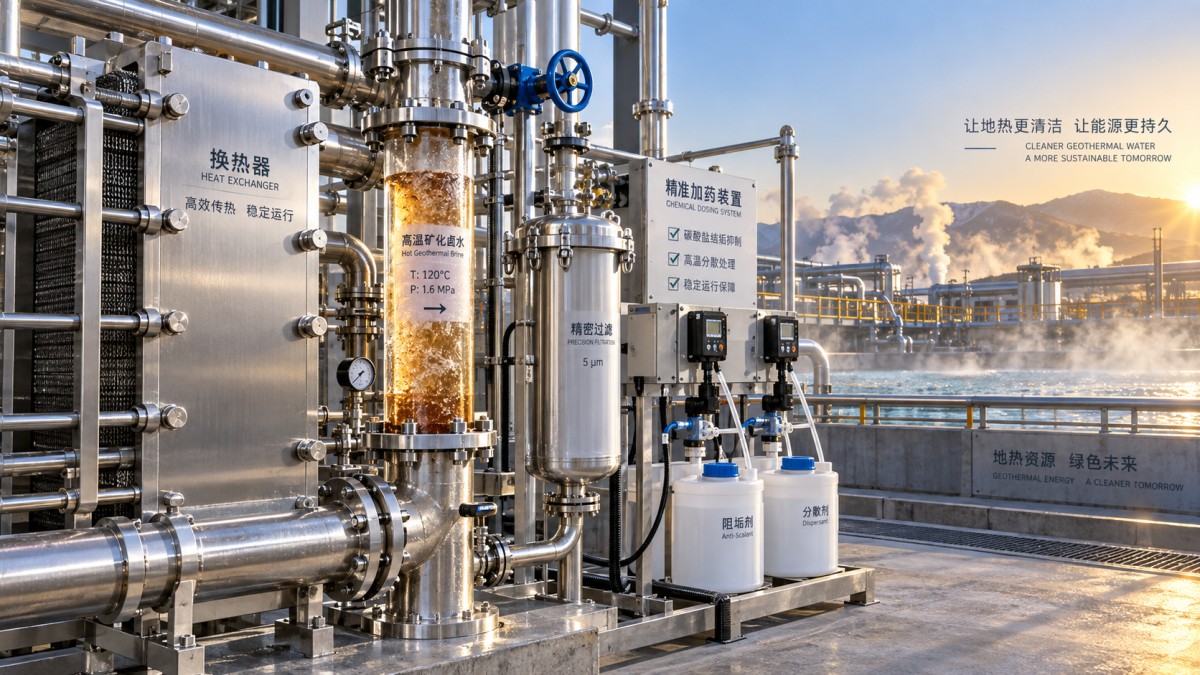
Four technical criteria that should drive selection
1. Inhibition mechanism under expected saturation conditions
A suitable geothermal water scale inhibitor should interfere with crystal nucleation and crystal growth at practical treatment concentrations. For carbonate-rich brines, threshold inhibition is important, but it is not the whole story. The chosen chemistry should also keep fine precipitates dispersed long enough to avoid rapid attachment to heat-transfer surfaces or narrow flow passages.
Ask suppliers how performance was evaluated: Was the chemistry tested in synthetic water, actual brine, or both? Were tests conducted at the anticipated calcium level, alkalinity, residence time, and temperature? A product that performs well in moderate-hardness cooling water may need additional validation before being applied at geothermal salinity and thermal severity.
2. Thermal and hydrolytic stability
Geothermal applications can expose treatment chemicals to temperatures that are substantially higher than conventional cooling-water conditions. Some polymer structures gradually lose activity through thermal degradation or hydrolysis, especially where residence time is long. The concern is not only whether the active chemistry survives at the maximum wellhead temperature, but whether it remains functional across the complete operating route: production, separation, heat exchange, flash conditions, and reinjection.
Thermal stability should be assessed with the actual brine whenever possible. A product’s active content alone does not predict its endurance in a hot, saline environment. Technical evaluators should request temperature-specific stability data and clarify whether the dosing location avoids the most damaging exposure window.
3. Dispersancy for iron and mixed deposits
Carbonate scale frequently coexists with corrosion products. Dry iron oxide and hydrated iron oxide can accumulate in systems with oxygen ingress, mixed-metal equipment, or intermittent operation. These solids can create rough surfaces that make scale attachment easier. In such cases, a treatment program needs more than crystal-growth control; it needs particle management.
Carboxylate-sulfonate polymer chemistries are often considered where broad mineral dispersancy is needed. For example, Carboxylate-Sulfonate-Nonion Terpolymer PR-3100 is designed as a scale inhibitor and dispersant, with inhibitory performance for both dry and hydrated iron oxide. Its role is most relevant when the geothermal system or associated cooling loop has a mixed fouling profile rather than a simple, clean carbonate deposit.
4. Compatibility with the full treatment program
Inhibitor chemistry should not be assessed in isolation. Consider compatibility with corrosion inhibitors, pH-control chemicals, biocides where applicable, antifoams, filtration aids, and any reinjection-water treatment chemicals. In particular, phosphate, phosphonate, zinc, and iron-containing programs can form complex interactions under changing pH and temperature conditions.
A polymeric dispersant may help stabilize certain corrosion-inhibitor programs, but compatibility needs to be confirmed through jar testing, heated recirculation testing, or pilot work. Visual precipitation, haze, viscosity change, loss of active performance, and increased membrane or filter loading are all practical warning signs.
Do not rely on a single saturation index
Indices such as Langelier Saturation Index or Stiff-Davis calculations are useful screening tools, especially for carbonate tendency. However, they should not be treated as final selection evidence for a geothermal water scale inhibitor. Their assumptions may not capture rapid carbon dioxide flashing, local temperature gradients, non-ideal ionic behavior at high salinity, or deposition caused by suspended solids.
Use saturation modeling to identify risk windows and compare scenarios, then confirm the decision with application-relevant testing. A sensible evaluation sequence is:
- Analyze source brine and identify probable scale species.
- Map temperature, pressure, pH, and gas-release changes through the system.
- Screen candidate chemistries in actual or closely simulated brine.
- Test at multiple concentrations rather than seeking one theoretical “perfect” dose.
- Examine deposit mass, particle dispersancy, filtration behavior, and residual inhibitor where analytical methods are available.
- Run a controlled field trial with baseline operating data and clear success criteria.
Choosing the dosing point can matter as much as choosing the chemistry
Even a well-matched inhibitor can fail when introduced too late. Dosing should generally occur before the brine enters the pressure, temperature, or degassing zone where supersaturation begins to rise. Yet earlier injection is not automatically better if the chemical will face excessive high-temperature exposure before reaching the scale-prone equipment.
The best location is usually determined by balancing three factors: adequate mixing, sufficient contact before precipitation begins, and acceptable chemical stability. Injection quills, mixing energy, line velocity, and dead-leg conditions deserve attention during design. Poor mixing can produce local overdosing while leaving critical equipment underprotected.
For systems involving pressurized equipment and iron, zinc, or phosphate-containing water programs, formulations with both scale-control and dispersant properties may be worth screening. PR-3100 is supplied as a colorless to light-yellow transparent liquid with 42.0–44.0% solids, and is available in 25 kg, 250 kg, and 1250 kg IBC packaging. These handling details can support pilot planning, but they should not substitute for brine-specific performance testing.
What a credible field trial should measure
A field trial should be designed to reduce uncertainty, not merely demonstrate that chemical has been fed. Before dosing begins, record heat-exchanger approach temperature, differential pressure, pumping energy, filter loading, cleaning frequency, production rate, and representative deposit characteristics. During the trial, monitor actual chemical feed, residual treatment level where possible, water chemistry shifts, and changes in operating indicators.
Inspection evidence is especially valuable. Compare coupon surfaces, removable spool pieces, strainers, filters, and cleaned equipment deposits against the baseline. If deposits remain, analyze their composition rather than assuming insufficient dosage. A persistent silica-rich or iron-rich deposit may call for a different treatment balance than a higher dose of a carbonate-focused inhibitor.
A practical decision standard for technical evaluators
The preferred inhibitor is not necessarily the product with the lowest apparent dose in a short test. It is the option that provides stable scale control within the real operating envelope, remains compatible with the treatment program, is practical to inject and monitor, and reduces total operating risk over time.
When reviewing suppliers, request clear product specifications, active-content consistency, recommended storage conditions, safety documentation, testing support, and an explanation of the chemistry’s expected role in your brine. A capable water-treatment materials supplier should be prepared to support laboratory screening, customized formulation discussion, and application guidance rather than offering a universal answer.
For carbonate-rich geothermal brines, that disciplined approach is usually the difference between buying an inhibitor and selecting a workable scale-control strategy.

ONLINE CONSULTATION
If you have any questions, please contact us and we will contact you as soon as possible.