


Selecting a Polyether Modified Silicone Defoamer for High-Shear Mixing
A polyether modified silicone defoamer should be selected for the foam control it retains after sustained high-shear exposure, not simply for how quickly it collapses fresh foam. A candidate that clears a beaker in seconds can still fail during recirculation if mixing changes its dispersion, the formulation alters its interfacial behavior, or the active material is depleted before the batch is complete.
The strongest candidate is therefore not necessarily the most dispersible or the most concentrated product. It is the grade that balances rapid foam knockdown, sustained suppression, and acceptable compatibility throughout the actual mixing, storage, and use conditions. Those requirements must be tested separately before they can be judged together.
High shear changes the selection problem
High-shear equipment can entrain air while breaking larger bubbles into smaller ones. Surfactants, dispersants, suspended solids, and other formulation components can then stabilize the newly created interfaces. The result may include both visible surface foam and dispersed microbubbles that do not disappear when the foam head collapses.
Mixing also acts on the defoamer. Depending on the grade, shear can alter droplet size, emulsifier distribution, and the accessibility of active components to foam films. Better initial distribution may improve performance, but excessive emulsification can reduce the effectiveness of some formulations. Loss of foam control after mixing should not automatically be interpreted as chemical degradation of the silicone.
Polyether modification adjusts the balance between silicone character and affinity for the aqueous phase. Too little compatibility can cause separation or localized oily deposits; excessive compatibility can leave insufficient interfacial activity for effective foam rupture. Selection is about finding the right balance in the process liquid, rather than maximizing water solubility.
Establish what the supplied grade actually contains
“Polyether modified silicone defoamer” describes a product family, not a standardized composition. Commercial grades may contain different silicone-polyether structures, carriers, emulsifiers, and hydrophobic solids. An aqueous emulsion and a concentrated, self-dispersing formulation can require different handling even when their labels use the same broad chemistry description.
Before screening, request the following information:
- Product form, carrier type, and declared active content, including how “active” is defined.
- Whether dilution is permitted, which dilution water is suitable, and how long a diluted preparation can be held.
- Recommended addition point, mixing conditions, and dosage range for the intended application.
- Evidence supporting pH, temperature, and shear-resistance claims, including the test medium and exposure time.
- Any application restrictions related to silicone carryover or downstream treatment.
Nonvolatile content is not necessarily equivalent to defoaming-active content. Comparing products only by solids percentage can therefore distort both technical and cost evaluations. Record dosage on an as-supplied basis, and use an active-content comparison only where the suppliers’ definitions are sufficiently comparable.
Test the complete chemical environment
Water-only foam tests are useful for checking handling and basic dispersibility, but they cannot qualify a defoamer for a formulated water treatment product. Electrolytes, polymers, surfactants, suspended matter, and incidental oil can change both foam stability and defoamer distribution.
For example, a formulation containing Carboxylate-Sulfonate-Acrylate Terpolymer (AA/AMPS/HPA) should be tested with that scale-inhibiting dispersant at its intended concentration, alongside the actual phosphonates, zinc salts, or other ingredients used. Compatibility between the dispersant and those treatment chemicals does not establish compatibility with a particular defoamer. The concentrate and its working dilution are separate test environments.
Use process-representative hardness, conductivity, pH, and solids loading. Where water quality varies materially, include the relevant operating extremes rather than qualifying the product in deionized water alone. Also reproduce the order of addition: exposure to a concentrated acidic ingredient before neutralization is not equivalent to addition into the finished blend.
Temperature deserves particular attention. Some polyether-containing systems exhibit temperature-dependent hydration and clouding behavior, which dissolved salts can shift. A cloud point measured in water is therefore not a universal operating limit for the finished formulation. Evaluate foam control and physical stability at the actual mixing temperature and through any subsequent cooling cycle.
Separate immediate performance from shear endurance
A useful test sequence distinguishes three questions: can the product remove existing foam, can it prevent further foam generation, and does it retain those abilities after process exposure? One short shake test cannot answer all three.
Include an untreated blank and, where available, the incumbent product. Keep vessel geometry, liquid volume, temperature, dosing sequence, and air introduction consistent. Repeat measurements sufficiently to distinguish real differences from test variability.
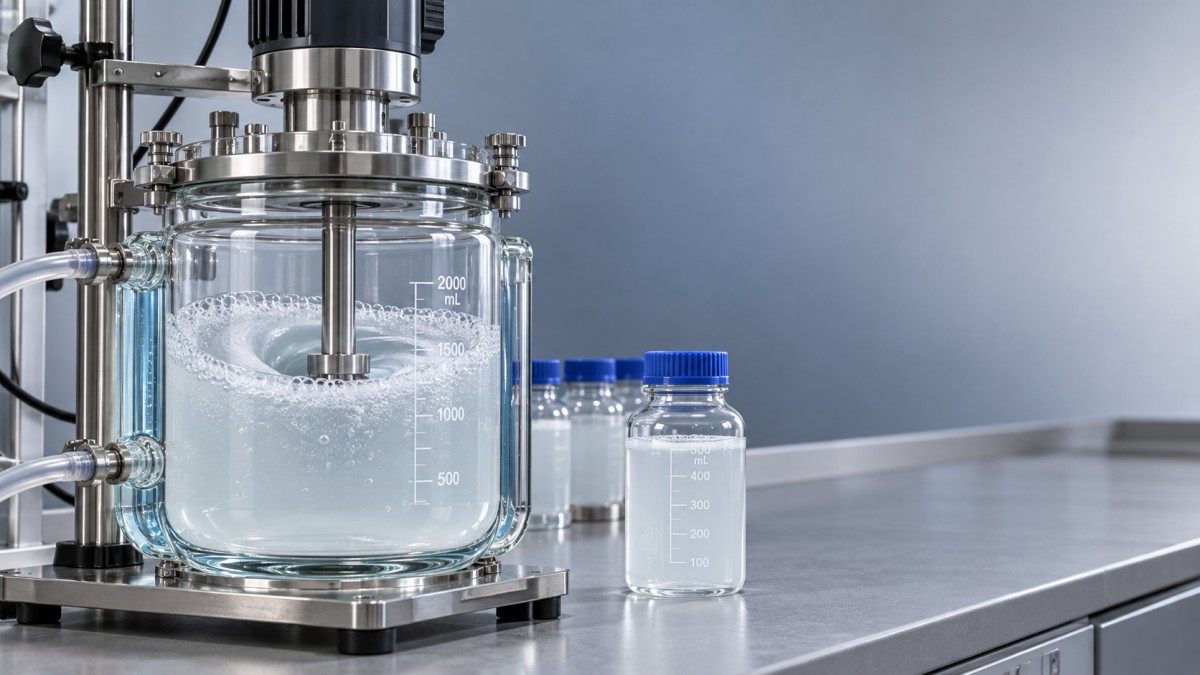
Laboratory rpm alone is not a reliable scale-up criterion. Impeller diameter, rotor-stator gap, power input, circulation rate, and exposure time affect the stress imposed on the liquid. Tip speed and power per unit volume can help characterize a test, but neither independently reproduces every production mixer. Record the equipment configuration and confirm shortlisted candidates in a representative pilot or controlled plant trial.
Where practical, compare fresh and shear-aged defoamer-containing liquid under the same subsequent foam challenge. This helps distinguish declining additive performance from a change in how the mixer generates foam. Control temperature during conditioning so that shear and heating effects are not unintentionally combined.
Measure more than foam height
Foam height is useful, but a low foam head does not prove adequate air release. Fine entrained bubbles can remain in the liquid and interfere with density measurement, filling, pumping, or downstream operations.
Record the maximum foam level, time to reach a defined foam limit, collapse time after stopping agitation, and recovery after restarting. Where entrained air matters, add a repeatable air-content measurement or compare apparent density against a suitably deaerated reference at the same temperature. Photographs taken at fixed intervals help document differences, but should supplement rather than replace quantitative endpoints.
Test several doses across a practical range. A candidate that works only at a narrowly defined dosage may be difficult to control when feed composition changes. Conversely, increasing dosage after performance has plateaued can add residue or compatibility problems without providing useful additional suppression.
Make compatibility a pass–fail requirement
A defoamer can perform well during mixing yet destabilize the product afterward. Examine freshly prepared samples and samples aged under relevant storage conditions for oiling, creaming, sediment, viscosity changes, or nonuniform appearance. Where uniform appearance is required, distinguish acceptable haze from progressive separation.
Check the intended dilution separately. A stable concentrate may release poorly dispersed silicone when diluted, while a satisfactory working solution may originate from an unstable concentrate. Premixes also require their own hold-time assessment; do not assume that a diluted defoamer can be stored as long as the supplied product.
Downstream compatibility can override otherwise strong foam results. If the treated liquid contacts membranes, coatings, filters, or sensitive surfaces, establish the applicable restrictions and test at the expected carryover level. Neither the silicone chemistry label nor apparent clarity demonstrates suitability for those operations.
Select against an operating window, not a single result
Set acceptance limits before ranking candidates: allowable foam level, required suppression duration, entrained-air tolerance, storage stability, and downstream compatibility. Reject products that fail a critical limit rather than allowing excellent knockdown to compensate for unacceptable separation or carryover.
For the remaining candidates, compare the delivered cost of maintaining control over the full operating cycle, including repeat dosing. Confirm performance using more than one production lot before fixing the specification. The defensible selection is the grade with a reproducible dose range and retained activity across realistic process variation—not the one that produces the most dramatic result in a fresh, short-duration test.

ONLINE CONSULTATION
If you have any questions, please contact us and we will contact you as soon as possible.