


How Polyether Modified Silicone Defoamers Control Foam in Aqueous Systems
Foam can look like a minor surface problem until it reaches an overflow point, interferes with level readings, or carries suspended solids into downstream equipment. In industrial wastewater and circulating water systems, persistent foam often reflects a combination of surfactants, dissolved organics, aeration, and mechanical mixing—not simply too much air.
A polyether modified silicone defoamer combines silicone’s low surface tension with polyether groups that adjust its interaction with water. Properly balanced, this chemistry can destabilize existing foam and limit further buildup. Its effectiveness, however, depends on a delicate requirement: the defoamer must disperse enough to reach foam films without becoming so compatible that it loses its foam-breaking action.
Why foam survives in an aqueous system
A clean water bubble usually breaks quickly. Industrial process water behaves differently because surfactants, proteins, polymers, and some fine particles can stabilize the thin liquid film surrounding a bubble. These materials slow liquid drainage or help the film resist local thinning and disturbance.
Continuous aeration, pump suction leaks, falling water, and agitation supply fresh bubbles. When bubble generation exceeds the rate of collapse, a foam layer accumulates. That explains why reducing visible foam alone may not solve the underlying problem: the system is still producing bubbles and replenishing their protective films.
Foam control therefore has two related objectives:
- Defoaming: breaking foam that has already formed.
- Antifoaming: reducing the formation or persistence of new foam during operation.
A formulation may perform well at one objective but less well at the other. Rapid knockdown in a beaker does not automatically mean reliable suppression throughout an operating shift.
What polyether modification changes
Silicone-based foam-control materials commonly use a polysiloxane backbone, often based on polydimethylsiloxane. This backbone provides low surface tension and a flexible molecular structure. Polyether segments, typically containing ethylene oxide and/or propylene oxide units, modify water affinity and interfacial behavior.
The relative amounts and arrangement of these segments matter. Ethylene oxide generally increases hydrophilic character, while propylene oxide is comparatively less hydrophilic. Backbone length, graft density, and molecular architecture also affect dispersibility, compatibility, and temperature response. Two products carrying the same broad chemical description can therefore behave quite differently in the same wastewater.
Importantly, polyether-modified silicone is not the same as a silicone-free polyether defoaming agent. The former contains a silicone structure modified with polyether groups; the latter relies on polyether chemistry without that silicone backbone. Product names alone are not enough to establish composition.
How a polyether modified silicone defoamer breaks foam
The working mechanism is best understood as an interfacial process rather than a chemical reaction that consumes the foam.
- Distribution through the liquid. The active material travels through the aqueous phase as dispersed droplets or other formulation-dependent structures. Mixing helps distribute it, although excessive shear can change droplet size and performance.
- Contact with the foam film. Active material reaches the liquid–air interface. Whether it can enter the film depends on the balance of interfacial tensions and the barriers created by the surrounding surfactants.
- Local destabilization. When conditions favor entry, the active material can spread, disturb the stabilizing layer, or form an unstable bridge across a thin film. These effects promote local thinning and rupture.
- Bubble collapse and continued suppression. Ruptured films allow bubbles to merge or release gas. Active material remaining available in the system can act on newly forming foam.
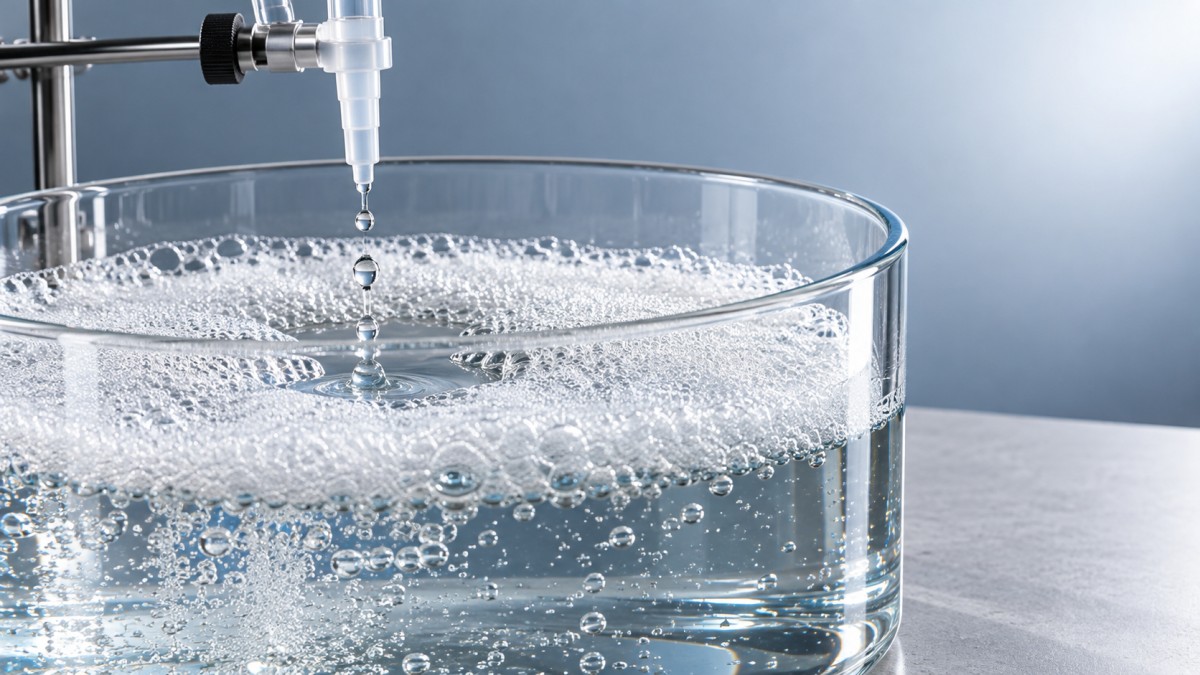
Not every formulation follows exactly the same pathway. Some silicone defoamers contain hydrophobic particles that contribute to film rupture; others do not. It is therefore more accurate to describe foam control through film entry, destabilization, and rupture than through a universal claim about breaking an electrical double layer.
Why performance changes with operating conditions
A product that works in cool process water may behave differently in hot, saline wastewater. The following variables deserve attention before changing the dose.
High chemical oxygen demand, or COD, is useful background information, but it does not identify the foam stabilizer. Two wastewater streams with similar COD may require different foam-control chemistry because their surfactants, oils, proteins, and solids differ.
Choosing chemistry without confusing product categories
Polyether-modified silicone is one option, not a universal default. Silicone-free polyether formulations may also warrant screening where process compatibility or downstream requirements guide selection.
For example, Prio New Materials offers a polyether-polyol-based Polyether defoamer for evaluation in applications including landfill leachate, papermaking white water, power plant desulfurization wastewater, and biochemical wastewater. Its listed properties include a colorless to pale yellow transparent appearance, solids content of at least 99%, and viscosity of 150–500 mPa·s at 25°C. These are useful handling and comparison details, but they do not establish equivalence to a silicone-modified formulation.
Likewise, a listed product pH of 6.0–8.5 should not be interpreted as its full application pH range. Compatibility in acidic or alkaline process water needs confirmation under the intended conditions.
A practical test should measure more than disappearing foam
Start with fresh, representative water and reproduce the operating temperature, aeration, and mixing as closely as practical. Compare an untreated control with several measured additions, using supplier guidance as a starting point. Record both the commercial product dose and, where known, its active content.
Observe the initial collapse, residual foam height, and the time taken for foam to return under continued aeration. Repeat with samples collected during changing production loads. This reveals whether apparent success depends on an unusually easy water sample.
Dosing location also matters. Addition upstream of foam generation may support suppression, while direct application near accumulated foam may favor immediate knockdown. Dilution should follow supplier instructions: some concentrates tolerate it, while others lose stability or require freshly prepared dilutions.
Finally, check consequences beyond the foam layer. In biological treatment, assess effects on oxygen transfer and biomass performance. Before membrane processes, confirm membrane compatibility and potential deposition risks. In reuse systems, look for oil-like residues, turbidity changes, or interference with subsequent treatment.
The best foam-control choice is not necessarily the fastest visible breaker. It is the chemistry and dosing strategy that maintain acceptable foam levels without compromising the rest of the water-treatment process. Understanding that balance makes a polyether modified silicone defoamer easier to evaluate—and helps distinguish a promising laboratory result from dependable operation.

ONLINE CONSULTATION
If you have any questions, please contact us and we will contact you as soon as possible.