


How tolerant is MA-AA.Na to high chloride in desalination pretreatment?
MA-AA.Na can remain a useful dispersant in chloride-rich desalination pretreatment, but high chloride alone should not be treated as a pass/fail specification. Chloride is generally not the ion that directly consumes or precipitates a polycarboxylate dispersant. Its importance is indirect: it signals high ionic strength, accompanies elevated calcium and magnesium in many feeds, changes the concentration profile across pretreatment equipment, and may expose weaknesses in the overall chemical program.
For a technical evaluator, the practical question is therefore narrower: can the selected MA-AA.Na grade maintain dispersion and scale-control performance at the expected salinity, hardness, pH, temperature, solids loading, and residence time before the RO membranes? A product that appears stable in a chloride-only laboratory solution may still lose useful performance when seawater-derived feedwater contains suspended iron, aluminum carryover, carbonate alkalinity, coagulant residuals, or recycled reject water.
Chloride tolerance is mainly a formulation and water-chemistry question
MA-AA.Na refers to a maleic acid-acrylic acid sodium salt type copolymer used for threshold inhibition and crystal dispersion. Its carboxylate groups interact with hardness ions and nascent scale crystals. In desalination pretreatment, elevated chloride does not normally create an insoluble chloride salt of the polymer in the way that multivalent cations can create adverse interactions. However, a high-chloride feed has a higher ionic background, which can compress electrostatic interactions and alter the way the polymer holds fine particles and scale-forming species in suspension.
This distinction matters because a supplier statement such as “high-salt compatible” can be interpreted too broadly. Chemical solubility in brine is only the first screen. An MA-AA.Na dispersant should also be assessed for its ability to:
- remain homogeneous after dilution into the actual feedwater or prepared dosing solution;
- limit calcium carbonate, calcium sulfate, barium sulfate, and silica-associated deposition risks relevant to the source water and recovery target;
- prevent agglomeration of iron hydroxide, clay, organic particulates, and coagulant-derived flocs that can reach cartridge filters or membranes;
- retain performance after contact with oxidants, biocides, coagulants, antiscalants, and pH-adjustment chemicals used in the same pretreatment train;
- avoid creating unacceptable membrane-fouling, residual-organic, or downstream discharge concerns.
High chloride should consequently be considered a stress condition rather than the sole performance variable. A dispersant may be technically compatible with chloride while still being unsuitable for a high-recovery duty because calcium, sulfate, alkalinity, temperature, and concentration factor push the system beyond its effective control range.
Where chloride-rich feedwater changes the evaluation
In open-intake seawater pretreatment, chloride concentration is usually stable enough that the larger challenge is the combined salt matrix. In brackish-water desalination, chloride can vary more sharply with source blending, seasonal groundwater changes, produced-water influence, or recycle streams. That variability can be more problematic than a consistently high chloride level because dosing is often set against a nominal water analysis while the saturation tendency shifts during operation.
MA-AA.Na performance also needs to be separated by pretreatment location. Upstream of media filtration or ultrafiltration, the dispersant may be expected to manage suspended solids, iron deposits, and mineral particles. Closer to RO, the concern shifts toward membrane compatibility, residual chemistry, and the concentration of rejected salts at the membrane surface. A polymer that helps keep iron oxide dispersed in a dirty upstream water may not be the appropriate primary chemical for final membrane-scale control.
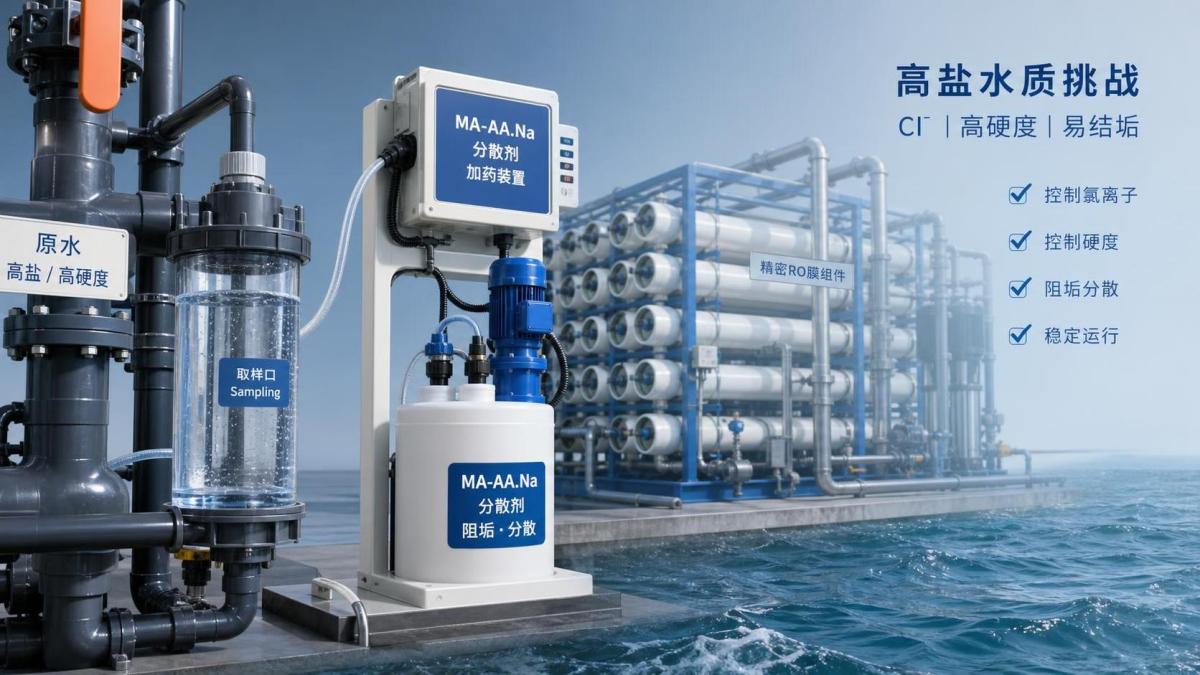
Chloride-rich waters can magnify three operational conditions that are often mistakenly attributed to the dispersant itself:
- Higher hardness loading: seawater and many saline brackish waters bring substantial calcium and magnesium. Calcium tolerance is more informative than chloride tolerance when screening a carboxylate-based dispersant.
- Higher concentration at RO: the bulk feed analysis understates the scale environment at the membrane interface. Recovery, flux, temperature, and crossflow determine the local concentration conditions that matter.
- More severe corrosion control constraints: chloride raises corrosion sensitivity in metallic upstream equipment. The chemical program must not destabilize corrosion products that later become membrane foulants.
What a meaningful qualification test should include
A desk review of product specifications cannot establish MA-AA.Na dispersant tolerance to high chloride in desalination pretreatment. The evaluation should use the intended source water, or a synthetic water that reproduces its relevant ionic composition. Matching chloride without matching calcium, magnesium, sulfate, bicarbonate, silica, iron, pH, and temperature produces an overly optimistic result.
A useful laboratory sequence begins with dilution and compatibility testing. Observe the chemical after introduction into actual feedwater at the proposed dosing concentration and at a reasonable overdose condition. Haze, sediment, viscosity change, or delayed precipitation may reveal incompatibility with coagulant residuals, hardness, or another additive. This test should include the expected dilution-water quality, since poor-quality dilution water can change the active product before it reaches the main line.
The next stage is scale and dispersion testing under representative concentration conditions. The test approach should reflect the risk being managed. For carbonate risk, control pH, alkalinity, calcium, temperature, and concentration factor. For sulfate risk, include the relevant divalent and trace scale-forming ions. For particulate fouling, evaluate turbidity, particle-size changes, filterability, and iron behavior rather than relying only on a mineral scale result.
Bench results are most useful when compared across a dose range, not when reduced to one selected dose. A curve showing performance at underdose, target dose, and modest overdose helps determine whether the program has practical operating margin. This is particularly important where intake salinity fluctuates or where upstream clarification can occasionally carry more solids into the RO feed.
Common assumptions that lead to poor selection
The first is assuming that a sodium salt form automatically guarantees brine compatibility. Sodium counterions can help product handling and solubility, but the polymer’s molecular architecture, molecular weight distribution, charge density, active content, and impurities still affect field performance. Two MA-AA.Na products described by similar chemistry can behave differently in a high-hardness, high-salinity feed.
The second is treating a dispersant as a complete antiscalant program. MA-AA.Na may contribute valuable crystal distortion and particulate dispersion, but desalination applications often require a formulation selected against the dominant mineral risks at the planned recovery. Where sulfate or silica limits control the system, relying on a general dispersant without confirming those limits can transfer the problem from pretreatment equipment to membrane surfaces.
The third is selecting on delivered concentration alone. A higher-solids product can reduce freight and storage volume, yet it does not prove higher active performance per unit dose. Procurement comparisons should normalize dose to active polymer, include dilution requirements, and account for the expected chemical consumption caused by varying water quality.
For duties where high hardness, alkalinity, temperature, and iron oxide dispersion are present upstream of the desalination section, a sulfonate-containing copolymer may merit comparison alongside MA-AA.Na. Acrylic Acid-Sulfonate-Acylamino Copolymers PR-615 is positioned as a scale inhibitor and dispersant with calcium tolerance and compatibility with common water-treatment agents. That does not establish its suitability for every RO feed, but it illustrates why evaluators should compare polymer chemistry against the actual fouling mechanism rather than ask only whether a product tolerates chloride.
How to make the final decision
An MA-AA.Na dispersant is a reasonable candidate when chloride-rich feedwater has manageable hardness and mineral saturation, the product remains compatible with the pretreatment train, and testing confirms sufficient dispersion or scale-control margin at the intended operating envelope. The decision becomes less secure when chloride is accompanied by unstable iron loading, high sulfate scaling potential, aggressive recovery targets, or changing blended-water composition.
The most defensible specification does not simply require “high chloride tolerance.” It defines the feedwater envelope, treatment point, expected concentration conditions, compatible chemicals, target contaminants, and acceptance observations. This shifts the conversation from a broad claim about salinity resistance to a verifiable question: whether the dispersant can remain effective throughout the conditions the pretreatment system will actually see.

ONLINE CONSULTATION
If you have any questions, please contact us and we will contact you as soon as possible.