


How HDTMPA·K6 supports calcium scale control in process water
Calcium scale is controlled most effectively before crystals become attached to heat-transfer surfaces, pipe walls, valves, or membrane-adjacent equipment. HDTMPA·K6 supports this objective by keeping calcium ions and early crystal nuclei in a less scale-forming condition as water becomes more concentrated, warmer, or chemically unstable. In process water, the benefit is not simply lower total calcium; it is a slower and less adherent precipitation process that leaves more time for circulation, bleed-off, filtration, and normal treatment controls to work.
Scale risk rises when dissolved calcium meets carbonate, phosphate, sulfate, silica-bearing solids, or other species under unfavorable concentration and temperature conditions. The visible deposit is often calcium carbonate, but a white or hard deposit alone does not identify the cause. A deposit near a hot exchanger outlet can indicate localized overheating or poor flow distribution, while deposits throughout a cooling loop may point to excessive cycles of concentration, insufficient inhibitor residual, pH drift, or inadequate makeup-water control. HDTMPA·K6 should be evaluated against these operating conditions rather than treated as a substitute for water balance control.
How HDTMPA·K6 interrupts calcium scale formation
HDTMPA·K6 is an organophosphonate salt with multiple phosphonate groups that interact strongly with hardness ions. Its calcium-control effect generally involves three related actions. First, it complexes a portion of dissolved calcium, reducing the calcium available to form insoluble salts. Second, it adsorbs onto growing mineral crystal sites, disturbing orderly crystal growth. Third, it can alter the character of particles that do form, making deposits less compact and easier to remove through controlled blowdown, filtration, or cleaning.
This threshold inhibition behavior is important. A scale inhibitor does not need to bind every calcium ion in the water to influence precipitation. The treatment objective is to maintain sufficient active chemistry at the point where concentration, pH, temperature, and residence time create the highest precipitation pressure. A feed point located too far downstream of a hot zone, for example, may leave a short but damaging interval in which crystals can begin to form before the treatment is fully dispersed.
Calcium carbonate control is especially sensitive to pH and temperature. Raising pH shifts carbonate species toward forms that combine more readily with calcium. Heating also reduces the stability of dissolved carbon dioxide and can intensify precipitation at metal surfaces. HDTMPA·K6 moderates crystal formation under these stresses, but it does not correct an uncontrolled alkali addition, an excessive concentration ratio, or a temperature excursion. When deposits persist despite treatment, those process causes need to be separated from a simple dosing problem.
Where the treatment program needs closer attention
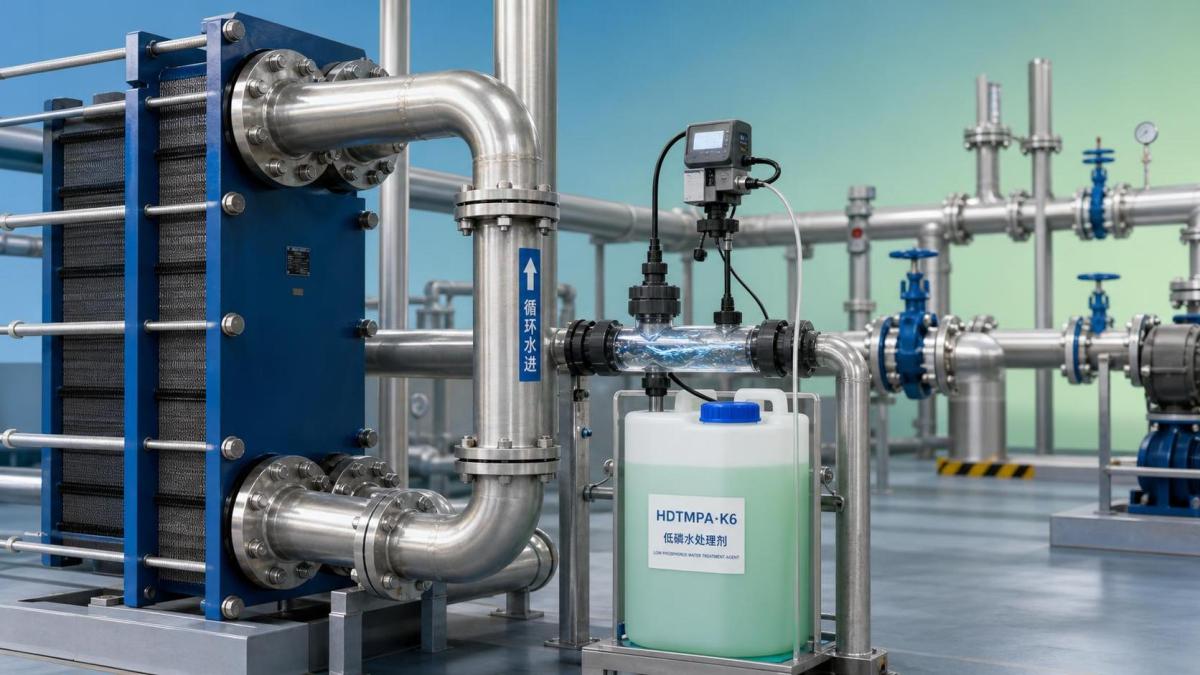
In recirculating cooling water, scale often develops at heat exchangers because surface temperatures exceed the bulk-water temperature. A bulk sample may appear acceptable while the water at the metal interface is already supersaturated. HDTMPA·K6 is therefore commonly assessed with the hottest exchanger duty, local velocity, recirculation rate, and expected concentration cycle in mind. Low-velocity areas, bypass legs, dead ends, and partially isolated equipment deserve separate attention because treatment chemistry cannot compensate fully for poor circulation.
In boiler makeup pretreatment or other high-hardness process-water applications, hardness removal upstream and phosphonate treatment serve different purposes. Softening reduces calcium loading. HDTMPA·K6 manages residual scale pressure and short-term variations that pass through the upstream system. Treating it as a replacement for severely underperforming softening equipment can lead to high chemical demand and inconsistent results. Resin exhaustion, regeneration quality, hardness leakage, and fluctuations in raw-water alkalinity should be reviewed when the treatment residual must be raised repeatedly.
Oilfield, geothermal, and high-salinity water systems require a broader precipitation assessment. Calcium may be only one part of a mixed-scale problem involving barium, strontium, sulfate, iron, or suspended solids. A phosphonate program selected for calcium carbonate behavior may need complementary chemistry where sulfate scale or particle deposition controls the operating limit. Water compatibility testing is particularly useful before commingling waters from different sources, since a blend can precipitate even when each individual stream appears stable.
Residual control is more useful than a fixed feed assumption
A pump setting alone is not evidence of scale control. The delivered active dose changes when feed stock concentration, dilution water, pump calibration, stroke rate, or recirculating-water volume changes. Monitoring should connect treatment feed with the actual water condition: calcium hardness, alkalinity, pH, conductivity or concentration ratio, temperature profile, and any available inhibitor residual method. A residual trend is meaningful only when interpreted alongside blowdown and makeup-water changes.
For example, a lower inhibitor residual can result from underfeed, but it can also follow increased makeup volume, an unnoticed bleed valve change, greater calcium demand, or degradation caused by incompatible oxidizing conditions. Conversely, a stable residual does not prove that deposits cannot form. Local overheating, stagnant zones, suspended solids, and fouled strainers can create deposition sites even when bulk-water testing appears within target ranges.
Combining phosphonate control with dispersion
HDTMPA·K6 addresses calcium scale pressure through chelation and crystal-growth interference, yet many process systems also contain corrosion products, clay, biological debris, or precipitated mineral fines. These solids create surfaces on which scale can anchor and can block heat-transfer passages before a dense mineral layer is visible. Polycarboxylate dispersants are often paired with phosphonate chemistry where suspended solids must remain mobile and removable. The combination should be screened against the actual water chemistry, especially where metal ions, high turbidity, or cationic treatment products are present.
For programs that also need broader phosphonate selection or strong barium sulfate inhibition, Sodium salt of Diethylene Triamine Penta (Methylene Phosphonic Acid) (DTPMP·Na2) is a relevant material for comparison in water-treatment formulation work. It can be used alone or alongside polycarboxylic acid-type scale inhibitor dispersants. Its suitability should still be confirmed against pH, hardness, oxidant exposure, salt content, and the particular deposits expected in the system.
Practical controls that prevent false conclusions
New treatment chemistry should not be judged immediately from an existing dirty exchanger. Old deposits can continue to release particles or restrict flow after a program change, making the system appear unstable even when new scale formation has slowed. Establish the baseline condition of heat-transfer equipment, strainers, filters, and representative pipe sections before comparing results. Where cleaning is required, remove or characterize the deposit first; otherwise, post-cleaning improvements can be wrongly attributed entirely to a chemical change.
Injection quality also matters. Feed HDTMPA·K6 into a location with reliable turbulence and enough downstream residence time for mixing. Avoid injecting into stagnant chemical lines or points where concentrated product contacts incompatible chemicals before dilution. If an oxidizing biocide or other reactive treatment is used, sequence and compatibility need review because loss of phosphonate activity can be mistaken for a higher calcium load.
Stable calcium scale control comes from matching HDTMPA·K6 treatment to the real precipitation environment: hardness loading, alkalinity, pH, temperature, concentration cycles, flow distribution, and solids handling. When those conditions are tracked together, changes in deposit behavior become easier to diagnose and treatment adjustments become more targeted.

ONLINE CONSULTATION
If you have any questions, please contact us and we will contact you as soon as possible.