


How to compare scale inhibitor manufacturers by supply consistency
A low quoted price can become expensive when the delivered scale inhibitor varies from batch to batch, arrives after the treatment program has been adjusted, or requires unexpected changes to dosage. Supply consistency should therefore be compared as an operating capability: the ability to provide the agreed chemistry, documentation, packaging and delivery rhythm repeatedly over the life of a purchase arrangement.
For circulating cooling water, boiler water and reverse osmosis pretreatment, a small change in active content or impurity profile can alter the treatment balance. A product may still look visually acceptable while performing differently in hard water, at elevated temperature, or alongside corrosion inhibitors, biocides and dispersants. The comparison should begin with the exact application rather than a generic product name.
Define what must remain consistent
“Scale inhibitor” covers several chemistries with different control points. Organophosphorus chelating agents, polycarboxylate dispersants and blended formulations do not have the same sensitivity to raw-material variation, pH adjustment or storage conditions. Before requesting quotations, define the required active basis, acceptable pH range, density, impurity limits, appearance, packaging format and intended water conditions.
Water chemistry is part of this definition. Calcium hardness, alkalinity, chloride concentration, iron contamination, temperature, cycles of concentration and residence time influence both treatment demand and the consequences of variation. A formula that works in a moderate-temperature cooling loop may not provide the same margin in a high-cycle system or a boiler feedwater program. Comparing suppliers against one broad specification can hide this difference.
For example, a pentasodium phosphonate product used as a scale and corrosion inhibitor should be reviewed on its stated active component basis, not density alone. Density is useful for receiving inspection and dosing-volume calculations, but two liquids with similar density can differ in active matter or salt balance. For a listed material such as Diethylene Triamine Penta (Methylene Phosphonic Acid) Pentasodium Salt (DTPMP·Na5), the specification should distinguish active content expressed as the acid form from active content expressed as the sodium salt. Treating those values as interchangeable creates an avoidable comparison error.
Look behind the certificate of analysis
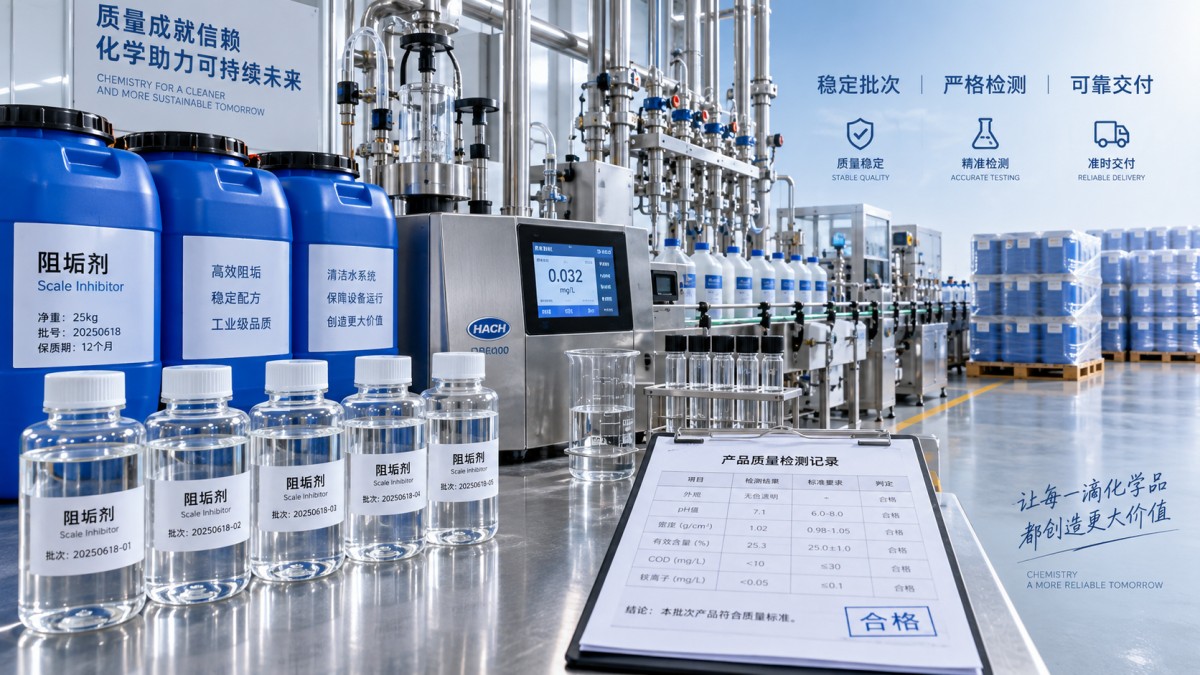
A certificate of analysis is necessary, yet a single compliant certificate does not establish repeatability. Ask for the test items used to release each lot, the test method or internal control method, and the frequency of testing. The relevant question is whether the recorded values stay controlled within a practical working band, rather than merely falling inside a wide acceptance limit.
Requesting retained-sample practice is particularly useful for recurring orders. When an on-site result changes, a retained sample from the same lot enables comparison with the receiving sample and separates a product issue from a dosing, water-quality or contamination issue. Without traceable lot records, investigation often turns into assumption and repeated sampling.
Assess production control, not claimed capacity
Production capacity matters only when it is available to the specified product at the required time. A scale inhibitor manufacturer with multiple production lines may still face scheduling conflicts if the same equipment is shared with products requiring different cleaning procedures, raw materials or reaction conditions. Ask how the product is assigned to production equipment, how batch identification is maintained, and whether changeover controls prevent contamination.
Raw-material control deserves equal attention. Phosphorus-containing intermediates, amines, alkali and process water can each influence final composition. Stable sourcing does not require that every input come from one source; it requires qualification of alternatives and a controlled process when a source changes. A supplier that can explain which incoming materials are critical, how they are verified, and when a change triggers revalidation presents a more reliable basis for long-term supply.
Blended products need an additional review. A formulation can meet a final active-content target while the ratio of functional components has shifted. This is especially relevant where the program relies on both threshold inhibition and crystal dispersion. Ask whether the stated specification controls only total solids or also the functional composition needed for the intended application. Confidential formula details need not be disclosed for this question to be answered clearly.
Separate stock availability from delivery reliability
“In stock” can mean finished goods ready for dispatch, bulk material awaiting packaging, or raw materials planned for production. These states have different lead-time risk. Confirm the usual inventory form, package availability and the point at which a lot becomes available for shipment. A 25 kg drum order, a 250 kg drum order and an IBC shipment may have different preparation requirements even when the same product is available in bulk.
Delivery consistency also depends on practical logistics details: compatible container materials, sealing, labels, palletization, export documentation and transport conditions. A water-based liquid that has been stored poorly can show settling, leakage or label damage during transit even when the factory release data was acceptable. The delivery plan should establish who verifies packaging integrity at handover and what evidence is required when a shipment arrives damaged or incomplete.
For repeat deliveries, compare the supplier's ability to provide a realistic shipment schedule with its handling of schedule changes. A dependable answer identifies the order cut-off, production allocation point, documentation lead time and the process for notifying a delay. General assurances of fast delivery have little value unless linked to these operating details.
Use samples as a controlled comparison, not a demonstration
Samples should be drawn from normal production material where possible and linked to a lot number and certificate. Test samples under water conditions that resemble the intended system: representative hardness and alkalinity, operating pH, temperature, concentration cycle and the other treatment chemicals already in use. A beaker test conducted in clean softened water may screen basic compatibility but cannot establish performance in a contaminated circulating system.
Keep the dosing basis consistent during comparison. If one product is dosed by commercial product weight and another by active component, apparent consumption differences can be misleading. Convert both to the same active basis, then account for delivered concentration, freight, packaging loss, storage requirements and any necessary change in feed-pump settings. The lowest price per kilogram is not automatically the lower annual treatment cost.
When an existing treatment program is being replaced, avoid changing the product, dose point and operational water conditions at the same time. A shift in blowdown, acid feed, make-up source or biocide regimen can cause deposits or turbidity that are incorrectly attributed to the new inhibitor. A short transition protocol with baseline samples, lot traceability and agreed test timing gives the result more meaning.
Compare response to deviations before they occur
Supply consistency includes the response when a lot does not meet the agreed requirement or an urgent replacement is needed. Clarify the procedure for technical review, sample collection, lot quarantine, replacement material and corrective-action reporting. The useful distinction is between a supplier that simply accepts a complaint and one that can trace the batch, review production records and provide a technically relevant response.
A concise comparison file can combine the product specification, recent lot certificates, sample-test observations, packaging details, lead-time assumptions and deviation procedure. This creates a decision record that can be revisited when water quality changes or volumes increase. It also prevents a later substitution from being approved solely because its nominal product name appears similar.
The most dependable selection is usually the source that demonstrates control across chemistry, production, release testing and delivery execution under the actual conditions of use. Unit price remains relevant, but it should be evaluated against the cost of dose variability, unplanned testing, delayed replenishment and treatment disruption.

ONLINE CONSULTATION
If you have any questions, please contact us and we will contact you as soon as possible.