


How to compare phosphorus-free RO antiscalants at high recovery rates
At high recovery, a phosphorus-free RO antiscalant should be compared against the concentrate chemistry at the last membrane element, not against a generic feed-water label or a single quoted dosage. As recovery rises, calcium, bicarbonate, sulfate, silica, barium, strontium, fluoride, iron, aluminum, and suspended solids become more concentrated. A product that appears adequate in a low-recovery projection may leave little operating margin when seasonal feed variation, pH drift, or a reduction in softener performance occurs.
The useful comparison starts by defining the intended operating envelope: feed-water analyses over time, target recovery, permeate flow, concentrate pH, temperature range, pretreatment arrangement, membrane type, and cleaning history. A phosphorus-free formulation should then be evaluated for its ability to control the actual limiting deposits without creating compatibility or discharge problems elsewhere in the system.
Start with the scaling limit, not the product label
“High recovery” does not identify the scale risk by itself. Two systems operating at the same recovery can have entirely different constraints. A brackish-water system with elevated alkalinity may approach calcium carbonate saturation first. Another system with moderate alkalinity but substantial sulfate can be limited by calcium sulfate. Silica can become the controlling deposit where concentrations rise in the concentrate, while barium sulfate and strontium sulfate may set a hard recovery ceiling even when calcium-based indices look manageable.
Obtain representative analyses that include calcium, magnesium, sodium, potassium, bicarbonate or alkalinity, sulfate, chloride, silica, barium, strontium, iron, aluminum, manganese, fluoride, pH, conductivity, temperature, turbidity, and total organic carbon where relevant. A single laboratory report is a starting point, not necessarily a design basis. Blended sources, changing well fields, recycled process water, and variable pretreatment performance can alter the ion balance enough to change the recommended chemistry.
Ask each candidate supplier to model the same feed-water dataset, membrane array, and recovery target. The output should identify the predicted limiting salts, the assumed pH adjustment, the proposed dosage range, and the margin to saturation. A comparison is weak when one proposal assumes acid addition and another does not, or when the calculations use different recovery rates. The chemistry assumptions must be normalized before dosage or cost figures have meaning.
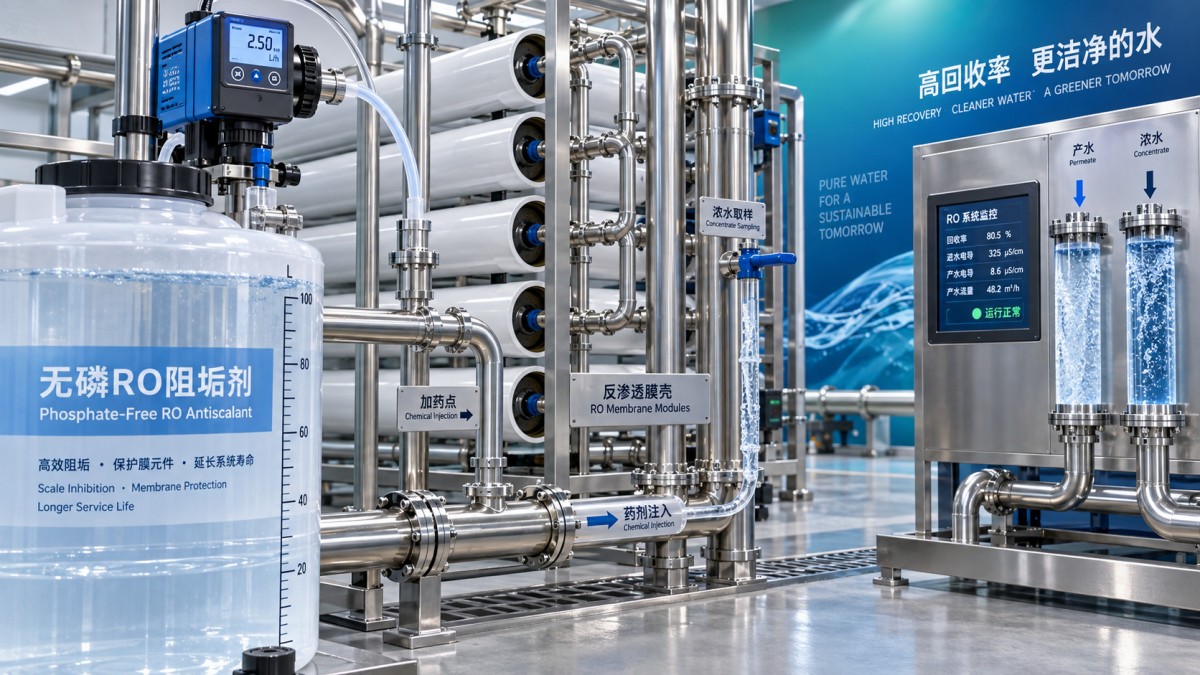
Define what “phosphorus-free” must mean at the site
The term phosphorus-free is sometimes used broadly, but the acceptance condition should be explicit. It may mean no intentionally added phosphonate, no inorganic phosphate, no detectable total phosphorus above a stated internal limit, or simply a formulation without phosphorus-bearing active ingredients. These are different specifications. A trace result can also originate from contamination, incoming water, cleaning chemicals, sampling equipment, or another chemical feed point rather than the antiscalant itself.
Request a composition statement suitable for the site requirement, together with a current safety data sheet, technical data sheet, and batch-level certificate of analysis where available. The documentation should distinguish active solids from total product solids and identify whether the formulation contains phosphorus-containing components. A supplier statement without an analytical basis may be insufficient where wastewater discharge, reuse applications, or internal material controls impose a defined phosphorus limit.
This distinction prevents a common error: selecting a high-performing phosphonate chemistry and calling it phosphorus-free because phosphate was not intentionally dosed. For example, Sodium Salt of HexaMethylene Diamine Tetra (Methylene Phosphonic Acid) (HDTMPA·Na6) is a phosphonate-based scale-control material with stated total phosphorus content. Its solubility and suitability for certain high-alkalinity or calcium-sulfate control duties do not place it in a phosphorus-free comparison group. It can serve as a technical reference point for the scale challenge, but it must be excluded when the specification requires phosphorus-free chemistry.
Compare inhibition by deposit family
Phosphorus-free antiscalants are often based on polymeric dispersants, carboxylate-containing chemistries, or blends designed to interfere with crystal growth and keep fine precipitates dispersed. Their performance is formulation-specific. A claim of broad-spectrum control should be supported by data relevant to the anticipated concentrate composition rather than inferred from chemical family alone.
Static bottle tests can be useful for screening, especially where calcium sulfate or silica behavior is uncertain, but they do not duplicate membrane concentration polarization, hydraulic conditions, or biological fouling. Conversely, a theoretical projection does not prove that a formulation will tolerate local feed-water excursions. The stronger comparison combines projection software, water analysis, product-specific data, and a controlled site trial when the recovery target is close to the scaling boundary.
Separate scale control from fouling control
A falling normalized permeate flow, rising differential pressure, and increased salt passage are not interchangeable indicators. Mineral scale often raises feed pressure or differential pressure and can be confirmed by cleaning analysis, membrane autopsy, or elemental evidence. Colloidal matter and biofilm can produce similar hydraulic symptoms, while oxidation damage or membrane compaction may affect salt rejection without a scale deposit being the primary cause.
This matters when comparing antiscalants because dosage escalation cannot correct an upstream solids-control problem. Cartridge filter breakthrough, poor multimedia filtration, inadequate coagulation, softener leakage, unremoved iron, residual aluminum from pretreatment, or intermittent oxidant exposure should be investigated separately. A phosphorus-free product may have useful dispersancy, but it is not a substitute for stable pretreatment.
Review the last several cleaning events before changing chemistry. Identify the cleaning sequence, cleaning pH, observed color or solids, conductivity response, normalized performance before and after cleaning, and any available deposit analysis. Repeated recovery after alkaline cleaning suggests a different foulant pattern from recovery only after acidic cleaning. When no deposit evidence exists, a trial should include sampling and monitoring provisions rather than relying only on operating impressions.
Membrane, pretreatment, and cleaning compatibility
Compatibility should cover the complete chemical program. Confirm that the phosphorus-free antiscalant is appropriate for the installed thin-film composite membranes, as well as the concentrate pH range, oxidant-control program, coagulants, biocides, reducing agents, and cleaning chemicals. Some interactions are indirect: a coagulant carryover may create deposits that look like antiscalant failure, while a reducing agent or preservative may alter microbiological conditions in storage tanks and feed lines.
The dilution point also deserves attention. Antiscalant is normally injected upstream of cartridge filtration or at another location that allows rapid, uniform mixing before the membranes. Injection into a stagnant zone, an oversized header with poor flow distribution, or a line with intermittent feed can cause uneven treatment. Confirm the dosing pump range, stroke control, calibration method, injection-quill material, back-pressure requirement, and whether the day tank has adequate agitation for the supplied formulation.
Product viscosity, density, freezing behavior, and dilution stability affect this practical side of selection. A low active-content product may require a larger pump capacity and more frequent deliveries, whereas a concentrated material may require different dilution-water quality or more careful calibration. Compare consumption in kilograms of active material and in delivered product volume only after the final treatment dose is established for the same operating case.
Use trial design that can distinguish products
A meaningful comparison does not alternate products during uncontrolled feed variation. Establish a baseline with stable pretreatment and normalized membrane data. Then hold recovery, flux, pH control, flushing practice, and pretreatment settings as constant as possible while evaluating one formulation. Changes in feed conductivity, hardness, alkalinity, silica, and temperature should be logged alongside the chemical dose.
Monitor normalized permeate flow, normalized salt passage, normalized differential pressure, feed and concentrate conductivity, recovery, concentrate pH, antiscalant consumption, cartridge-filter condition, and cleaning frequency. The purpose is to identify trends before a severe deposit obscures the cause. A product that supports a short period at elevated recovery but produces a steady pressure trend is not equivalent to one that maintains stable normalized performance over the intended run length.
Trial duration should reflect the deposit mechanism. Fast precipitation can show itself quickly, but low-rate silica deposition, colloidal accumulation, or interactions with intermittent source-water changes need longer observation. Define in advance what constitutes an unacceptable performance trend and how the system will be returned to the prior program if the threshold is reached. This protects the membrane train from an open-ended experiment.
Read dosage and cost in context
The lowest quoted dosage is not automatically the lowest chemical cost. Dosage units must be aligned: parts per million as product, parts per million as active, milligrams per liter, and kilograms per day are often used inconsistently. Compare the proposed daily consumption at the same feed flow and recovery, then include delivered concentration, storage volume, handling requirements, freight class, shelf life, and the analytical documentation required for release.
High recovery also changes the value of operating margin. If a formulation needs a narrow pH range, exceptionally stable hardness removal, or a fixed source-water profile to remain effective, its apparent treatment cost may not reflect the cost of maintaining those conditions. Conversely, a slightly higher dosage may be acceptable when it tolerates normal feed variation and reduces unplanned chemical changes or membrane cleaning. The comparison should state the exact water-quality boundaries behind each quoted program.
Supply continuity has a technical dimension as well. A replacement batch with different active content, density, pH, or viscosity can change the delivered active dose even when the pump setting remains unchanged. Define acceptable specification ranges, batch documentation, packaging format, storage temperature limits, and change-control notification requirements before routine supply begins. For bulk or IBC delivery, verify that the receiving tank material, venting, transfer connections, and secondary containment suit the product safety information.
Reach a defensible selection
A phosphorus-free RO antiscalant is suitable for high recovery when its phosphorus status is documented, its dose is calculated against the same conservative water scenario used for competing products, and its deposit-control claims match the actual limiting salts. Membrane compatibility, pretreatment stability, dosing hardware, cleaning evidence, and active-material cost should be reviewed as part of the same decision record.
Where the target recovery sits close to a saturation limit, retain a practical margin rather than treating a model prediction as a guaranteed operating point. The most reliable selection is the formulation whose performance boundaries are clear, whose quality characteristics are controlled, and whose trial data remain consistent with the water chemistry that the RO system will actually receive.

ONLINE CONSULTATION
If you have any questions, please contact us and we will contact you as soon as possible.