


Does a phosphorus-free RO antiscalant affect membrane cleaning frequency?
Does a Phosphorus-Free RO Antiscalant Affect Membrane Cleaning Frequency?
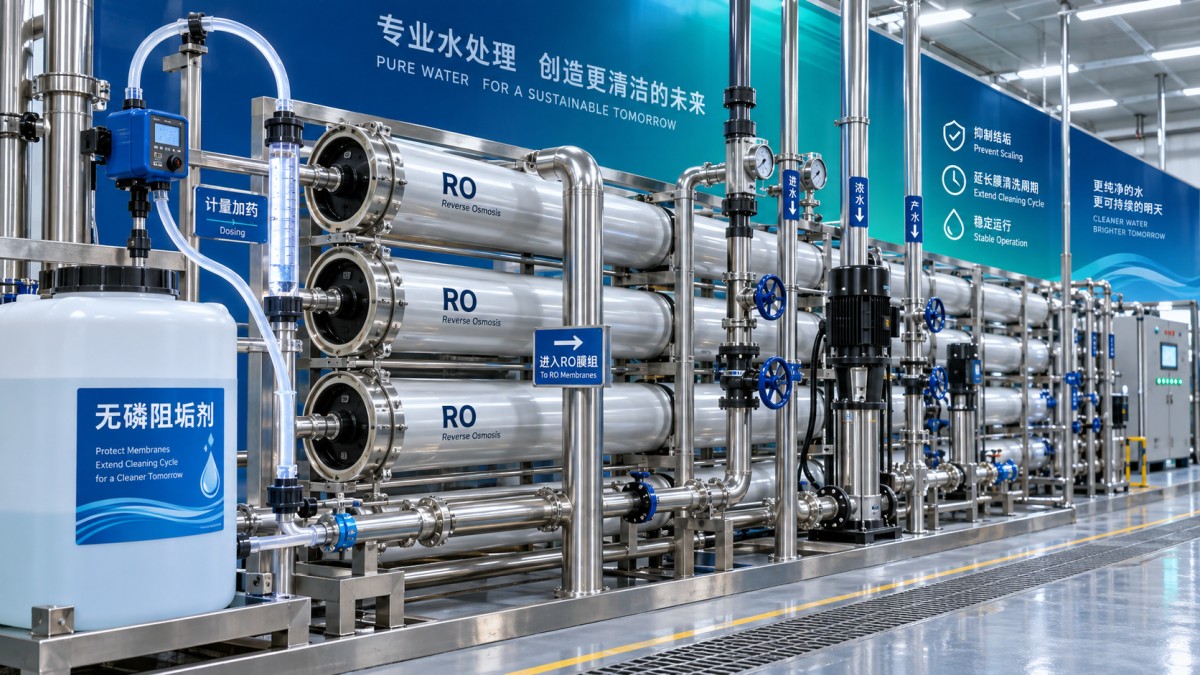
Does a phosphorus-free RO antiscalant affect membrane cleaning frequency? For industrial decision-makers, the answer depends on feedwater chemistry, operating conditions, and formulation performance rather than phosphorus content alone.
A well-designed phosphorus-free RO antiscalant can control scale formation, reduce fouling risks, and extend cleaning intervals while supporting discharge compliance and lower total water-treatment costs.
The commercial question is not whether phosphorus-free chemistry is automatically better. It is whether the selected formulation protects membrane performance under the site’s actual recovery rate and contamination profile.
Cleaning Frequency Is a Business Performance Indicator
Membrane cleaning frequency is more than an operational metric. It affects chemical consumption, labor requirements, downtime, membrane life, production reliability, and the cost of treated water.
When cleanings become more frequent, operators often face declining normalized permeate flow, rising differential pressure, higher salt passage, or unstable recovery performance across membrane trains.
These symptoms may indicate mineral scale, but they can also result from particulate loading, biological growth, organic fouling, colloidal silica, oxidant damage, or poor pretreatment.
Therefore, changing to a phosphorus-free RO antiscalant should not be assessed only by counting clean-in-place events during a short operating period.
Decision-makers should compare normalized operating trends, cleaning effectiveness, membrane replacement rates, chemical costs, wastewater compliance exposure, and water-production availability over a meaningful operating cycle.
A product that costs less per kilogram but requires higher dosing, reduces recovery, or allows more frequent cleaning may increase total ownership costs substantially.
Conversely, a higher-value formulation may deliver savings when it maintains stable operation at higher recovery, minimizes emergency cleanings, and reduces the likelihood of irreversible membrane damage.
Phosphorus-Free Does Not Automatically Mean More Cleaning
A phosphorus-free RO antiscalant does not inherently increase membrane cleaning frequency. Its impact depends on whether it provides sufficient threshold inhibition, crystal modification, chelation, and dispersion.
Traditional phosphonate-based antiscalants are widely used because they can inhibit calcium carbonate, calcium sulfate, barium sulfate, strontium sulfate, and some metal-related deposits effectively.
However, phosphorus-containing treatment programs may create regulatory or environmental concerns where concentrate discharge limits, eutrophication risks, or internal sustainability targets are important considerations.
Phosphorus-free alternatives commonly rely on polycarboxylates, specialized polymers, biodegradable components, or blended dispersant technologies designed for specific water-quality conditions.
The relevant comparison is formulation against formulation. A high-performance phosphorus-free product can outperform a poorly matched phosphonate product, while an unsuitable alternative can shorten cleaning intervals.
Site-specific performance is especially important when feedwater contains elevated hardness, sulfate, silica, iron, aluminum, manganese, suspended solids, or variable organic contamination.
For this reason, procurement teams should avoid treating “phosphorus-free” as a complete technical specification. It is an environmental and chemical classification, not a performance guarantee.
What Actually Determines RO Membrane Cleaning Intervals?
Cleaning intervals are primarily determined by the balance between feedwater risk, pretreatment effectiveness, antiscalant suitability, dosage accuracy, system recovery, membrane selection, and operating discipline.
Scale formation becomes more likely as dissolved salts concentrate along the membrane surface. Higher recovery increases water efficiency but also raises the saturation tendency of sparingly soluble salts.
Calcium carbonate risk is influenced by pH, alkalinity, calcium concentration, temperature, carbon dioxide balance, and recovery. Calcium sulfate and barium sulfate present different precipitation behaviors.
Silica deserves separate attention because its control can be difficult at high concentration factors. Once silica deposits become established, chemical cleaning may provide incomplete recovery.
Iron, aluminum, and colloidal particles often originate upstream. In these cases, no antiscalant program can fully compensate for inadequate filtration, poorly controlled coagulation, or contaminated storage systems.
Biological fouling also needs independent control. Antiscalants are not substitutes for microbial management, compatible biocide programs, sanitation procedures, or biofilm-focused cleaning strategies.
Before attributing increased cleaning frequency to a phosphorus-free product, review pretreatment logs, cartridge filter pressure trends, SDI values, turbidity, residual oxidant, and feedwater variability.
This investigation prevents a common management error: replacing a chemical program when the underlying cause is a mechanical, biological, or upstream water-quality problem.
How a Phosphorus-Free Antiscalant Can Extend Cleaning Cycles
A suitable phosphorus-free RO antiscalant can extend cleaning cycles by keeping mineral salts dispersed and delaying crystal nucleation before deposits form on membrane surfaces.
Effective formulations interfere with early crystal growth, distort crystal structure, and maintain fine particles in suspension so they are removed with concentrate instead of attaching to membranes.
Some polymeric systems also help disperse trace metal oxides and suspended solids. This can be valuable when upstream water contains variable iron, aluminum, or corrosion-product carryover.
The best results occur when the chemistry is matched to the feedwater’s scaling profile and injected consistently at the calculated dose through a properly maintained dosing system.
Stable injection matters because intermittent dosing can allow localized supersaturation events. A short upset may initiate deposits that continue accumulating even after normal treatment resumes.
Appropriate antiscalant selection may also permit higher recovery within safe operating margins. Increased recovery can lower raw-water demand and concentrate disposal volume when membrane protection remains stable.
However, maximizing recovery without respecting saturation limits is not an optimization strategy. It merely transfers cost into cleanings, chemical use, lost production, and earlier membrane replacement.
For management teams, the practical value lies in predictable operation: fewer unplanned interventions, more stable output, lower risk of capacity shortfalls, and defensible environmental compliance.
When a Phosphorus-Free Program May Increase Cleaning Frequency
Cleaning frequency can increase when a phosphorus-free formulation is selected only for its phosphorus status and not for its ability to control the site’s actual scaling conditions.
A generic product may be insufficient for high-barium brines, high-sulfate wastewater reuse streams, extreme silica conditions, or systems operating near aggressive recovery limits.
Underdosing is another frequent cause of disappointing results. Lowering the treatment dosage to reduce chemical spend can accelerate scale formation and create larger downstream costs.
Overdosing should also be avoided. Excess polymer may increase organic loading, interact with coagulant residuals, complicate cleaning, or provide no proportional improvement in membrane protection.
Incompatible chemistry can create additional risk. The antiscalant must be compatible with membrane materials, pretreatment chemicals, pH adjustment agents, biocides, cleaning compounds, and injected feedwater additives.
Product changeovers require particular care. Residual chemistry in tanks, dosing lines, or RO feed systems can interact with the new product and obscure trial results.
Operating teams should flush and inspect dosing equipment, verify calibration, and establish baseline performance data before comparing programs under similar feedwater and seasonal conditions.
A phosphorus-free transition should be treated as a controlled technical project, not merely as a purchasing substitution based on a product data sheet.
A Decision Framework for Selecting the Right Chemistry
Start with a complete feedwater analysis rather than a single hardness measurement. Include calcium, magnesium, barium, strontium, sulfate, alkalinity, silica, iron, aluminum, pH, conductivity, and temperature.
Assess variability as well as average values. Seasonal source-water changes, regeneration wastewater, process recycle streams, and batch discharges can create short-term conditions that drive severe scaling events.
Next, define operating targets clearly. Key parameters include feed flow, recovery, permeate quality, concentrate limits, membrane configuration, flux, pressure, temperature range, and planned production capacity.
Use recognized scaling projections to evaluate saturation risk at the final concentrate condition. The model should account for recovery, ionic strength, temperature, pH, and specific mineral species.
Then request formulation-specific recommendations from suppliers. A credible recommendation identifies target scales, dosage range, operating limitations, test assumptions, and monitoring requirements rather than making universal claims.
For high-risk applications, conduct a documented field trial or pilot comparison. Evaluate normalized permeate flow, normalized salt passage, differential pressure, cleaning interval, cleaning recovery, and total chemical cost.
Decision-makers should require clear success criteria before conversion. Examples include maintaining recovery, avoiding additional cleanings, meeting discharge limits, and achieving a defined cost-per-cubic-meter target.
This approach makes procurement decisions more defensible because it connects chemical selection directly to operating outcomes, compliance requirements, and financial performance.
Monitoring Data That Shows Whether the Program Is Working
Operators should trend normalized permeate flow because raw flow alone can be misleading when feedwater temperature changes. Declining normalized flow can indicate fouling or scaling development.
Normalized differential pressure is equally important. A sustained increase may indicate particulate accumulation, biofouling, channel blockage, or deposits in feed spacers and membrane elements.
Salt rejection and normalized permeate conductivity help identify membrane integrity concerns, scaling effects, and changes in operating performance that may not appear in pressure data.
Track cartridge filter replacement frequency, feed turbidity, SDI, and pretreatment chemical use. These indicators reveal whether upstream conditions are driving membrane fouling independently of antiscalant performance.
Cleaning reports should record trigger conditions, cleaning chemicals, temperature, pH, circulation time, recovered performance, and suspected foulant type. Vague cleaning records limit future optimization.
Where possible, analyze removed foulants or used cleaning solutions. Laboratory evidence can distinguish carbonate scale from silica, metal oxides, biological matter, organic deposits, or mixed fouling.
A phosphorus-free RO antiscalant should be judged by these integrated trends over time, not by a single laboratory result or an isolated production upset.
Regular reviews between operations, maintenance, procurement, environmental teams, and chemical suppliers help ensure that treatment decisions remain aligned with changing water conditions.
Balancing Phosphorus Reduction With Broader Water-Treatment Needs
Phosphorus-free RO treatment is often selected to support discharge requirements, wastewater-reuse objectives, customer sustainability commitments, or local restrictions on phosphorus-bearing chemicals.
That objective is valid, but it should be considered within the whole facility treatment program. Cooling water, boiler systems, wastewater treatment, and RO plants may have different chemistry needs.
For example, phosphonate chemistry may still be technically appropriate in non-RO applications where high-temperature stability, corrosion inhibition, or difficult scale control is required and permitted.
Diethylene Triamine Penta (Methylene Phosphonic Acid) (DTPMPA) is an organophosphonic acid used in broader industrial water-treatment applications, including scale inhibition, chelation, and corrosion-control programs.
Its inclusion in a facility-wide chemical strategy should be assessed separately from a phosphorus-free RO antiscalant decision, particularly where discharge permits or phosphorus balances are critical.
This distinction helps organizations avoid oversimplification. A sustainable program is not necessarily one chemistry used everywhere; it is a managed combination of suitable chemistry and responsible control.
Suppliers with formulation development, laboratory testing, and field technical support can help identify where phosphorus-free technology is appropriate and where alternative chemistry remains justified.
How to Compare Total Cost Instead of Product Price
Antiscalant price per drum is an incomplete purchasing metric. The more useful measure is total treatment cost per cubic meter of permeate produced at required quality and availability.
Include dosage rate, chemical handling, testing, clean-in-place frequency, cleaning chemicals, labor, membrane replacement, lost production, concentrate management, and compliance risk in the comparison.
Also assess the financial impact of recovery. A product that safely supports a modest recovery increase may reduce feedwater demand and wastewater volume enough to offset treatment cost.
Consider reliability value as well. Unplanned cleaning can disrupt downstream production, increase overtime, create delivery risk, and reduce confidence in the plant’s available treatment capacity.
For large industrial facilities, preventing one major membrane scaling incident can outweigh the annual cost difference between two apparently similar antiscalant products.
Procurement contracts should therefore include technical accountability. Define accepted dosage windows, product consistency requirements, test support, delivery reliability, and escalation procedures for performance deviations.
A supplier should be able to provide stable production quality, application guidance, and practical troubleshooting support rather than only a generic recommendation and shipment documentation.
Conclusion: Choose Performance First, Then Confirm Compliance
A phosphorus-free RO antiscalant can reduce, maintain, or increase membrane cleaning frequency depending on formulation quality, feedwater chemistry, recovery targets, and operating control.
Phosphorus-free status alone does not predict membrane cleanliness. The correct product is the one that controls relevant scale risks while fitting discharge requirements and overall treatment economics.
For decision-makers, the strongest selection process combines water analysis, scaling assessment, formulation-specific dosing guidance, controlled performance monitoring, and total-cost evaluation over an adequate operating period.
When these steps are followed, phosphorus reduction can be pursued without sacrificing membrane reliability, cleaning intervals, water output, or the long-term value of RO assets.

ONLINE CONSULTATION
If you have any questions, please contact us and we will contact you as soon as possible.