


How to choose RO antiscalants for feedwater with high sulfate levels
How to Choose RO Antiscalants for Feedwater with High Sulfate Levels
High-sulfate feedwater creates a difficult operating environment for reverse osmosis systems. As water passes through the membrane, dissolved salts become more concentrated in the reject stream. Where sulfate is paired with calcium, barium, or strontium, this concentration effect can move the system rapidly toward mineral precipitation. The result may be a gradual loss of permeate flow, higher differential pressure, more frequent cleaning, or—in more severe cases—hard scale that is difficult to remove without affecting membrane life.
For a project manager, selecting RO Antiscalants is therefore not a simple matter of buying the lowest-dose product. The appropriate treatment program depends on the full feedwater profile, the planned recovery rate, membrane configuration, pretreatment reliability, temperature variation, and the operating margin the project can realistically maintain. A product that performs acceptably on a moderate-sulfate well-water system may be unsuitable for industrial wastewater reuse, mine water, desulfurization wastewater, or concentrated brackish water.
The decision should begin with chemistry, then move to compatibility, verification, operational control, and supply reliability. That order prevents a common problem: choosing an antiscalant based on a product label, only to discover later that the formulation was never tested against the actual scaling risks of the plant.
Why sulfate scaling needs a separate selection approach
Not all scales behave in the same way. Calcium carbonate scaling is strongly influenced by pH and alkalinity, while sulfate scales can remain problematic even when pH adjustment is used. Calcium sulfate, barium sulfate, and strontium sulfate each have different solubility behavior and different levels of operational concern. Barium sulfate is particularly challenging because it can form tenacious deposits and is generally much less responsive to routine cleaning than more soluble scale types.
This matters because an antiscalant designed mainly for carbonate control may not provide a sufficient safety margin when the sulfate load is high. Effective RO Antiscalants typically work by interfering with crystal nucleation and growth, dispersing fine particles, or helping keep scale-forming ions from organizing into deposits. Their practical performance, however, varies with ionic composition and concentration. A formulation must be assessed against the salts that will become saturated at the final concentrate conditions, not merely against the raw-water sulfate reading.
A high sulfate number alone does not tell the whole story. Sulfate without appreciable calcium, barium, or strontium may present a different risk profile than sulfate-rich water containing these cations. Chloride, sodium, silica, iron, aluminum, phosphate, organic matter, and residual coagulants may also influence membrane fouling or alter treatment performance. That is why a complete analysis is more valuable than a single parameter.
Start with the water analysis that supports a real decision
Before comparing products, obtain a representative feedwater analysis and confirm when the sample was taken. Seasonal shifts, production changes, upstream chemical additions, groundwater blending, and wastewater recycling can all change sulfate concentration and hardness. In projects using multiple water sources, the design case should normally account for the most demanding credible water condition rather than relying only on annual averages.
The following parameters are normally needed for a meaningful scale projection and antiscalant recommendation:
- Calcium, magnesium, barium, strontium, sodium, potassium, chloride, sulfate, bicarbonate, and silica;
- pH, conductivity or total dissolved solids, temperature, turbidity, and dissolved iron or manganese where relevant;
- Feed flow, permeate flow, concentrate flow, membrane array, staging, and target system recovery;
- Pretreatment chemicals, including coagulants, oxidants, reducing agents, biocides, and cleaning products;
- Expected fluctuations in water quality and the operational limits of the dosing equipment.
For high-sulfate applications, the project team should specifically ask whether barium and strontium were tested. These ions are sometimes omitted from basic water reports, yet their presence can substantially change the recommended recovery and chemical program. If the available analysis is incomplete, it is usually safer to close that gap before finalizing the design. Guessing can lead either to under-treatment or to unnecessary chemical consumption.
Evaluate scale risk at concentrate conditions, not at the inlet
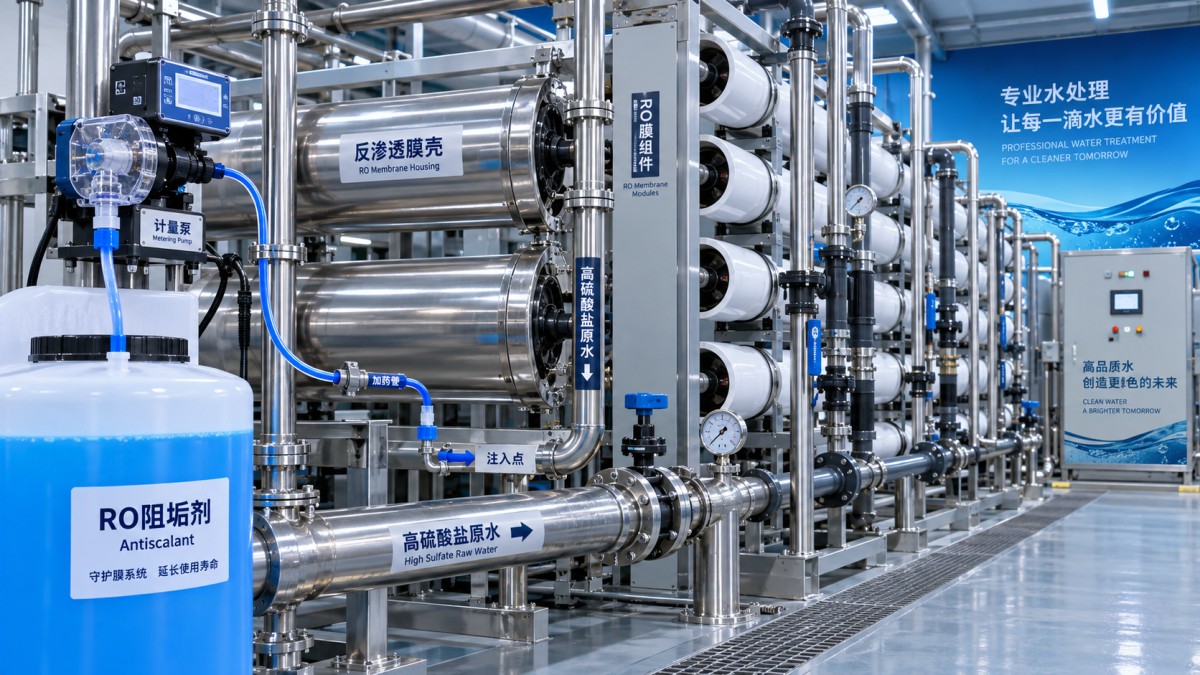
Membrane recovery determines how strongly dissolved ions are concentrated. Raising recovery can improve water utilization, but it also narrows the operating window. In a sulfate-limited system, a modest recovery increase may have consequences that are not visible from the feedwater analysis alone. The correct question is not “Can this product handle sulfate?” but “At our intended recovery, temperature, pH, and membrane configuration, which salts are projected to exceed their acceptable saturation limits?”
A supplier should be able to use a recognized calculation method or project-specific software model to review the likely concentrate composition. The output should be discussed as a design tool rather than treated as an absolute guarantee. Real plants experience flow variation, sensor drift, mixing delays, and changes in pretreatment performance. A sensible selection includes an operational margin instead of designing directly at the edge of predicted scale formation.
Choose the chemistry for compatibility, not only dose rate
Dose rate is important, but it should be viewed as one part of total treatment value. A very low quoted dosage is not automatically economical if the product has a narrow sulfate-control range, poor compatibility with upstream chemicals, or inconsistent performance when feedwater changes. Conversely, selecting a higher dose without a scale projection and verification plan can add cost without increasing reliability.
Project teams should ask suppliers whether the proposed formulation is designed for calcium sulfate only or also for barium sulfate and strontium sulfate risks. This distinction should be explicit. It is also reasonable to ask about membrane compatibility, compatibility with polyamide RO membranes, stability in the prepared dosing solution, and compatibility with the plant’s reducing agent or other injected chemicals. The chemical should remain homogeneous under expected storage and dosing conditions; separation, precipitation, or microbial contamination in the day tank can undermine an otherwise sound treatment program.
For industrial reuse water, the decision may extend beyond mineral scaling. Organic loading, suspended solids, surfactants, residual flocculant, and biological growth can create a mixed fouling problem. An antiscalant is not a substitute for effective pretreatment. If upstream clarification or filtration is unstable, increasing antiscalant dosage may conceal the actual cause for a short time but will not correct it.
Build dosing and monitoring into the project scope
Even a suitable formulation can fail in operation when dosing is poorly controlled. The injection point should provide adequate mixing before the membranes, and the dosing pump should be sized for both normal operation and realistic flow changes. The system should avoid chemical starvation during start-up, shutdown, membrane flushing, or transfer from one feedwater source to another. These details belong in the commissioning plan, not as an afterthought once pressure has already increased.
Operators need a practical baseline for normalized permeate flow, salt passage, differential pressure, feed conductivity, recovery, and antiscalant consumption. A trend is usually more useful than a single reading. A slowly increasing differential pressure may point to particulate or biological fouling, while declining normalized permeate flow combined with scale indicators can justify a closer review of recovery, dosage, feed chemistry, and membrane-cleaning records. Early diagnosis is less disruptive than waiting for an irreversible deposit.
Foam may also need attention in integrated wastewater treatment and pretreatment systems, particularly where surfactants or polymers are present. That is a separate control issue from membrane antiscaling, but it can affect tank operation, dosing consistency, and filtration. For suitable upstream applications, an emulsion-type Polyether-silicon defoamer can be considered where rapid foam knockdown, persistent antifoaming behavior, and compatibility with other additives are required. Its use should be evaluated within the pretreatment process so that the selected defoamer does not create an unintended membrane-fouling concern.
Avoid the selection shortcuts that create later risk
Several shortcuts recur in sulfate-heavy RO projects. One is basing the decision on total hardness alone. Hardness is useful, but it does not reveal barium or strontium risk. Another is copying the chemical program from a different site with a similar conductivity reading. Conductivity does not describe ionic composition, and two waters with similar total dissolved solids can have very different scaling behavior.
A third mistake is using acid as the sole response to sulfate scaling. Acidification can be effective for carbonate-related issues, but it does not remove the need to control sulfate precipitation. It can also introduce corrosion, handling, and process-control considerations. The final shortcut is judging chemical performance only by the period between membrane cleanings. Cleaning frequency is influenced by many variables, including feedwater solids, biofouling, operating recovery, and cleaning effectiveness. Performance should be assessed through water chemistry, projected saturation risk, operating trends, and inspection of the whole treatment train.
What a credible supplier review should include
A credible technical review should leave the project team with more than a recommended product name and dosage. It should identify the water analysis used, operating assumptions, principal scale risks, proposed dosage range, membrane and chemical compatibility considerations, and the conditions that would require the recommendation to be revisited. It should also clarify the product’s quality-control documentation, packaging options, storage requirements, and supply continuity for the project location.
For larger projects or variable industrial water sources, laboratory evaluation and site-oriented technical support can be more valuable than a generic program. Prio New Materials combines water-treatment chemical R&D, automated production, and customized technical service across RO purification, industrial wastewater, power, petrochemical, oilfield, and desalination-related applications. Its portfolio includes organophosphorus scale-inhibiting chelating agents and polycarboxylate dispersants, alongside other functional water-treatment materials. In practice, this type of capability is useful when a standard antiscalant must be matched to a changing feedwater condition rather than treated as a fixed commodity.
Make the final choice around operating margin
The right antiscalant for high-sulfate RO feedwater is the one supported by the actual concentrate chemistry and capable of fitting the plant’s operating discipline. It should control the relevant sulfate salts at the intended recovery, remain compatible with the membrane and pretreatment program, and be backed by a clear dosing and monitoring plan. Price per kilogram and nominal dose matter, but neither replaces technical fit.
Before issuing a final procurement specification, confirm the latest full water analysis, maximum recovery scenario, membrane supplier requirements, temperature range, and planned chemical handling arrangement. If sulfate concentration or hardness fluctuates materially, define the trigger points for re-evaluating the program. That discipline gives the RO system a better chance of maintaining stable production without relying on frequent cleaning as its primary scale-control strategy.

ONLINE CONSULTATION
If you have any questions, please contact us and we will contact you as soon as possible.