


Can DTPMPA CAS 15827-60-8 stabilize peroxide bleaching systems?
For project managers evaluating peroxide bleaching systems, DTPMPA CAS 15827-60-8 can be a practical stabilizing chelant when premature peroxide loss, variable whiteness, or excessive chemical consumption starts affecting production targets. The issue is rarely “peroxide quality” alone. Trace metals introduced through process water, raw materials, equipment corrosion, or recycled streams may catalyze peroxide decomposition before the oxidant has completed its intended bleaching work.
In that situation, the right phosphonate-based chelant can make the process more controllable. DTPMPA binds troublesome metal ions, reducing their catalytic activity and helping hydrogen peroxide remain available for the bleaching stage. For an engineering team, the value is not simply higher brightness. It is greater consistency between batches, fewer unexplained excursions in peroxide demand, and a more stable basis for optimizing water, heat, and chemical usage.
Why peroxide bleaching systems become unstable
Hydrogen peroxide is widely used in textile preparation, pulp processing, detergent-related operations, and industrial cleaning because it can provide effective oxidation without introducing chlorinated bleaching by-products. Yet peroxide is inherently sensitive to operating conditions. Excessive temperature, strongly alkaline conditions, incompatible auxiliaries, and especially transition-metal contamination can accelerate its breakdown.
Iron, copper, manganese, and similar ions can trigger radical-forming reactions that consume peroxide rapidly. The visible symptom may be uneven bleaching or insufficient final brightness. The less visible consequences can be more expensive: wasted peroxide, foam changes, fluctuating pH profiles, localized fiber damage, increased rinse requirements, and a process team that keeps adjusting dosage without identifying the underlying cause.
For a project manager, this creates a familiar challenge. A bleaching line may perform well during commissioning, then become unpredictable after a water-source change, equipment aging, higher recycled-water use, or a change in incoming substrate. The question is not merely whether to add a stabilizer, but whether the selected chemistry will remain effective under actual plant conditions.
What DTPMPA CAS 15827-60-8 does in a bleaching formulation
DTPMPA, or diethylene triamine penta(methylene phosphonic acid), is a multifunctional organophosphonic chelating agent. The CAS number 15827-60-8 refers to the acid form. Its molecular structure contains multiple phosphonic acid groups and nitrogen-containing coordination sites, allowing it to complex with metal ions that would otherwise promote peroxide decomposition.
In a peroxide bleaching system, DTPMPA is generally used to control metal-ion interference rather than to replace peroxide itself. By sequestering catalytic metals, it helps slow unproductive peroxide breakdown. More of the oxidant can then participate in the intended bleaching reaction, provided that pH, temperature, residence time, wetting performance, and substrate cleanliness are also properly managed.
This distinction matters. A chelant cannot correct every cause of poor bleaching. It will not compensate for inadequate wash-off, poor liquor circulation, severe organic contamination, incorrect alkali control, or an undersized heating system. It is one component within a connected process. Used thoughtfully, however, it can remove a major source of instability that is often difficult to see from routine operating data.
The practical chemistry behind stabilization
Metal ions can act as catalytic centers for peroxide degradation. When uncontrolled, the reaction may produce oxygen rapidly, creating peroxide loss before the chemical reaches the target material evenly. A chelant such as DTPMPA surrounds and binds those metal ions, reducing their availability for catalytic reactions.
The result is often a calmer and more predictable bleaching bath. Peroxide consumption is better aligned with bleaching demand rather than unwanted decomposition. In well-designed formulations, this can also support a more consistent operating window when feedwater quality or substrate metal content varies within a normal production range.
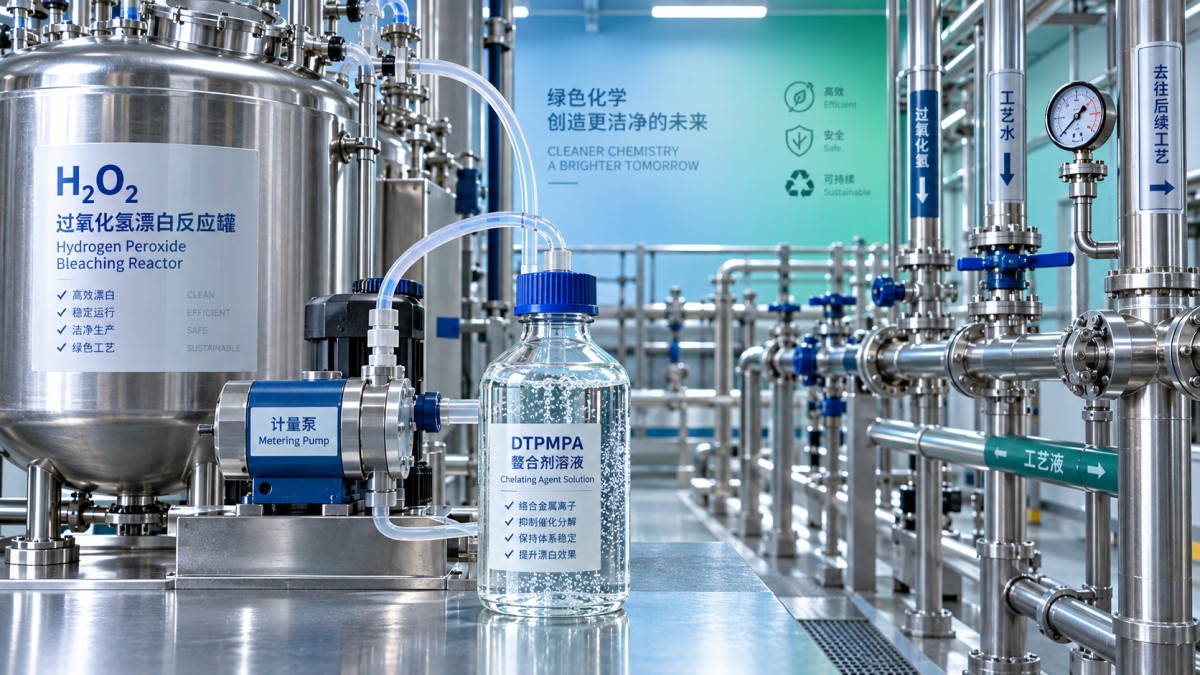
Acid form versus sodium salt: an important procurement detail
When searching for DTPMPA CAS 15827-60-8, buyers should avoid assuming that every commercial product is supplied in the same form. The acid form and neutralized sodium salts are chemically related, but they have different CAS registrations, pH characteristics, handling profiles, and formulation behavior.
For example, the hepta-sodium salt of DTPMPA is commonly used where a more neutral-to-alkaline liquid product is advantageous for blending, storage, or compatibility with an alkaline peroxide bleaching formulation. The salt form is not simply a label change; it affects how the product is introduced into the process and how the final formulation’s pH balance should be designed.
For projects requiring a ready-to-dose aqueous chelant with practical handling properties, Prio New Materials supplies Hepta sodium salt of Diethylene Triamine Penta (Methylene Phosphonic Acid) (DTPMP·Na7). This reddish-brown liquid is manufactured to HG/T 4330-2012 and is used not only as a stabilizer for peroxide bleaching, but also in cooling water treatment, detergent auxiliaries, industrial cleaning water, geothermal water treatment, and oilfield scale-control programs.
That broader application history is relevant because many industrial sites do not operate bleaching systems in isolation. The same facility may face hard water, iron contamination, scale formation, recycled-water variability, and cleaning-water challenges. A chelant selection that fits the site’s wider water-management strategy can simplify purchasing, technical evaluation, and inventory planning.
Where project teams see the greatest benefit
DTPMPA-based stabilization is worth closer evaluation when a bleaching operation has a recognizable metal-related risk profile. Common examples include groundwater or mixed water sources with variable iron and hardness; reclaimed process water; aging pipelines with corrosion products; mineral-contaminated textiles or pulp feedstocks; and systems where peroxide is exposed to elevated temperatures for extended periods.
It may also be useful during capacity expansion. A line running close to its design limit has less tolerance for chemical variability. If a new project is expected to process more variable raw materials or increase water recirculation, metal control should be considered at the formulation stage rather than added only after bleaching inconsistency appears.
In detergent or industrial cleaning applications, the concern may be different but related. Metal ions in wash water can reduce oxidant efficiency and contribute to redeposition or discoloration risks. A compatible phosphonate chelant can support cleaning performance while also offering scale-control value in water-contact equipment.
How to assess suitability before full-scale use
Project leaders should treat stabilizer selection as a small technical validation project, not a catalogue comparison. Product activity percentage is important, but it is not enough. The actual operating environment determines whether a specific DTPMPA product, dosage, and addition point will perform as expected.
- Review water quality: Test for iron, manganese, copper, calcium, magnesium, alkalinity, conductivity, and suspended solids. Historical variability is often more useful than a single sample.
- Map contamination sources: Metals may enter through incoming water, dyes, fillers, raw materials, corrosion debris, or recycled streams. Without this map, dosage adjustments can become trial-and-error.
- Confirm the process sequence: Decide whether chelant addition should occur before peroxide charging, during water preparation, or in a premixed stabilizer package. Premature contact between peroxide and contaminated water should be minimized.
- Check formulation compatibility: Evaluate interaction with alkali, surfactants, silicates, magnesium salts, optical brighteners, antifoams, and other auxiliaries.
- Use controlled trials: Compare peroxide residual, bleaching result, pH drift, foam behavior, and repeatability—not only one visual brightness result.
A pilot trial should reflect production realities. Testing only with clean laboratory water can make any stabilizer look successful. Better validation uses representative process water, normal substrate variation, and the expected temperature profile. When process risk is high, collect samples over a full operating shift rather than relying on a single start-up test.
Dosage should follow metal load, not habit
One of the most common mistakes is treating chelant dosage as a fixed number that can be transferred from one site to another. The right starting point depends on metal contamination, peroxide concentration, liquor ratio, bath pH, temperature, contact time, and the presence of other complexing agents. Overdosing is not automatically beneficial; it can increase chemical cost and may alter the behavior of a carefully balanced formulation.
A sound approach is to begin with a supplier-recommended trial range, then optimize against measurable operating indicators. If peroxide residual is unstable, investigate the water and metal profile before simply increasing the dose. If brightness is already satisfactory but chemical cost rises, determine whether the chelant level is exceeding the actual metal-control requirement.
For sodium-salt products, active content should also be compared on a consistent basis. Some specifications report active ingredient as DTPMPA acid equivalent, while others report the sodium salt equivalent. Project specifications should state clearly which basis is being used. This prevents an apparently similar concentration from becoming an inaccurate purchase or dosing comparison.
Compatibility and handling considerations
Although DTPMPA chemistry is valued for stability and strong sequestration performance, every bleaching formulation needs compatibility review. Particular attention should be paid to formulations containing metal salts intentionally used for another function, as chelation may change their availability. Operators should also confirm storage compatibility, transfer-pump materials, and the preferred order of addition.
The DTPMP·Na7 grade supplied by Prio New Materials is available in 25 kg, 250 kg, and 1250 kg IBC packaging, supporting both formulation trials and larger procurement programs. Its specified pH for a 1% aqueous solution is 7.0–9.0, which may be useful where direct handling of a highly acidic chelant would create additional formulation constraints. Final use conditions should still be confirmed through site-specific evaluation.
As with other water treatment and process chemicals, teams should use the current safety data sheet, establish suitable spill-control procedures, and ensure that storage conditions match the supplier’s recommendations. Procurement, EHS, process engineering, and quality teams should review the same technical document set before the product is introduced to a production line.
A useful decision framework for managers
If peroxide consumption is rising while bleaching quality becomes less consistent, DTPMPA CAS 15827-60-8 deserves consideration as part of the investigation. The strongest business case usually appears when the plant can link process instability to trace metals or fluctuating water quality—not when the stabilizer is viewed as a universal cure for every bleaching issue.
Ask three practical questions: Are metal ions likely causing premature peroxide decomposition? Can the selected acid or sodium-salt form be incorporated without upsetting the existing formulation? Will the trial measure chemical efficiency and process consistency over enough operating time to support a scale-up decision?
When those answers are supported by water analysis and representative trials, a DTPMPA-based chelation strategy can help turn peroxide bleaching from a reactive adjustment exercise into a more predictable operating process. For project managers balancing production reliability, chemical cost, water variability, and commissioning risk, that control is often the most meaningful outcome.

ONLINE CONSULTATION
If you have any questions, please contact us and we will contact you as soon as possible.