


What causes RO antiscalants to fail at higher recovery rates?
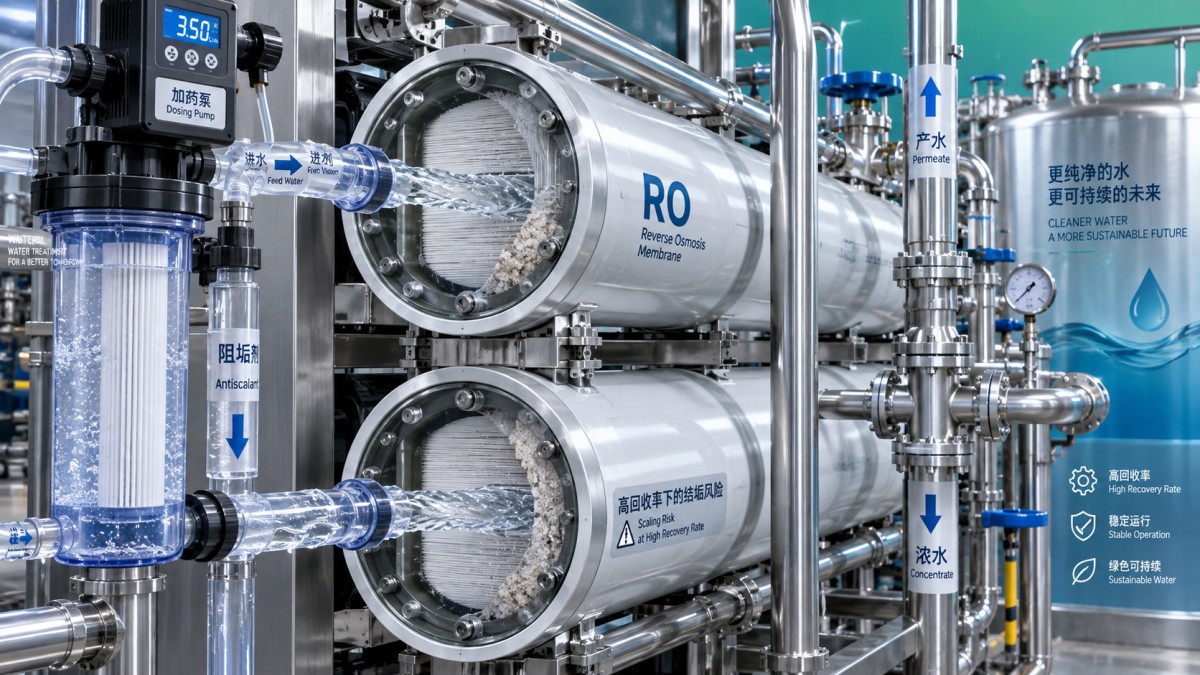
At higher recovery rates, an RO antiscalant program can appear adequate during commissioning and then lose control as the system approaches its intended operating point. The chemical may not have changed, but the concentrate chemistry has. As water recovery rises, dissolved salts, alkalinity, silica, metals, and suspended contaminants become progressively concentrated at the membrane surface. Small errors in water analysis, dose control, pretreatment, or product selection can therefore become membrane-scale deposits rather than manageable operating variation.
For project managers, antiscalant failure at high recovery should be treated as a system-design and control issue before it is treated as a chemical-performance issue. Increasing dosage alone may delay a problem, but it will not correct a mismatched saturation model, poor cartridge filtration, unstable feedwater, or an antiscalant that is incompatible with the target scale species and operating pH.
Recovery rate changes the chemistry faster than many designs assume
Recovery is the percentage of feedwater converted to permeate. The remaining concentrate carries most dissolved constituents, so its ionic strength and scale-forming tendency rise as recovery increases. This is especially important because scale formation is not driven only by bulk concentrate chemistry. Conditions directly next to the membrane surface can be more concentrated than the average stream leaving the pressure vessel.
At a moderate recovery rate, calcium carbonate, calcium sulfate, barium sulfate, strontium sulfate, silica, or calcium phosphate may remain below their precipitation thresholds. A higher recovery target can move one or several of those salts into a supersaturated range. The transition is often nonlinear: a modest increase in recovery may produce a much larger rise in scaling risk when alkalinity, pH, temperature, and concentration polarization act together.
This is why an antiscalant selected from a general feedwater description can fail after a capacity upgrade. A treatment program must be based on the final operating condition, including the expected concentrate composition at the highest planned recovery, not merely on raw-water values or the initial commissioning setpoint.
Incorrect or incomplete water analysis leads to the wrong treatment target
Many apparent chemical failures begin with an incomplete analysis. Total hardness and TDS are useful screening values, but they do not identify the full scale risk. A high-recovery RO design needs enough data to estimate the likely limiting salts and to identify constituents that interfere with antiscalant performance.
For carbonate scaling, the calculation depends on calcium, magnesium, alkalinity, pH, temperature, and carbon dioxide balance. For sulfate scales, the concentrations of calcium, barium, strontium, and sulfate must be understood. Silica requires its own assessment because its behavior differs from conventional mineral scales and can be strongly affected by aluminum, iron, pH, and concentration conditions. Phosphate, fluoride, dissolved metals, and residual coagulants can also matter in difficult feedwaters.
Sampling quality is as important as the laboratory report. Feedwater may vary by source, season, wellfield blend, regeneration cycle, or upstream treatment condition. A single sample collected during stable operation may not represent the water reaching the RO system during the most demanding period. For projects using recycled water, industrial wastewater, or mixed sources, a treatment program based only on average values can leave little protection when conductivity, hardness, silica, or alkalinity shifts upward.
The practical question is not whether the water meets a generic antiscalant application range. It is whether the treatment model remains valid under the high-side composition that the plant can realistically receive. Where source variability is material, the recovery limit and dosage should be established with operating margin rather than at the narrow point where calculations first predict acceptable control.
Dosage failures are often feed and control failures
Antiscalant dose is normally expressed relative to feed flow. At high recovery, an error in flow measurement, pump calibration, chemical strength, or injection timing can have a larger consequence because the process is already closer to saturation limits. A dosing pump that delivers intermittently, a diluted product made up incorrectly, or a low-level chemical tank can create short periods of underfeed that are sufficient for early nuclei to form on membrane surfaces.
Once deposits begin, restoring the specified dose may not reverse the problem. The antiscalant is intended to delay precipitation and disperse particles; it is not a substitute for cleaning established mineral scale. Operators may then interpret rising differential pressure or declining normalized permeate flow as evidence that the product “stopped working,” when the initiating event was a temporary loss of dosing control.
- Verify the actual chemical delivery rate against the dosing-pump setting and feedwater flow.
- Confirm the active concentration of the product after any onsite dilution or batch preparation.
- Inject upstream of sufficient mixing length, while avoiding locations where chemical may contact incompatible treatment streams.
- Review low-level alarms, pump stroke verification, calibration frequency, and standby pump changeover procedures.
- Trend dose, recovery, feed conductivity, pH, differential pressure, and normalized permeate performance on the same time scale.
Project teams should also distinguish a dose increase from a treatment redesign. More chemical may be appropriate after a validated calculation or operating change, but escalating dosage without identifying the scale mechanism can increase cost while masking a deeper issue.
Pretreatment problems can be mistaken for mineral scaling
RO antiscalants cannot compensate for every type of foulant. At higher recovery, suspended solids, colloids, oxidized iron, residual aluminum-based coagulant, organic matter, and biological material can concentrate and accumulate on the membrane. These deposits may trap mineral crystals or create localized conditions where scale develops more readily. The result can look like antiscalant failure even when the antiscalant is chemically suitable for the dissolved salts.
Iron deserves particular attention. Dissolved ferrous iron can oxidize downstream and form particulates; ferric solids may enter from corrosion, source water, or inadequate filtration. Likewise, residual coagulant carryover can create dense fouling layers that restrict mass transfer and increase concentration polarization. Under such conditions, a scale calculation based on clear feedwater may underestimate the membrane-surface risk.
A useful diagnostic is the cleaning response. If an acidic clean restores performance, mineral scale may be a major contributor. If alkaline cleaning, surfactants, chelants, or oxidizing-free biological cleaning steps are needed to recover performance, fouling may be equally important. Cleaning results are not a complete identification method, but they can direct the next investigation toward feedwater solids, organic contamination, membrane autopsy, or pretreatment performance rather than toward a simple antiscalant dose change.
Formulation compatibility matters more as the operating margin narrows
“Antiscalant” is a functional category, not a guarantee that every formulation is suitable for every RO feedwater. Products differ in their ability to control carbonate, sulfate, phosphate, silica-associated deposits, and metal-related fouling. They also differ in compatibility with pH adjustment chemicals, coagulant residues, membrane materials, and the concentration ranges created by the intended recovery rate.
For example, organophosphorus chelating chemistry may be highly relevant where difficult sulfate scales, including barium sulfate, are part of the water chemistry. Raw materials such as Hepta sodium salt of Diethylene Triamine Penta (Methylene Phosphonic Acid) (DTPMP·Na7) are used in scale-inhibition applications because of their chelating and barium sulfate control characteristics. That does not make a raw material, by itself, an RO treatment recommendation. In membrane service, the final formulation, dose, compatibility, impurity profile, and water-specific performance all require evaluation against the actual operating conditions.
This distinction matters during procurement. Comparing products only by unit price, active content, or a broad statement such as “high-performance scale inhibitor” can lead to a false economy. The relevant comparison is the cost and reliability of the treatment program at the required recovery: product quality consistency, formulation suitability, dosing concentration, technical documentation, and the ability to revise the program when feedwater changes.
pH adjustment and temperature changes can invalidate the original projection
Acid dosing is often used to reduce carbonate scaling potential, but its effectiveness depends on stable control. A pH probe drift, acid pump interruption, altered alkalinity, or changed feedwater blend can raise carbonate risk rapidly. Conversely, lowering pH may improve carbonate control while affecting corrosion management, downstream materials, or the behavior of other dissolved constituents. The operating target should therefore be controlled as part of an integrated water balance rather than as an isolated chemical number.
Temperature is another common source of error. Feedwater temperature can vary with season, process conditions, storage time, or source location. Solubility and membrane flux both respond to temperature, while higher flux can intensify concentration polarization. A design validated at one temperature may have less margin at another. Where recovery is pushed near a calculated limit, the temperature range should be included in the operating envelope and not treated as a secondary detail.
How to investigate an apparent high-recovery antiscalant failure
The investigation should begin before changing chemicals. First, confirm whether the system is operating at the recovery, flow, pH, temperature, and feedwater quality assumed during treatment selection. Then review whether the performance change is consistent with scaling, particulate fouling, organic fouling, biofouling, or a combination of mechanisms.
Where membrane deposits can be sampled, laboratory identification is more useful than assumption. Deposit composition can reveal whether calcium carbonate, calcium sulfate, barium or strontium sulfate, silica, metal oxides, organics, or mixed foulants dominate. A mixed deposit usually calls for coordinated changes in pretreatment, cleaning, recovery control, and chemical treatment rather than a single-product replacement.
Set a defensible recovery limit instead of chasing the highest possible number
Higher recovery reduces concentrate volume and can improve water yield, but it also narrows the buffer against feedwater variation and control error. The best recovery target is therefore not necessarily the highest number the system can reach under ideal feed conditions. It is the level that can be maintained with stable membrane performance, manageable cleaning frequency, dependable dosing, and adequate allowance for expected water-quality excursions.
For a project manager, the decision sequence is straightforward: validate the current water analysis, calculate concentrate risks at the intended operating envelope, verify pretreatment and dosing performance, identify deposits when performance has already declined, and then adjust recovery or treatment chemistry based on the confirmed mechanism. RO Antiscalants perform most reliably when they are part of that controlled operating strategy, rather than the final defense against an overloaded RO system.

ONLINE CONSULTATION
If you have any questions, please contact us and we will contact you as soon as possible.