


Where MA-AA-Na fits in dispersant applications for water treatment
MA-AA-Na fits best where a water treatment program needs to keep scale-forming minerals or fine suspended solids from depositing on equipment surfaces. It is generally used as a polycarboxylate dispersant: it does not simply “remove” hardness salts from water, but helps keep particles small, separated, and mobile long enough to leave the system through blowdown, filtration, or normal water circulation.
That distinction matters. A system can have a scale inhibitor and still develop deposits if precipitated calcium salts, iron oxides, clay, corrosion products, or biological debris agglomerate and settle in low-flow areas. MA-AA-Na is usually considered when this particle-control role is missing from the treatment program, particularly in industrial circulating water, boiler-related water systems, membrane pretreatment, and wastewater processes with variable solids.
What MA-AA-Na is designed to do
MA-AA-Na commonly refers to the sodium salt of a maleic acid-acrylic acid copolymer. The polymer contains negatively charged carboxyl groups that interact with mineral particles and suspended matter in water. These groups can adsorb onto particle surfaces, increasing electrostatic repulsion and making it harder for particles to join into larger, deposit-forming clusters.
In practical terms, this gives MA-AA-Na three related functions:
- It disperses precipitated inorganic salts, especially particles that may otherwise collect on heat-transfer surfaces or in pipework.
- It helps stabilize suspended corrosion products and fine solids, reducing their tendency to settle as sludge.
- It can support broader treatment formulations by improving the handling of particles created after scale control, corrosion control, coagulation changes, or fluctuating water quality.
Its role is therefore narrower than “general water treatment chemical,” but also more useful than a simple label such as “antiscalant.” MA-AA-Na is mainly a deposition-control component. It is selected when the chemistry must manage solids already present or likely to form in the water.
Where it is most relevant
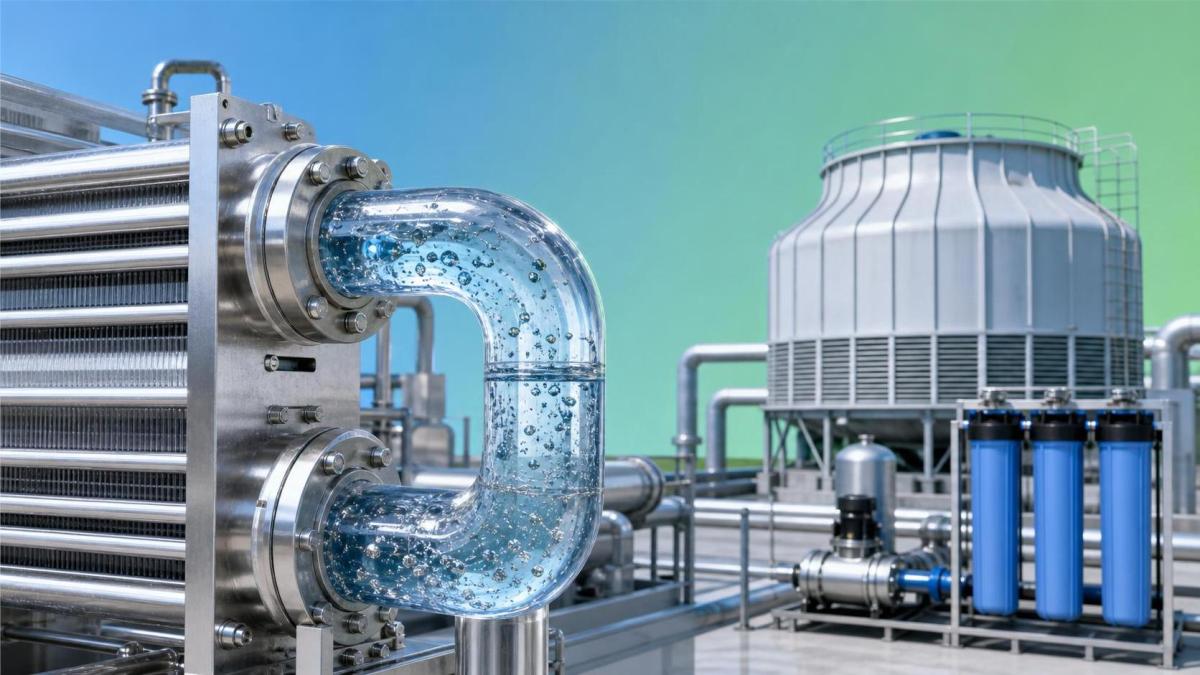
In recirculating cooling water, evaporation concentrates calcium, alkalinity, silica, dissolved salts, and incoming contaminants. A dispersant can help prevent fine precipitates and corrosion debris from attaching to heat exchangers, cooling towers, and distribution lines. MA-AA-Na is often evaluated alongside threshold scale inhibitors, corrosion inhibitors, and microbiological control products. The dispersant is not a replacement for any of those functions; it complements them when particulate deposition is part of the risk.
For boiler makeup water and auxiliary systems, the question is usually whether suspended solids or hardness leakage can contribute to deposits before the water reaches stricter-quality sections of the process. A dispersant may be useful in pretreatment or in systems where feedwater quality is less consistent. However, it should not be treated as a substitute for proper softening, demineralization, deaeration, or blowdown control. If dissolved hardness is excessively high, correcting the upstream water source remains the first task.
In RO pretreatment, MA-AA-Na may help manage fine particulate matter and mineral precipitation risks upstream of membranes. The suitability depends on the full pretreatment train. It must be assessed with coagulants, filtration media, membrane chemistry, and the planned cleaning regime in mind. A dispersant that performs well in open cooling water is not automatically appropriate for every membrane system, because residual polymer, compatibility, and fouling mechanisms need to be considered together.
Industrial wastewater treatment is another relevant area, especially where water contains fluctuating mineral solids, pigments, metal oxides, or process-derived fines. Here, the goal may be to keep solids dispersed temporarily before a controlled separation step, or to prevent unwanted deposits in pumps, pipelines, and transfer equipment. The desired behavior is process-specific: in a clarification stage, strong dispersion can work against rapid settling if used in the wrong location or at the wrong point in the treatment sequence.
Dispersant, scale inhibitor, and chelant are not interchangeable
A frequent selection error is to use these terms as though they describe the same chemical action. They overlap in real formulations, but their primary jobs differ.
MA-AA-Na may contribute to scale-management performance, but it is most clearly valuable when particle dispersion is required. A program designed only around dissolved-ion control can leave a gap once solids have formed. Conversely, a dispersant cannot solve a severe scale tendency caused by poor concentration control or inappropriate operating conditions.
Conditions that change the selection decision
Water chemistry should drive the choice, not the product name alone. The first items to examine are hardness, alkalinity, pH, conductivity, silica, iron, manganese, suspended solids, and the expected cycles of concentration. These values help distinguish a mineral-scaling problem from a corrosion-product problem, an incoming-solids problem, or a mixed condition.
Temperature and flow pattern are equally important. Hot surfaces and stagnant zones create the conditions in which particles are most likely to adhere and harden into deposits. A dispersant can reduce the probability of deposition, but it cannot fully compensate for dead legs, poor filtration, inadequate blowdown, or an exchanger operating beyond its intended thermal conditions.
Compatibility deserves the same attention as dispersancy. MA-AA-Na is an anionic polymer. Its behavior can be affected by strongly cationic treatment chemicals, metal salts, and certain coagulant programs. Mixing incompatible products in a concentrated dosing tank may cause haze, flocculation, loss of active performance, or feed-line deposits before the chemicals even reach the system.
This issue is relevant in cooling-water programs that also require biological control. For example, Dodecyl Dimethyl Benzyl Ammonium Chloride (1227) is a cationic quaternary ammonium biocide used to control bacteria, algae, and biological slime in recirculating systems. Because it is cationic while MA-AA-Na is anionic, they should not be assumed compatible in concentrated form. Separate storage, separate feed points, or a controlled dosing sequence may be needed so that the biocide and dispersant can perform their intended roles without direct chemical interference.
When MA-AA-Na may not be the main answer
It is not the primary remedy for every deposit. If the deposit is already thick, hard, and strongly attached, a cleaning program may be required before a dispersant can help maintain cleaner operation. If the problem is microbiological slime, the treatment plan needs an appropriate biocide and monitoring approach; dispersing organic debris does not control microbial growth. If foam is disrupting operation, defoamer selection should be evaluated separately.
It is also not automatically the best choice where rapid solids settling is the objective. In clarification, thickening, or sludge dewatering, treatment chemicals are often selected to aggregate particles rather than keep them separated. The correct question is not whether dispersion is generally beneficial, but whether dispersion is beneficial at that exact point in the process.
A practical way to evaluate it
Before adding MA-AA-Na to a water treatment formulation, define the deposit mechanism and the operating point where deposition occurs. A focused evaluation normally starts with these questions:
- What is the deposit made of: calcium salt, silica-rich material, iron oxide, silt, biological matter, or a mixture?
- Is the problem caused by dissolved salts becoming supersaturated, by solids entering with makeup water, or by corrosion products circulating through the system?
- Does the process need particles to remain dispersed, or does it need them to settle for removal?
- Which existing inhibitors, biocides, coagulants, defoamers, and corrosion inhibitors will share the same dosing system?
- Are there filtration, blowdown, or separation steps capable of removing the solids kept in suspension?
This last point is often missed. A dispersant reduces deposition by keeping particles mobile; the system still needs a way to remove those particles. Without adequate filtration or discharge, solids can remain in circulation and create a different fouling burden elsewhere.
For formulation development, the most useful next step is usually a compatibility and water-condition review using actual makeup water or representative process water. Suppliers that combine polycarboxylate dispersants with water-condition testing can help compare polymer options against the system’s mineral load, operating pH, temperature, and existing treatment chemistry. The aim is not simply to choose a more active dispersant, but to build a treatment program in which scale control, solids management, corrosion protection, biological control, and removal capacity work together.

ONLINE CONSULTATION
If you have any questions, please contact us and we will contact you as soon as possible.