


What causes PAPE to lose effectiveness in high alkalinity boiler systems?
When a boiler treatment program that once kept surfaces clean begins to underperform, operators often notice the symptoms before they identify the cause: rising blowdown demand, harder deposits around high-heat areas, declining heat-transfer efficiency, or more frequent cleaning. In many cases, the question is not simply whether the dosage is high enough. What causes PAPE to lose effectiveness in high alkalinity boiler systems? The answer usually lies in the combined effects of pH, temperature, water chemistry, and the changing condition of the boiler itself.
PAPE is valued as an organophosphorus scale-control agent because its phosphonate groups can chelate metal ions and interfere with crystal growth. Yet no scale inhibitor works independently of its environment. In a high-alkalinity boiler, the chemistry can move beyond the operating window where PAPE provides dependable threshold inhibition and dispersion. Understanding that shift helps operators correct the real problem rather than repeatedly increasing chemical feed.
High pH changes the scale-forming balance
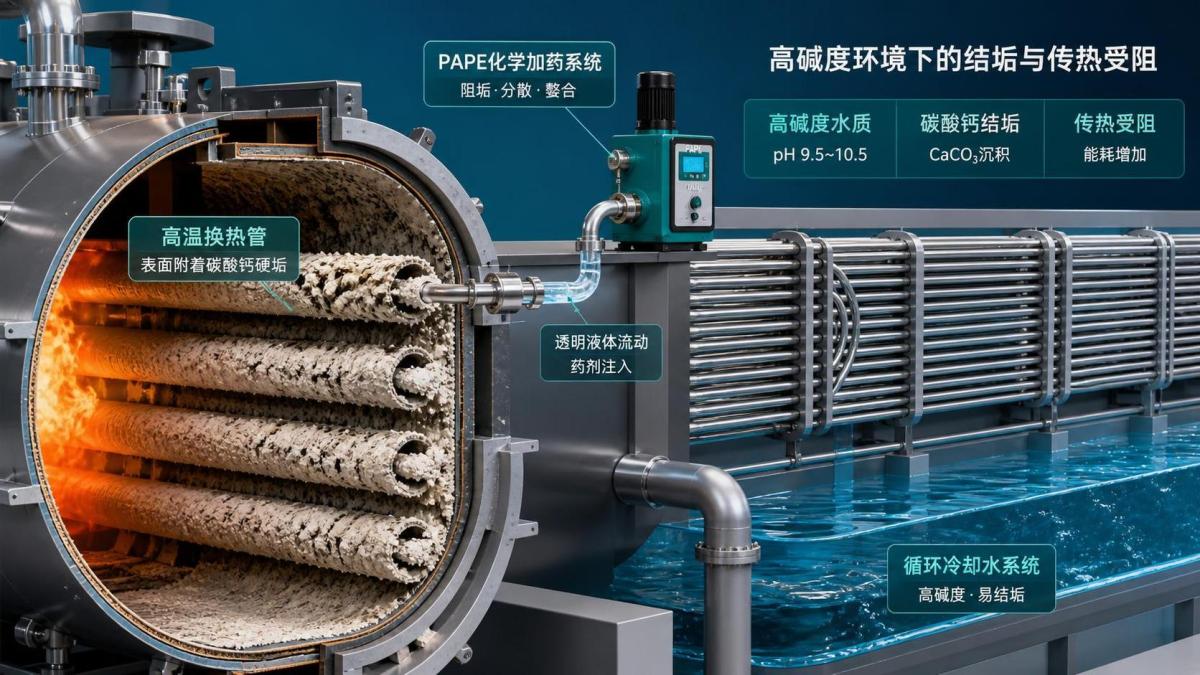
Boiler alkalinity is managed for important reasons, including corrosion control and stable operation. However, when alkalinity becomes excessive, calcium carbonate scale becomes much easier to form. As pH rises, bicarbonate species convert toward carbonate ions. If calcium is present in the feedwater or concentrated boiler water, the calcium carbonate saturation level can increase rapidly.
PAPE may still complex part of the dissolved calcium, but it is then working against a much heavier precipitation load. Once crystal formation accelerates, the inhibitor may no longer be able to keep every particle dispersed. This is especially evident near heat-transfer surfaces, where local temperature and concentration are higher than the values shown by a bulk-water sample.
In practical terms, high alkalinity can overwhelm the treatment program before the operator sees an obvious change in the feedwater. A boiler may appear chemically stable at the sampling point while deposits are already forming in high-flux tubes, mud drums, or low-circulation zones.
PAPE can lose functional availability through calcium interaction
PAPE controls hardness ions through sequestration and threshold inhibition, but excessively high calcium concentration changes the treatment demand. When calcium hardness, alkalinity, and cycles of concentration rise together, the ratio of available PAPE to scale-forming ions may become unfavorable.
This does not always mean the product has “failed.” More often, the active chemistry is being consumed or tied up by a greater ionic burden than the program was designed to manage. A dose that performed well during normal makeup-water quality may become inadequate after a softener breakthrough, condensate contamination event, reduced blowdown, or a change in makeup source.
Operators should therefore avoid judging PAPE performance from dosage alone. The more useful question is whether the active dosage is still matched to current calcium, magnesium, phosphate, silica, iron, and alkalinity conditions after concentration in the boiler.
Thermal stress and residence time also matter
High alkalinity rarely acts as a single isolated variable. It often occurs in systems operating at elevated temperature, high dissolved solids, and substantial cycles. Under these conditions, phosphonate-based treatment chemistry can face thermal stress over time. The degree of impact depends on boiler pressure, local metal-surface temperature, treatment formulation, oxygen control, and how long the chemical remains in the system.
Where thermal exposure is severe, PAPE may not retain the same level of scale-control activity expected in lower-temperature or lower-alkalinity service. Decomposition or reduced functional performance can leave less active material available to control hardness deposits. This is why a treatment program that appears satisfactory in a low-pressure application cannot automatically be transferred to a more demanding boiler without review.
Localized overheating makes the situation more difficult. A fouled tube, poor circulation area, or burner-side hot spot can create a surface environment far more aggressive than the average boiler-water analysis suggests. Deposit formation then becomes self-reinforcing: the deposit insulates the metal, the surface runs hotter, and further precipitation becomes more likely.
Iron, suspended solids, and old deposits can mask the real issue
Not every deposit in a high-alkalinity boiler is pure calcium carbonate. Iron oxides from corrosion, copper-bearing particulates, silica, phosphate solids, oil contamination, and old scale fragments can all create surfaces where new mineral scale anchors more easily. In these circumstances, PAPE may retain some chelating function but still deliver disappointing visible results because it is not designed to solve every deposition mechanism on its own.
Iron is particularly important. Corrosion products can form a porous, uneven base layer that traps solids and encourages under-deposit corrosion. If the boiler has poor condensate quality, oxygen ingress, or returning corrosion debris, a scale inhibitor alone is not a complete answer. Filtration, condensate protection, blowdown control, and dispersant selection should be reviewed together.
Old deposits create another common misunderstanding. A program may successfully slow new scale formation but cannot instantly remove thick, aged mineral deposits. If deposits begin shedding after a chemistry change, operators should confirm whether they are seeing fresh scale formation, cleaned-off legacy deposits, or loose corrosion products moving through the system.
Check these operating conditions before changing the chemical feed
When PAPE appears less effective, a structured review is more useful than immediately raising the pump stroke. Start by comparing current data with the period when the boiler performed well. Small changes can have a large combined effect.
- Boiler-water pH and M-alkalinity: Confirm that control limits are appropriate for the boiler design and pressure. Look for upward drift, not only single test results.
- Makeup-water hardness: Check for softener leakage, regeneration problems, bypassing, or a new water source.
- Conductivity and blowdown: Excessive cycles concentrate calcium, alkalinity, silica, and dissolved contaminants.
- Phosphate residual and phosphate balance: A mismatched phosphate program can contribute to sludge or hard deposits, depending on the chemistry and operating conditions.
- Iron and suspended solids: Increased iron may point to corrosion, pretreatment deficiencies, or return-line contamination.
- Chemical feed integrity: Verify pump calibration, day-tank concentration, injection location, and whether the treatment is being diluted or mixed with incompatible products.
- Deposit appearance: A deposit sample often reveals more than a routine water test. Carbonate-rich, phosphate-rich, silica-rich, and iron-rich deposits require different corrective priorities.
Why compatibility is more important than simply using more PAPE
In high-alkalinity service, effective treatment is usually a balanced program rather than a single active ingredient. The selected inhibitor must tolerate the temperature and water chemistry, while dispersants help keep precipitated solids from adhering to metal surfaces. Polymer chemistry can be particularly useful where iron oxide, calcium carbonate, calcium phosphate, or calcium sulfate deposits coexist.
For lower-pressure boilers and related industrial water systems, Copolymer of Sodium P-Styrene Sulfonate and Maleic Anhydride (SSS/MA) may be considered as a complementary dispersant and scale-inhibition component after compatibility testing. This copolymer has strong dispersion capability for iron oxide and is used in applications including low-pressure boilers, industrial circulating cooling water, and seawater flash evaporation equipment. Its scale inhibition performance for calcium carbonate, phosphate, and calcium sulfate can support a broader deposit-control strategy where mineral precipitation and suspended corrosion products occur together.
That said, adding a polymer does not remove the need to control alkalinity and hardness. A dispersant can help keep particles mobile; it cannot permanently compensate for severe softener leakage, uncontrolled concentration cycles, or a boiler operating outside its intended chemistry limits.
A practical response when deposits are already appearing
If scale is visible or heat-transfer performance is declining, stabilize the system before making major treatment changes. Confirm boiler-water testing methods, bring blowdown back to the correct control range, inspect makeup-water softening performance, and verify the actual chemical feed rate. Where safe and appropriate, collect deposit samples for analysis instead of relying on color or texture alone.
Then review the treatment program as a whole: alkalinity control, phosphate management, PAPE dosage, dispersant support, oxygen scavenging, condensate treatment, and the location where chemicals enter the system. An injection point with poor mixing can make a well-designed formula behave inconsistently. Likewise, a sudden increase in load can change concentration behavior faster than routine sampling intervals reveal.
The central lesson is that PAPE does not usually lose effectiveness for one mysterious reason. High alkalinity increases carbonate scale pressure, concentrates hardness ions, magnifies thermal and local surface effects, and can expose limitations in dispersancy or feedwater control. By tracing those connected factors, boiler operators can restore a more stable water-treatment balance and reduce the cycle of deposits, cleaning, and lost efficiency.

ONLINE CONSULTATION
If you have any questions, please contact us and we will contact you as soon as possible.