


How to troubleshoot an industrial wastewater scale inhibitor program
Start by confirming that the deposit is truly scale. A hard, adherent layer on heat-transfer surfaces, pipe elbows, pump internals, clarifier launders, or membrane-feed equipment suggests mineral precipitation, but sludge, iron oxide, biological film, polymer residue, and gypsum-rich deposits can look similar. Treating every deposit as calcium carbonate often leads to unnecessary dose increases and no improvement.
Collect a representative deposit sample before cleaning the affected area. Compare its appearance and location with current water analyses: calcium hardness, magnesium, alkalinity, pH, conductivity, sulfate, silica, phosphate, iron, suspended solids, temperature, and concentration factor where recirculation occurs. A deposit forming immediately downstream of a chemical injection point points toward localized overdosing or poor dilution. Deposits concentrated on the hottest exchanger channels point toward heat-driven precipitation. Scaling in low-flow dead legs often indicates settling, inadequate turnover, or stagnant zones rather than a simple inhibitor shortage.
Establish whether the water chemistry has changed
A scale inhibitor program is designed around a specific relationship between dissolved ions, pH, temperature, retention time, and flow. When influent quality changes, the previous program may no longer match the precipitation risk. Review a time series rather than relying on one current sample. The useful comparison period begins before the first scaling observation and continues through the present condition.
Pay particular attention to changes in source water, regenerated water, process wash water, cleaning effluent, and blowdown rate. A small rise in calcium can become significant when evaporation, recycling, or reduced blowdown concentrates the system. Higher alkalinity or a pH increase shifts carbonate equilibrium toward calcium carbonate formation. By contrast, a sulfate increase can shift the problem toward calcium sulfate, where pH adjustment alone is less effective. Silica requires separate interpretation because it may form a hard deposit with metal ions or co-deposit with iron, aluminum, and organic matter.
Conductivity is valuable for tracking concentration, but it does not identify which ions are driving scale. Two wastewaters with similar conductivity can have very different scaling behavior. Likewise, a stable pH does not prove stable saturation risk if calcium, sulfate, silica, temperature, or dissolved solids have shifted.
Verify the inhibitor feed before changing the chemistry
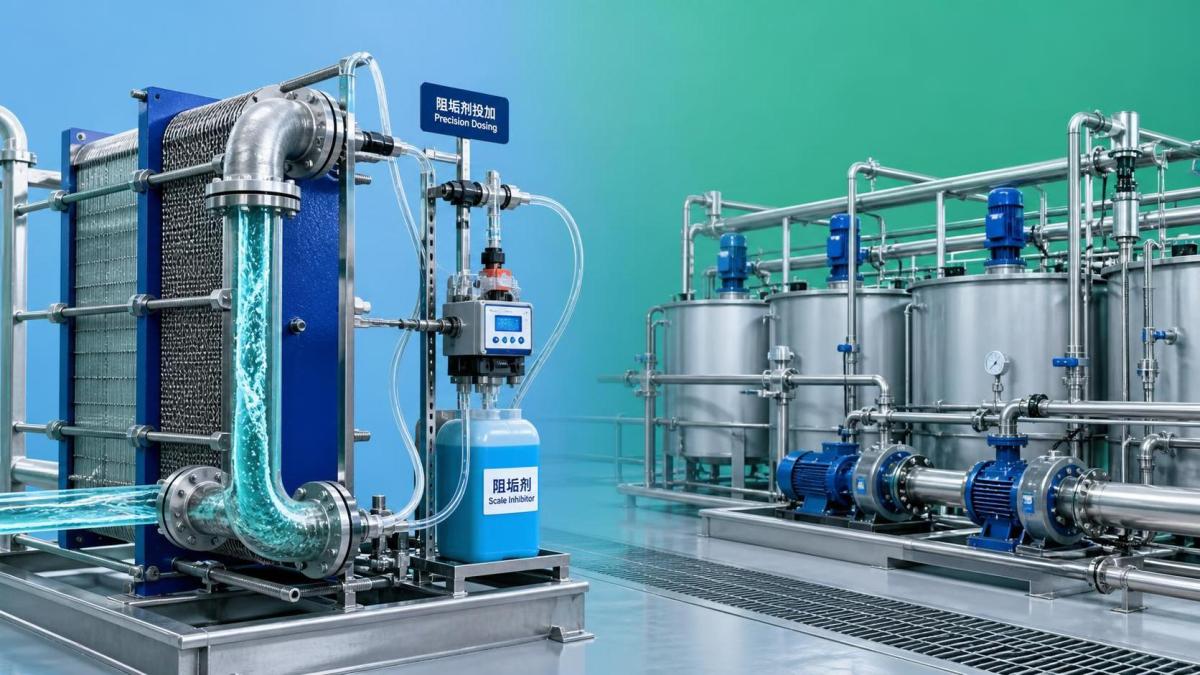
Many apparent chemical failures are delivery failures. Confirm the active product concentration in the day tank, the dilution water source, pump calibration, suction-line integrity, injection quill condition, and actual run time. A metering pump can show normal strokes while delivering less chemical because of gas locking, crystallized check valves, worn diaphragms, blocked strainers, or loss of prime. A transparent suction line may reveal intermittent bubbles that are missed during a brief inspection.
Review inventory use against the intended feed rate and wastewater flow. This simple mass-balance comparison often exposes a mismatch between the programmed dose and the chemical actually consumed. Do not assume that a tank level change proves correct dosing; unnoticed transfer errors, dilution variation, leaks, and manual additions can distort the result.
The injection point matters as much as the nominal dose. The inhibitor should enter a location with sufficient turbulence and residence time before the water reaches a hot surface, high-pH zone, membrane, or pressure-reduction point. Injection into a poorly mixed sump can leave part of the system unprotected while producing a locally high chemical concentration. If feed enters beside caustic, lime, coagulant, oxidant, or a metal salt, assess whether immediate contact causes precipitation, degradation, or loss of dispersant performance.
Separate scale control from solids control
An industrial wastewater scale inhibitor keeps sparingly soluble salts dispersed or interferes with crystal growth; it does not replace removal of excessive suspended solids. When clarifier carryover increases, fine solids provide surfaces on which crystals can grow and adhere. A filter may then plug with a mixed deposit of mineral scale, sludge, and organic material. Raising inhibitor dosage without restoring solids separation can make the deposit softer or more dispersed in one location while increasing downstream loading elsewhere.
Examine turbidity, settleability, filter differential pressure, sludge blanket behavior, and polymer dosing alongside the scale observations. Cationic polymer carryover can also interact with anionic dispersants or alter particle transport. The result may be misread as inhibitor incompatibility when the primary issue is poor separation upstream.
Iron and aluminum deserve special attention. Corrosion products, coagulant carryover, and dissolved metal released under changing pH conditions can combine with phosphates, silicates, or organics. A brown or reddish deposit is not automatically iron oxide; laboratory analysis is needed before selecting a cleaning method or altering the treatment formula.
Test compatibility under the actual operating sequence
Bench testing is most useful when it reproduces the order of addition, dilution ratio, contact time, temperature, and pH shift seen in the process. Combining full-strength products in a sample bottle can create a precipitate that would never form after proper dilution. Conversely, a room-temperature jar test may miss a deposit that develops only after heating or after several hours of recirculation.
Run comparative tests using current wastewater and, where available, a retained sample from stable operation. Include the existing treatment program, revised inhibitor dose, and suspected interfering chemicals. Observe turbidity, color change, sediment formation, pH drift, and filterability. For severe deposits, analyze the solids rather than making decisions from solution appearance alone.
For alkaline systems where calcium carbonate risk is dominant, an organophosphonate can be part of a blended program with polycarboxylate dispersants. Penta Sodium Salt of Amino Trimethylene Phosphonic Acid (ATMP·Na5) is an alkaline, sodium-salt phosphonate with chelating and scale-control functions. Its selection still requires confirmation of active concentration, wastewater pH, metal-ion content, phosphorus limits within the treatment train, and compatibility with the rest of the formula. A chemical that performs well in circulating cooling water is not automatically the correct standalone response for a wastewater stream containing high solids, unusual salts, or variable process contaminants.
Look for operating conditions that overpower the program
Scaling can begin when flow distribution changes even if bulk water tests remain within the prior operating range. Partially closed valves, fouled strainers, bypass leakage, pump degradation, and uneven exchanger loading create local hot spots or low-velocity regions. These conditions concentrate ions at a surface and reduce the opportunity for the inhibitor to control early crystal growth.
Inspect equipment history alongside treatment data. A recurring deposit at the same exchanger pass, nozzle, elbow, or membrane stage is a hydraulic clue. A system-wide deposit after a production change is more consistent with altered water chemistry, evaporation, recovery, or chemical feed. If the issue began after cleaning, consider whether loosened deposits redistributed downstream or whether residual cleaner changed pH and dissolved metal concentrations.
Do not change dosage, pH control, blowdown, and formula composition all at once. That approach can stop visible scaling temporarily but removes the evidence needed to identify the cause. Correct the verified mechanical or feed defect first, then make one controlled chemical adjustment and monitor the response through water analysis, deposit observation, pressure drop, heat-transfer behavior, and cleaning frequency.
Restore control and document the new baseline
After the immediate issue is stabilized, record the conditions under which the program is performing acceptably: influent chemistry range, wastewater flow, dilution method, injection location, pump output, pH control point, temperature, blowdown or purge rate, and the acceptable condition of critical equipment. Include the analytical method and sample location, since a sample taken before reagent addition cannot confirm conditions at a downstream scaling surface.
Set action limits around meaningful trends rather than waiting for visible deposits. A gradual increase in calcium concentration, exchanger differential pressure, conductivity, or filter loading can identify deteriorating control before equipment requires cleaning. When a raw-material, production, or water-source change is planned, repeat a short compatibility and saturation review before returning the system to full operating load.

ONLINE CONSULTATION
If you have any questions, please contact us and we will contact you as soon as possible.