


Prio Cooling Water Scale Inhibitor: Assessing Cost per Cubic Meter Treated
A useful cost comparison for Prio Cooling Water Scale Inhibitor starts with the delivered chemical price, the dose required under the plant’s operating conditions, and a clearly defined water-volume basis. A quotation becomes meaningful when those three elements are connected. Price per tonne alone cannot establish which option will cost less to operate.
For procurement, the first benchmark should be chemical cost per cubic meter of makeup water, supported by a separate assessment of water, discharge, and maintenance costs. A lower calculated chemical cost is attractive only if the proposed treatment maintains acceptable deposit control and remains compatible with the rest of the cooling-water program.
Define what “per cubic meter treated” actually measures
A circulating cooling system contains several different water volumes: system inventory, recirculating flow, makeup, and blowdown. Each describes a different part of operation. Dividing chemical expenditure by whichever volume is easiest to obtain can make competing quotations appear more favorable or less favorable without any change in treatment performance.
Makeup water provides a practical basis for comparing ongoing chemical consumption, provided both suppliers express their recommendations on that basis. Recirculating flow repeatedly counts water passing through the system, so a cost calculated against it will be much smaller. Such a figure can be useful within a consistently defined site metric, but it cannot be compared directly with a cost based on makeup.
Also distinguish a maintenance feed rate from an initial system charge. A concentration specified in the circulating water does not automatically translate into the same concentration dosed into makeup water. Chemical losses, blowdown, system volume, and the dosing-control method affect the required feed.
Before comparing offers, ask each supplier to state whether its recommendation describes:
- An as-supplied product dose per cubic meter of makeup water.
- An active-material dose on the same water basis.
- A target concentration maintained in the circulating water.
- A one-time initial charge followed by a separate maintenance feed.
If the quotation specifies only a circulating-water target, request an estimated consumption calculation using the site’s water balance. Otherwise, the procurement spreadsheet may assign a precise cost to an undefined dosing requirement.
Calculate chemical cost using comparable doses
When dosage is expressed as milligrams of as-supplied product per liter of makeup water, the calculation is straightforward:
Chemical cost per m³ of makeup = delivered price per kg × product dosage in mg/L ÷ 1,000.
The conversion matters: 1 mg/L equals 1 gram per cubic meter. A dose of 20 mg/L therefore consumes 0.020 kg of product per cubic meter of makeup water.
Consider a hypothetical comparison, with all prices and doses used only to demonstrate the calculation. Product A costs $2.00/kg delivered and requires 20 mg/L, giving a chemical cost of $0.040/m³. Product B costs $2.50/kg and requires 14 mg/L, giving $0.035/m³. Despite its higher unit price, Product B has the lower calculated chemical cost. That advantage depends on the lower dose delivering acceptable performance under equivalent operating conditions.
Active content introduces another potential mismatch. If a recommendation is expressed on an active basis, convert it to the purchased product before calculating expenditure:
As-supplied dose = required active dose ÷ active mass fraction.
For example, an illustrative requirement of 8 mg/L active material would require 20 mg/L of a product containing 40% active material. However, a specification for 40% solids should not automatically be treated as 40% effective active ingredient. The analytical definition and formulation composition must support that conversion.
Price per kilogram of active material can help compare equivalent grades. It is less useful when comparing different chemistries or formulated blends, because equal active mass does not establish equal scale-control performance.
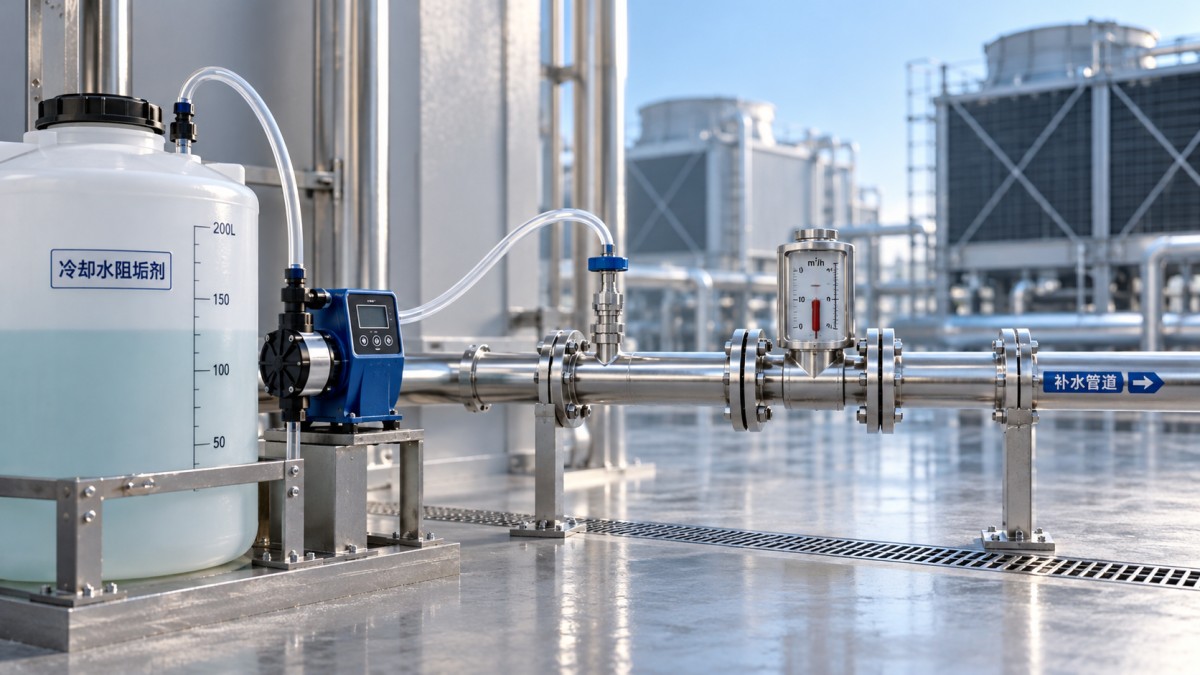
Use a delivered price that includes the costs actually borne by the plant, such as freight, applicable duties, and packaging charges. Keep recoverable taxes separate. Package size can also affect usable cost through handling requirements, retained product, storage limits, and the time needed to consume an order.
Establish whether the quoted dose fits the water
A dosage recommendation should connect to the deposit risk at the intended operating conditions. Calcium hardness, alkalinity, pH, temperature, silica, suspended solids, and cycles of concentration can all influence the treatment requirement. The conditions at heated surfaces also matter; a satisfactory bulk-water reading does not by itself demonstrate adequate protection at a heat exchanger.
For a Prio Cooling Water Scale Inhibitor quotation, provide the makeup-water analysis and the intended operating range before asking for a firm consumption estimate. Include seasonal variation where it is material. A recommendation developed around one water source may need adjustment if the plant switches sources or increases concentration cycles.
A phosphorus-free polymer may merit evaluation where phosphorus discharge constraints affect treatment selection. One relevant option is Sodium Salt of Polyaspartic Acid (PASP), offered as a liquid with specified solids content of at least 40.0%. Its purchase specification can support grade comparison, but the economical operating dose still requires assessment against the site’s scale-forming conditions and treatment program.
Corrosion protection deserves a separate acceptance criterion. A scale-control ingredient’s corrosion-related properties do not establish that it can replace a complete corrosion inhibitor program. If a formulation change requires additional corrosion inhibitor, dispersant, or other treatment chemicals, include those costs in the comparison.
Laboratory screening can help narrow the choices, particularly when tests reproduce the relevant water chemistry and temperature. Procurement should request the test conditions behind any inhibition percentage. A result obtained under one set of conditions cannot establish the dose needed across a plant’s operating range.
Price the operating outcome before awarding the order
A treatment program may justify a higher chemical cost if it permits reliable operation at higher cycles of concentration. Under a suitable water balance, this can reduce makeup and blowdown requirements. The savings depend on actual operating limits: conductivity, silica, corrosion, suspended solids, or discharge conditions may prevent the proposed increase even when calcium-scale control improves.
For that reason, compare operating scenarios over the same period and cooling duty. Calculate total expenditure for chemicals, makeup water, blowdown handling, and any materially affected operating costs. Dividing annual expenditure by each option’s own makeup volume can obscure the financial benefit of reducing water consumption, because the denominator changes.
Keep demonstrated savings separate from estimates. Reduced cleaning frequency or improved heat transfer may have substantial value, but those benefits need evidence before they are credited in a purchase decision. A defensible comparison can show the chemical-only result first, then add water savings and other benefits as their assumptions become supportable.
A controlled site trial should record chemical consumption, makeup and blowdown volumes, operating conditions, and agreed indicators of deposition and corrosion. The observation period must be long enough to reveal the relevant behavior, with allowance for changes in load or water quality. A low dose during favorable conditions provides limited evidence for a more demanding season.
The final purchasing specification should connect product quality, delivered price, expected consumption, and performance acceptance. It should also define how dosage will be reviewed if water chemistry changes. The strongest quotation is one whose cost per cubic meter can be reproduced from clear assumptions—and whose operating dose remains credible when the plant reaches the conditions it actually needs to manage.

ONLINE CONSULTATION
If you have any questions, please contact us and we will contact you as soon as possible.