


Deposits After Switching to Prio Cooling Water Scale Inhibitor: What to Check
Deposits appearing in strainers, cooling tower basins, or heat exchangers after switching to Prio Cooling Water Scale Inhibitor do not automatically indicate product failure. The material may be fresh mineral scale, loosened legacy deposits, corrosion products, or biological fouling. Increasing the dose before identifying it can leave the actual cause untreated and complicate troubleshooting.
Start by collecting representative deposits, verifying actual chemical delivery, and comparing water chemistry before and after the changeover. Track heat-transfer performance and pressure drop alongside these checks: suspended material with stable equipment performance requires a different response from an adherent deposit accompanied by rising operating temperatures or restricted flow.
Establish where the deposit is forming
Record the first observation, affected equipment, and whether the material is loose or firmly attached. Deposits in a basin are not equivalent to deposits on a hot exchanger surface. A dispersant may mobilize existing debris, while fresh mineral precipitation can concentrate at surfaces where temperature and local water chemistry differ from the bulk circulating water.
Compare the changeover date with maintenance, makeup-water changes, production load, blowdown adjustments, and biocide treatments. Timing helps narrow the investigation but does not establish causation. A partially blocked exchanger discovered after the switch may have accumulated deposits beforehand.
Protect equipment first. Rapidly increasing differential pressure, declining cooling capacity, abnormal metal temperatures, or evidence of leakage should trigger site operating procedures. Do not keep equipment running solely to complete a chemical trial.
Identify the material before choosing a treatment
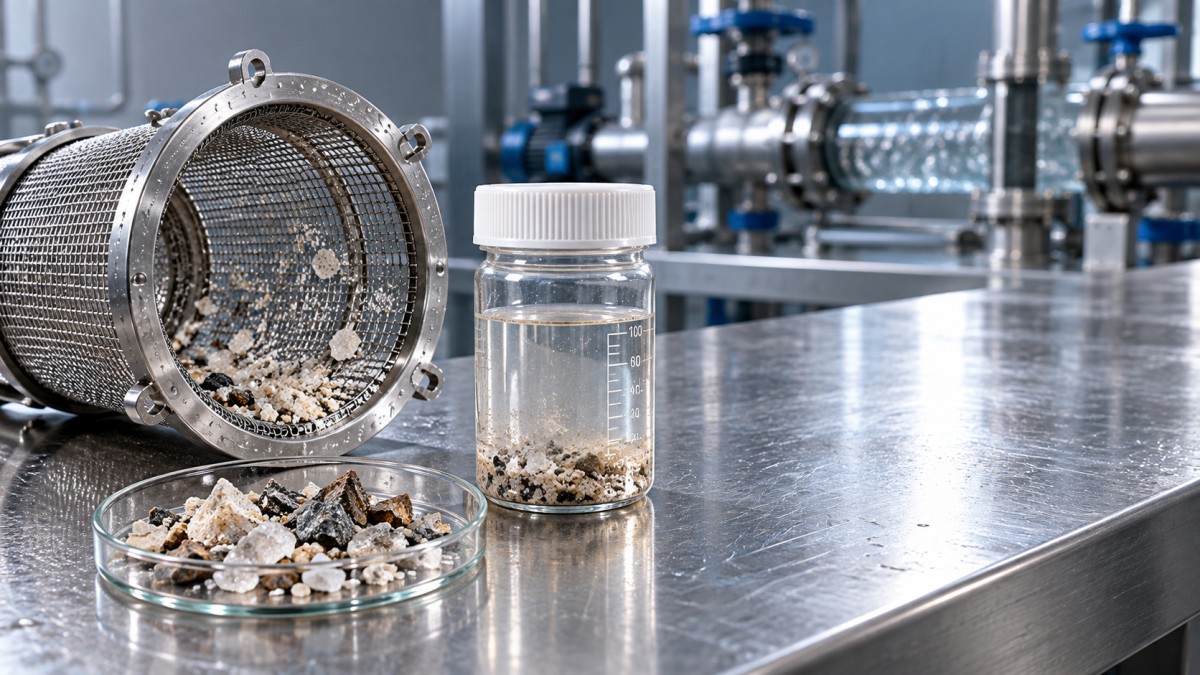
Take separate samples from affected surfaces, strainers, and basin sediment using site-approved sampling procedures. Label each with its location and collection date. Photographs are useful, but color and texture alone cannot establish composition; mixed deposits are common.
Laboratory methods such as elemental analysis and mineral-phase identification can help distinguish calcium carbonate, calcium phosphate, iron-rich material, and mixed deposits. Leave chemical spot tests to trained personnel under laboratory procedures. An acid response alone is not a reliable basis for selecting an operating correction.
Verify delivery rather than relying on pump settings
A pump display confirms a setting, not the mass of treatment reaching the system. Check tank consumption against the expected feed, inspect suction lines for air entry, and examine strainers, check valves, and injection quills for restriction. Calibrate delivery under actual discharge conditions using an approved method.
- Confirm the product and concentration basis. Match the container label, batch details, and dilution instructions to the approved treatment program. Distinguish commercial-product dose from active-solids dose.
- Review the feed calculation. Confirm whether control is based on makeup flow, system volume, bleed losses, or another approved model. Recheck units, density conversions, and changes in operating demand.
- Inspect the injection location. Verify adequate mixing and avoid concentrated contact with incompatible chemicals. A blocked quill or poorly mixed injection point can create local conditions that bulk sampling misses.
- Check interruptions. Refill gaps, interlock faults, loss of power, and intermittent makeup flow can create periods of inadequate treatment despite acceptable daily consumption.
Use the supplier-recommended residual method where available, and confirm what it measures. A phosphorus result may include contributions from other treatment chemicals or source water; it should not automatically be interpreted as the concentration of the new inhibitor.
Compare water chemistry across the changeover
Review makeup and circulating-water analyses together. Relevant parameters include pH, conductivity, calcium hardness, alkalinity, phosphate, silica, iron, and suspended solids. Add other constituents when the deposit analysis or source-water history indicates a need.
Check cycles of concentration using an appropriate conservative constituent and a verified water balance. Conductivity is useful for control, but changes in makeup composition and chemical additions can affect interpretation. Inspect the conductivity probe, sample flow, bleed valve, and controller settings before concluding that blowdown is adequate.
Higher concentration cycles, increased pH, or hotter exchanger surfaces can increase precipitation risk even when the treatment feed is unchanged. Bulk water temperature does not describe the hottest metal surface. Review load, flow distribution, and low-flow branches alongside the chemical data.
A fall in dissolved calcium can support a precipitation hypothesis, but it is not proof by itself: makeup variability, dilution, and sampling inconsistency can produce similar changes. Compare equivalent sampling points and operating conditions. Saturation calculations help assess mineral risk, but they do not independently predict the performance of a treated system.
Check formulation fit and changeover compatibility
A switch between treatment programs may change dispersancy, phosphorus contribution, acidity, or compatibility with the remaining corrosion-control package. Review the complete program, including biocides, corrosion inhibitors, process contamination, and residual material in the feed tank. Compatibility in diluted circulating water does not establish compatibility between concentrates.
For calcium carbonate or calcium phosphate control, Acrylic Acid/Acrylate/Phosphonic Acid/Sulfosalt Tetra-copolymer (PR-241) is a scale-inhibiting dispersant intended for circulating cooling water. Its stated properties include inhibition of these scales and compatibility with common water-treatment agents. Those properties make it relevant to a formulation review, not a substitute for confirming the deposit or validating the complete program under site conditions.
The supplied product has a solids specification of at least 35.0%. Its specified pH of 3.0–5.0 applies to a 1% aqueous solution, not to the required operating pH of the cooling system. Do not transfer the previous product’s pump setting directly without checking concentration, formulation, and the approved dose basis.
Match corrective action to the confirmed cause
- Fresh mineral scale: restore verified feed and blowdown control, then review pH, concentration cycles, heat load, and formulation suitability. Existing adherent scale may require a separately engineered cleaning procedure.
- Mobilized legacy material: assess filtration capacity, strainer loading, and controlled solids removal. Track whether suspended solids decline without new adherent deposits forming.
- Corrosion products: investigate corrosion-control continuity, pH excursions, contamination, and affected metallurgy. Increasing scale inhibitor alone does not correct metal loss.
- Biological fouling: review biocide delivery, contact conditions, attached growth, and cleaning requirements. Do not improvise biocide combinations or concentrate mixing.
Make controlled changes and define the response to monitor: deposit accumulation, normalized exchanger performance, differential pressure, suspended solids, or corrosion indicators. Visual clarity alone is insufficient; clearer water can coexist with continued deposition on equipment.
When laboratory interpretation or a formulation change is needed, send technical support the deposit findings, product batch and dilution records, verified feed rate, water analyses, blowdown history, chemical schedule, and operating trends. Agree on a monitoring period appropriate to system turnover and operating variability before judging the correction. Continued fresh deposition despite verified delivery and controlled chemistry warrants reassessing the program’s suitability rather than repeatedly increasing the dose.

ONLINE CONSULTATION
If you have any questions, please contact us and we will contact you as soon as possible.