


How to Select the Best RO Antiscalant for Feedwater with High Sulfate Levels
The best RO antiscalant for high-sulfate feedwater is the formulation that controls the specific sulfate salts predicted at the membrane surface—not simply the product advertised for “high sulfate.” Calcium, barium, and strontium concentrations, system recovery, and operating conditions determine whether a formulation is suitable. Sulfate concentration alone cannot establish either the product choice or its dosage.
A defensible selection requires a complete feedwater analysis, concentrate-side scaling projections, and performance evidence within the proposed operating range. Where those projections exceed a formulation’s validated limits, reducing recovery or removing scale-forming ions is more reliable than increasing the chemical dose without supporting data.
Identify which sulfate salt sets the operating limit
Sulfate scaling begins when dissolved ions become sufficiently supersaturated for crystals to form and grow. An antiscalant delays nucleation and interferes with crystal growth; it does not remove sulfate or hardness from the water. Its protection therefore has limits, particularly as concentration and residence time increase.
The distinction between calcium sulfate, barium sulfate, and strontium sulfate matters because their solubilities and inhibition requirements differ.
A product supported only by calcium carbonate testing is not adequately qualified for sulfate-dominated duty. Likewise, strong calcium sulfate performance does not establish equivalent protection against barium sulfate. The controlling salt may be a minor constituent of the feed rather than the most abundant one.
Build the projection around concentrate conditions
The water analysis should represent the feed entering the RO after pretreatment and chemical additions. It should include calcium, magnesium, barium, strontium, sulfate, alkalinity, pH, temperature, conductivity or total dissolved solids, and other relevant ions. Silica, phosphate, iron, aluminum, and manganese also deserve attention because competing deposits or chemical interactions can undermine an otherwise suitable sulfate inhibitor.
For barium and strontium, request analytical reporting limits low enough to support the projection. A result reported as “not detected” is not equivalent to zero. Where the reporting limit could affect the selection, evaluate a conservative case using that limit and obtain more sensitive analysis if necessary.
As an initial approximation, the bulk concentration factor is 1/(1 − recovery), assuming negligible salt passage and no precipitation. At 75% recovery it is approximately four; at 80% it is approximately five. This illustrates why a relatively small recovery increase can materially change scaling risk. It is not a substitute for a membrane-system projection.
A useful projection accounts for ion activities, temperature, salt passage, staging, and concentration polarization. The membrane surface can experience higher concentrations than the bulk concentrate. Saturation indices or saturation ratios must also be interpreted according to the software’s definitions; numerical limits from different calculation methods are not automatically interchangeable.
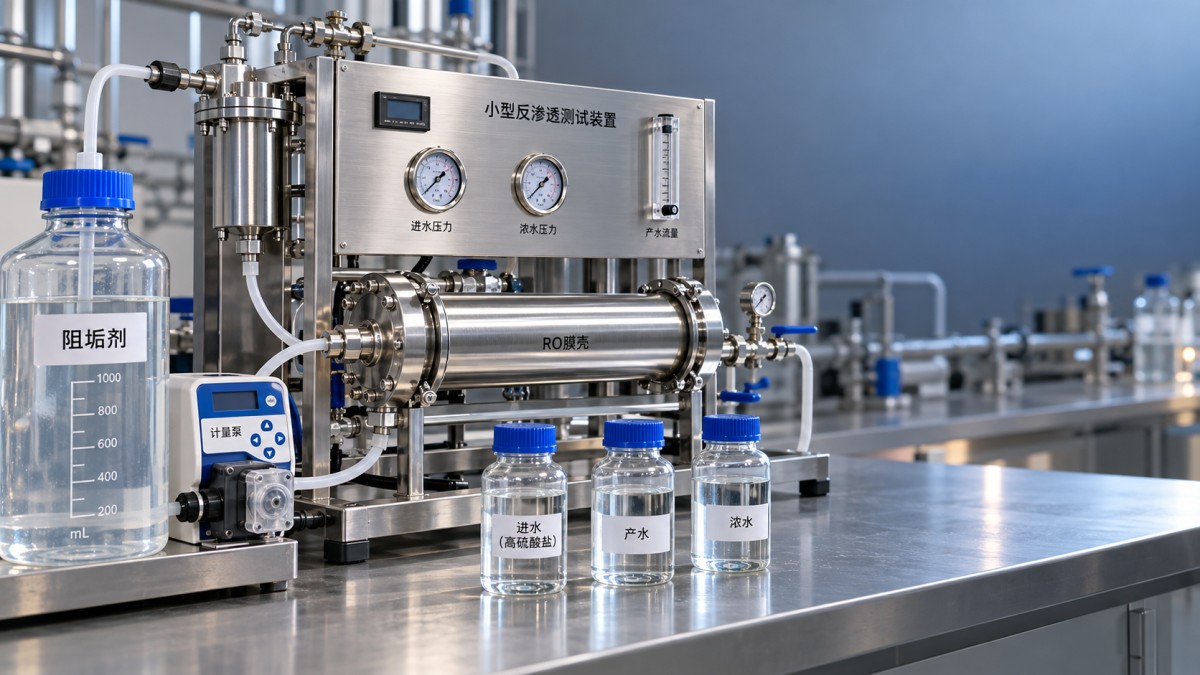
Ask for separate results for each relevant sulfate salt at normal operation and at credible extremes: maximum recovery, seasonal water-quality changes, source blending, and the expected temperature range. A recommendation based on one favorable sample provides little protection when the feed composition changes.
Select a formulation by evidence, not chemical family alone
RO antiscalants can contain phosphonates, polycarboxylates, other functional polymers, or combinations of these chemistries. Chemical family helps explain potential behavior, but it does not establish a universal performance ranking. Molecular structure, formulation balance, active concentration, and the surrounding water chemistry all affect inhibition.
For sulfate-rich feedwater, the decisive evidence is a formulation-specific operating envelope. A supplier’s recommendation should identify the limiting salt, projected saturation, proposed dose, and assumptions behind the calculation. A broad claim such as “effective at high hardness” is insufficient.
Laboratory results are more useful when the test conditions are disclosed. Relevant details include ion concentrations, temperature, pH, exposure time, dose basis, and the method used to detect precipitation. A short static test showing clear water may demonstrate delayed precipitation, but it does not establish long-term protection in a continuously concentrating membrane system.
Other deposits cannot be ignored simply because sulfate is the principal concern. A sulfate-focused formulation must still accommodate the projected carbonate and silica conditions. Iron or aluminum carryover from pretreatment may also interact with some antiscalants, creating deposits that are not sulfate scale.
Check the whole chemical program for incompatibilities
Compatibility review should cover the membrane, antiscalant, coagulants, biocides, reducing agents, and dilution water. Confirm suitability for the actual membrane type and intended exposure conditions, rather than relying on an unrestricted “membrane-safe” description.
Cationic treatment chemicals require particular scrutiny when an anionic antiscalant is used. For example, Dodecyl Dimethyl Benzyl Ammonium Chloride (1227) is a quaternary ammonium biocide, not a sulfate antiscalant. Its activity against sulfate-reducing bacteria should not be confused with inhibition of inorganic sulfate precipitation. Carryover into an RO feed requires a specific membrane and chemical compatibility assessment because interactions with anionic formulations can create fouling risks.
Acid selection also affects the calculation. Lowering pH can reduce calcium carbonate scaling potential, but it does not provide equivalent control of sulfate salts. Sulfuric acid introduces additional sulfate and can worsen the sulfate balance. Any change in acid type or dose should therefore be included in the projection.
Establish a dose that can be delivered reliably
There is no technically defensible universal dose for “high-sulfate water.” Establish the starting dose from the selected formulation’s projection and supporting test data. The recommendation should state whether the concentration refers to the commercial product as supplied or to active ingredients. Comparing products on different dose bases can distort both performance and cost comparisons.
Verify that the dosing equipment can deliver the required amount across the actual feed-flow range. Flow-paced dosing, low-level alarms, pump calibration, and adequate mixing help keep the membrane exposure consistent. Injection should occur at a supplier-approved location that provides effective mixing before the membranes without adverse contact with incompatible chemicals.
Dilution introduces another potential failure point. Use suitable dilution water, follow the product’s storage and dilution instructions, and avoid excessive tank residence time. A correct calculated dose offers little protection if the solution deteriorates, precipitates, or is delivered intermittently.
Overdosing is not a substitute for correcting an unrealistic recovery target. Beyond the validated range, additional chemical may provide little extra inhibition while increasing cost or chemical-interaction risk. If the required conditions exceed demonstrated performance, evaluate lower recovery, hardness or barium/strontium removal, or changes in source-water blending.
Validate the selection against membrane performance
Where barium sulfate risk is substantial or the proposed conditions approach the formulation’s limits, laboratory screening followed by a controlled membrane pilot provides stronger evidence than a projection alone. Test realistic water chemistry and recovery, not merely a convenient synthetic solution at milder conditions. For severe risk, establish safe trial limits before exposing a production array.
During validation, track normalized permeate flow, normalized salt passage, stage differential pressure, feed chemistry, recovery, and actual chemical consumption. Tail-stage deterioration is consistent with a concentration-related problem, but operating data alone cannot identify the deposit. Deposit analysis or membrane examination may be needed to distinguish sulfate scale from silica, metal deposits, or biological fouling.
Acceptance should mean stable normalized performance over a meaningful operating period under representative conditions—not simply the absence of visible crystals. Define action limits for changes in feed composition, recovery, and dosing interruptions, with conservative operating settings available when those limits are exceeded.
The final commercial comparison should use treatment cost at the validated dose and recovery, supported by batch consistency, traceable quality documentation, and access to projection support. A lower price per kilogram is not an advantage if the formulation requires more frequent cleaning or an unsupported operating margin. The strongest choice is the one with documented sulfate-specific performance, compatible chemistry, and a clearly defined boundary beyond which the process must change.

ONLINE CONSULTATION
If you have any questions, please contact us and we will contact you as soon as possible.