


Comprehensive Guide to Water Treatment Chemicals: Scale Inhibitors, Biocides & Custom Solutions
Effective water treatment starts with matching each chemical to a measured problem: scale inhibitors control mineral deposition, biocides suppress microbial growth, dispersants keep particles suspended, and defoamers control persistent foam. Selection depends on water composition, operating temperature, equipment materials, and the other chemicals already present. Increasing dosage without identifying the deposit or contaminant can waste chemicals and create new compatibility problems.
A useful treatment program therefore begins with representative water analysis and operating data. Feedwater hardness alone is insufficient: concentration through evaporation or membrane recovery changes the chemistry inside the system, while heated surfaces create local conditions that differ from a bulk water sample.
Identify the deposit before selecting the chemistry
White deposits often suggest mineral scale, but appearance cannot reliably distinguish calcium carbonate, calcium sulfate, silica, or mixed deposits. Slippery material suggests biological activity, yet biofilms also trap corrosion products and suspended solids. A membrane pressure increase can result from particulate fouling, biological growth, or mineral precipitation; these mechanisms require different responses.
Useful starting measurements include pH, alkalinity, calcium, magnesium, sulfate, silica, conductivity, and suspended solids. Iron and manganese deserve attention where source water, corrosion, or upstream treatment introduces them. Biological testing adds context when slime, odor, or recurring fouling persists. Sampling should represent both incoming water and the water actually contacting the affected equipment.
Scale inhibitors must match the limiting mineral
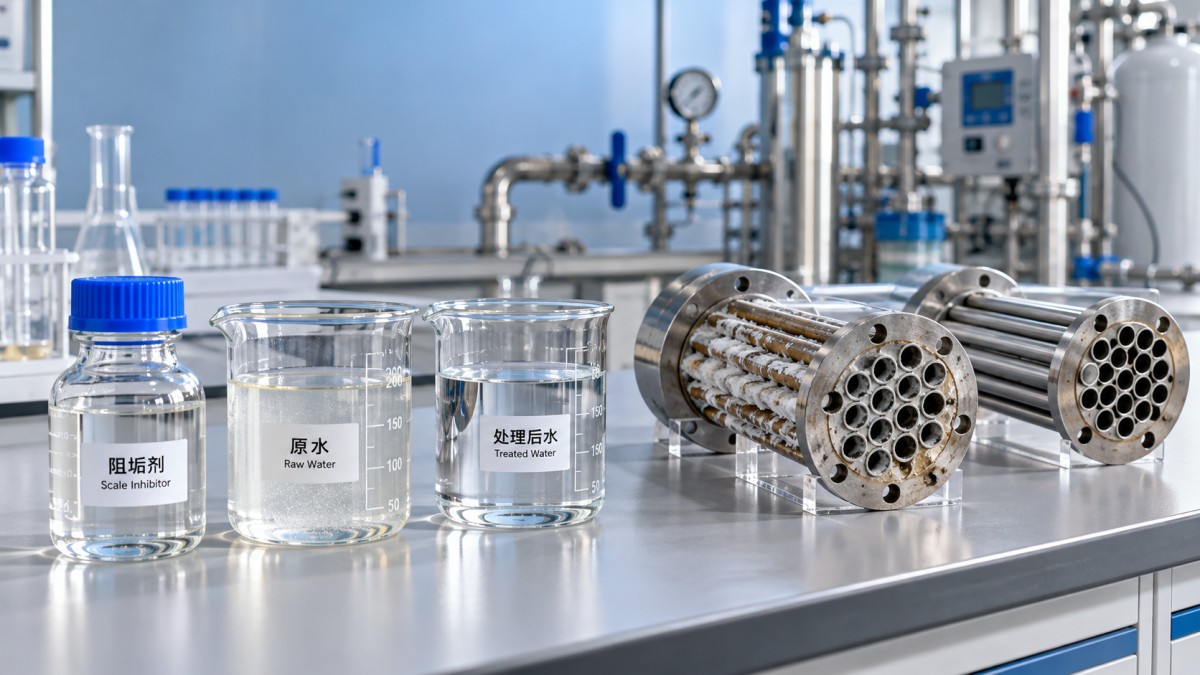
Scale inhibitors interfere with crystal formation, growth, or attachment. Organophosphorus compounds and polycarboxylate polymers are common chemical families, but their performance varies with mineral type, pH, temperature, and dissolved ions. A formulation effective against calcium carbonate should not automatically be treated as suitable for silica or every sulfate scale.
Scale inhibition and chelation are different treatment mechanisms. Threshold inhibitors work at concentrations below those required to bind all scale-forming ions. Chelating agents form complexes with dissolved metals, with performance governed by the agent, metal, pH, and competing ions. Treating these functions as interchangeable can produce an unrealistic dosage estimate.
In cooling towers, evaporation raises dissolved salt concentrations. Increasing cycles of concentration reduces blowdown but also changes precipitation potential. Scale calculations should use circulating water conditions and account for hot surfaces. An acceptable bulk water result does not eliminate the possibility of deposition at a heat exchanger wall.
Reverse osmosis requires a different assessment. Recovery concentrates salts toward the membrane concentrate outlet, where scaling limits are often reached first. Antiscalant selection should use the complete feed analysis, proposed recovery, and membrane system design. A cooling water product is not automatically suitable for RO; compatibility with membranes, pretreatment chemicals, and cleaning procedures requires confirmation.
Biocides: control exposure and biological demand
Oxidizing biocides act through oxidation, while non-oxidizing biocides use other mechanisms to disrupt microbial function. The appropriate choice depends on the system, organisms present, organic loading, pH, contact time, and material compatibility. For chlorine-based treatment, pH changes the balance between hypochlorous acid and hypochlorite, affecting disinfection performance.
A measured residual helps establish whether an oxidant survives the system’s chemical demand. However, a residual at one sampling point does not prove adequate exposure throughout dead legs, poorly mixed zones, or deposits. Established biofilms protect microorganisms and consume treatment chemicals. Physical cleaning and improved circulation can therefore be necessary alongside chemical treatment.
For non-oxidizing products, dose timing and contact time should follow the product’s validated application instructions. Unplanned dilution, rapid blowdown, or incompatible co-dosing can undermine exposure. Rotating products has value only when their mechanisms and performance support the change; changing product names alone does not establish better control.
Oxidant-sensitive RO membranes require particular care. Where upstream disinfection is used, the membrane manufacturer’s limits determine whether dechlorination is necessary. Oxidant removal protects the membrane but also removes a biological control barrier, making downstream cleanliness and stagnation management important.
Dispersants and defoamers solve different problems
Dispersants help prevent suspended particles from agglomerating and attaching to surfaces. Their effectiveness depends on particle chemistry, polymer structure, molecular characteristics, and water composition. Keeping solids suspended only transfers the problem unless blowdown, filtration, clarification, or another removal route carries them out of the system.
Polymer names alone do not establish application suitability. For example, Carboxylate-Sulfonate Copolymer PR-2000 is described as an acrylic acid-sulfonate copolymer for pesticide suspension concentrates, water-dispersible granules, and wettable powders. Its stated function is particle dispersion and resistance to flocculation and sedimentation in those formulations. That application information does not establish performance as an industrial water treatment antiscalant; water-system use would require separate compatibility and performance testing.
Defoamers destabilize foam films, but selection requires more than observing rapid foam collapse in a beaker. Silicone-based and non-silicone formulations differ in persistence, dispersibility, and effects on downstream processes. Membranes, coatings, and biological treatment can impose compatibility limits.
Persistent foaming also deserves a source investigation. Surfactant contamination, process carryover, excessive aeration, and biological imbalance require different corrective actions. A defoamer trial should evaluate foam recurrence and downstream effects under representative agitation and temperature.
Custom formulations need compatibility testing
Customization is useful when standard formulations cannot accommodate the combination of water chemistry, process conditions, and treatment objectives. The starting point is a defined operating envelope: feedwater variability, temperature range, concentration or recovery, metallurgy, residence time, and discharge constraints. A single favorable laboratory sample offers limited evidence for a system with seasonal changes.
Concentrated chemicals require separate attention. Products that coexist after dilution can precipitate, react, or lose activity when mixed directly. Anionic polymers can interact with cationic treatment chemicals, and high local concentrations can produce deposits at dosing points. Separate storage, controlled dilution, and suitable injection locations should follow formulation-specific compatibility findings.
Boiler makeup water also needs a separate treatment basis. External softening or demineralization, internal deposit control, oxygen management, and steam purity requirements address different functions. Cooling tower chemistry should not be transferred to boiler service without evaluating pressure, feedwater quality, and the boiler manufacturer’s requirements.
Validate performance against operating results
A meaningful trial connects dosage to measurable outcomes. Cooling systems can track heat transfer, corrosion indicators, deposit formation, and microbial trends. RO evaluation should use normalized permeate flow, normalized salt passage, and differential pressure so that temperature and operating changes do not obscure fouling behavior.
Record chemical feed rates alongside makeup flow, blowdown, recovery, and water analysis. A dosing pump setting does not establish the concentration reaching the equipment. Product strength, pump calibration, feed interruptions, and changing water demand all affect delivered dosage.
When performance deteriorates, compare current conditions with the tested operating envelope before increasing treatment strength. A new water source, higher recovery, leaking heat exchanger, or upstream coagulant carryover can change the required chemistry. Retaining deposit samples and reviewing operating trends helps distinguish a formulation limitation from a change elsewhere in the process.

ONLINE CONSULTATION
If you have any questions, please contact us and we will contact you as soon as possible.