


How to Optimize Antiscalant Dosing Calculation to Reduce Water Treatment Operational Costs
A dosing pump may run at the same setting for months while feedwater flow, hardness, and operating recovery change. The result can be wasted chemical during low-load operation or insufficient protection when scaling risk rises. Cutting the pump setting without checking these conditions can turn a chemical saving into additional cleaning, lost production, or equipment damage.
To optimize an antiscalant dosing calculation, first establish a validated dose for the actual water chemistry and operating conditions, then convert that dose into product mass and pump flow. Confirm whether the recommendation refers to supplied product or active material, calibrate the pump, and reduce consumption only through monitored trials. The lowest reliable operating cost is not necessarily the lowest dose.
Establish the dosing basis before changing the pump
A recommendation in mg/L is incomplete unless it identifies the chemical basis and the water stream being treated. In RO systems, dosing commonly refers to feedwater flow. In recirculating cooling systems, a target circulating-water concentration requires a chemical balance that includes blowdown, drift, other losses, and product depletion; it should not automatically be multiplied by total recirculation flow.
Collect the following information before recalculating consumption:
- Water analysis: calcium, magnesium, alkalinity, sulfate, silica, pH, conductivity, and relevant metals. Include barium and strontium where RO sulfate scaling is a concern.
- Operating conditions: actual flow, temperature, RO recovery or cooling-water concentration cycles, and seasonal variation.
- Chemical specification: recommended dose basis, supplied concentration, density, dilution instructions, and application compatibility.
- Performance history: cleaning frequency, deposits, pressure trends, heat-transfer performance, and measured chemical consumption.
Use representative samples rather than an old commissioning analysis. A changed water source, pretreatment upset, or increased recovery can invalidate a previously acceptable dose.
Convert the validated dose into a measurable injection rate
For continuous dosing into a once-through stream, including RO feedwater, use the following equations when the recommendation is expressed as supplied product:
Product consumption (kg/h) = dose (mg/L) × treated flow (m³/h) ÷ 1,000
Pump delivery (L/h) = product consumption (kg/h) ÷ product density (kg/L)
For illustration only, assume a validated supplied-product dose of 4 mg/L, a feedwater flow of 100 m³/h, and a product density of 1.15 kg/L. These values demonstrate the calculation; they are not a treatment recommendation.
When a recommendation is explicitly expressed as active material, divide the required active mass by the verified active mass fraction to obtain supplied-product consumption. Do not assume that total solids equals active content: a solids specification alone may not define the supplier’s dosing basis.
Dilution introduces another conversion. Calculate the required stock-solution mass from its known product mass fraction, then use the stock solution’s density to determine pump volume. Record whether dilution is specified by mass or volume; confusing the two creates avoidable dosing errors.
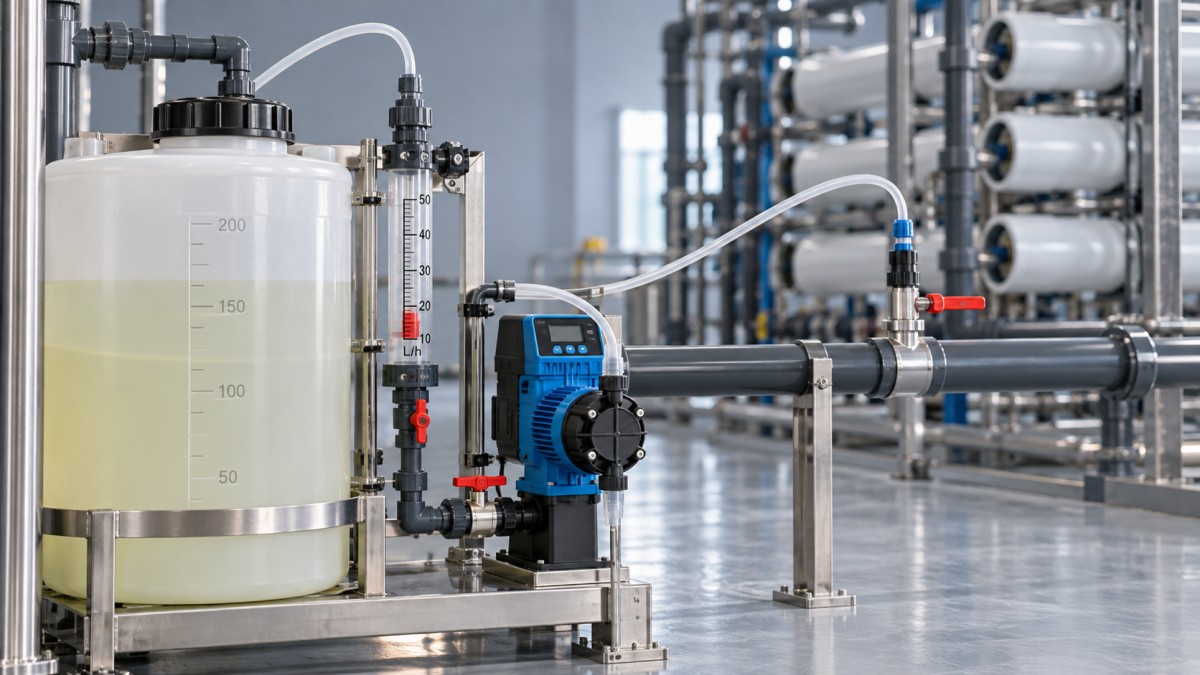
For cooling-water maintenance dosing, estimate replacement demand from the target concentration and net liquid losses, then account for depletion or removal using treatment-specific measurements. Initial system charging is a separate calculation based on system volume. Treating circulation flow as continuous chemical loss can substantially overstate demand.
Check concentration risk, not just feedwater hardness
RO recovery determines how strongly rejected salts concentrate. As a simplified screening estimate, concentration factor is approximately 1 ÷ (1 − recovery), with recovery expressed as a decimal. At 75% recovery, this gives a factor of four. It is not a complete scale prediction: membrane rejection, concentration polarization, precipitation, temperature, and pH affect actual conditions.
Use membrane-system calculations and product-specific inhibition limits to assess concentrate-side risks. Calcium carbonate, calcium sulfate, barium sulfate, and silica do not respond identically to one formulation. A dose that controls carbonate deposition may not provide adequate protection against another limiting species.
Cooling-water decisions likewise require more than bulk hardness. Higher concentration cycles can reduce makeup and blowdown demand but increase dissolved-salt concentrations. Hot heat-transfer surfaces may face more severe deposition conditions than a basin sample suggests. Evaluate changes in cycles together with temperature, alkalinity, corrosion control, and dispersant performance.
Separate chemical selection from dose adjustment
Raising the dose is unlikely to solve deposition caused by the wrong treatment chemistry. Iron oxide transport, calcium phosphate precipitation, and mineral scaling may require different combinations of inhibition and dispersion. Analyze deposits where practical before assuming every pressure rise or heat-transfer loss indicates insufficient antiscalant.
For relevant industrial circulating cooling-water applications, Acrylic Acid-Sulfonate-Acylamino Copolymers PR-615 is a scale inhibitor and dispersant intended to inhibit deposition of iron oxide, calcium phosphate, zinc phosphate, and calcium carbonate. Its stated properties include high calcium tolerance and suitability under high-temperature, high-pH, high-hardness, and high-alkalinity conditions.
The listed normal dosage is 2–40 mg/L, while the listed dosage for iron oxide dispersion is 80–100 mg/L. These are application ranges, not automatic setpoints. Confirm the dosing basis and appropriate grade, including the ≥30.0% or ≥50.0% solids specification, before comparing consumption. Its stated applications do not establish RO membrane suitability; that requires separate confirmation.
Compatibility with common treatment agents such as polyphosphates, zinc salts, and organophosphonates can support formulation selection, but does not establish that concentrated products can be mixed in one tank. Confirm dilution-water quality, mixing order, and storage compatibility before changing preparation procedures.
Verify what the pump actually delivers
A correct spreadsheet cannot compensate for an inaccurate pump. Air ingress, worn check valves, blocked injection fittings, and changing backpressure can make delivered flow differ from the controller display. Check output under representative operating pressure using an appropriate calibration method and site chemical-handling procedures.
- Compare calibrated delivery with the required L/h at normal and reduced operating loads.
- Reconcile delivery with tank drawdown or container mass loss over a defined period.
- Check flow-meter accuracy and the control signal used for proportional dosing.
- Verify shutdown interlocks so chemical does not continue entering a stopped water stream.
A very low calculated delivery may fall outside a pump’s reliable operating range. Approved dilution or a better-sized pump can improve control, provided solution stability and preparation accuracy are maintained.
Reduce consumption through controlled operating trials
Begin from a stable baseline and change one variable at a time. Keep recovery, concentration cycles, and other treatment settings steady while assessing a dose change. Define monitoring frequency and rollback criteria before starting; immediate absence of visible scale does not demonstrate long-term protection.
For RO, follow normalized permeate flow, normalized salt passage, and stage differential pressure alongside feed chemistry. For cooling systems, track heat-transfer performance, relevant deposit indicators, water chemistry, and corrosion measurements. Use treatment-specific residual testing where suitable, recognizing that a residual alone does not prove scale control.
Compare total cost over equivalent operating conditions: chemical consumption, dilution and handling, pumping, cleaning, water losses, and production disruption. Evaluate product prices on a validated cost-per-treated-volume basis rather than container price or solids content alone.
When adverse trends appear, return to the last validated setting and investigate before further reductions. Mixed deposits, changing source water, or operation close to product inhibition limits justify updated laboratory evaluation and application-specific technical support. Keep the approved dose, calculation basis, pump calibration, and operating limits together so that the next flow or recovery change triggers a deliberate recalculation.

ONLINE CONSULTATION
If you have any questions, please contact us and we will contact you as soon as possible.