


A Step-by-Step Guide to Water Quality Analysis and Custom Antiscalant Formulation Testing
Effective scale control starts with water quality analysis under actual operating conditions. A formulation that performs well in fresh feedwater may fail after evaporation, heating, or membrane concentration changes the chemistry. Custom antiscalant formulation testing should therefore answer two questions: which deposits are likely to form, and which treatment controls them at a practical dose without creating compatibility problems?
The most useful workflow connects representative sampling, scaling calculations, ingredient selection, laboratory screening, and a controlled field trial. Skipping any of these can produce a convincing laboratory result that does not translate into reliable operation.
1. Collect water samples that represent the problem
Start with a clear sampling plan. For a cooling system, collect makeup water and circulating water, and record where each sample was taken. For reverse osmosis, distinguish raw water, pretreated feed, and concentrate. If deposits already exist, collect a deposit sample as well; a water report alone may not reveal what is accumulating on equipment.
Record operating conditions alongside the samples: temperature, pH, flow, cooling tower cycles of concentration, RO recovery, and current chemical dosing. Include changes such as seasonal source switching or intermittent process contamination. These details explain why apparently similar water samples may behave differently.
Measure unstable properties, particularly pH and temperature, promptly. Follow the laboratory’s container and preservation instructions for each analysis. Dissolved and total metals require different sample handling, so identify which result is needed before sampling. A preserved metals sample cannot also represent the original water’s precipitation behavior.
2. Build a water analysis that explains potential deposits
Hardness and conductivity are useful starting points, but they cannot define a complete antiscalant program. The analytical panel should reflect the water source, equipment, and suspected deposit.
Check units before using the results. Calcium reported as calcium carbonate is not interchangeable with calcium reported as the element. A major-ion balance check can also help identify missing constituents or reporting errors before they affect formulation decisions.
3. Calculate risk where concentration and heat occur
Assess scaling at the conditions the water reaches during operation. In cooling systems, evaporation concentrates dissolved salts, while hot heat-transfer surfaces can create more severe local conditions than the bulk-water sample suggests. In RO systems, increasing recovery concentrates salts, and concentration at the membrane surface can exceed that in the bulk concentrate.
Use suitable water chemistry calculations or membrane projection software to examine the relevant minerals. A calcium carbonate index does not evaluate calcium sulfate, barium sulfate, or silica deposition. High-salinity waters also require calculation methods that account adequately for ionic interactions.
Saturation calculations indicate a tendency to precipitate; they do not establish a guaranteed operating limit or prove that a particular antiscalant will work. Use them to prioritize test conditions, including the normal operating point and a credible difficult condition such as higher recovery, warmer water, or a changed source blend.
4. Select ingredients for the identified mechanism
Antiscalants can delay crystal formation, alter crystal growth, and help disperse particles. These functions overlap, but they are not interchangeable. A blend selected for carbonate control may provide insufficient protection against sulfate scales or metal-rich deposits.
Phosphonates and polycarboxylate polymers are common formulation components. Their suitability depends on the target scale, water chemistry, temperature, treatment program, and discharge constraints. Adding more ingredients does not automatically broaden protection; interactions within the blend can reduce stability or performance.
For cooling water containing iron and phosphate-based corrosion inhibitors, dispersancy and inhibitor stabilization deserve specific attention. Carboxylate-Sulfonate-Nonion Terpolymer PR-3100 is one candidate raw material for this screening. Its stated applications include cooling-water scale control, iron oxide dispersion, and stabilization of phosphate or phosphonate corrosion inhibitors, including systems containing iron, zinc, and phosphate. Those functions make it relevant to such cooling-water formulations; they do not establish suitability for RO membranes.
For RO applications, assess compatibility with the membrane and the complete pretreatment program. Carryover of cationic coagulants can interact with anionic treatment chemicals and contribute to fouling. If suspended solids or biological growth dominate the problem, increasing antiscalant dosage will not address the underlying cause.
5. Screen formulations with controlled comparisons
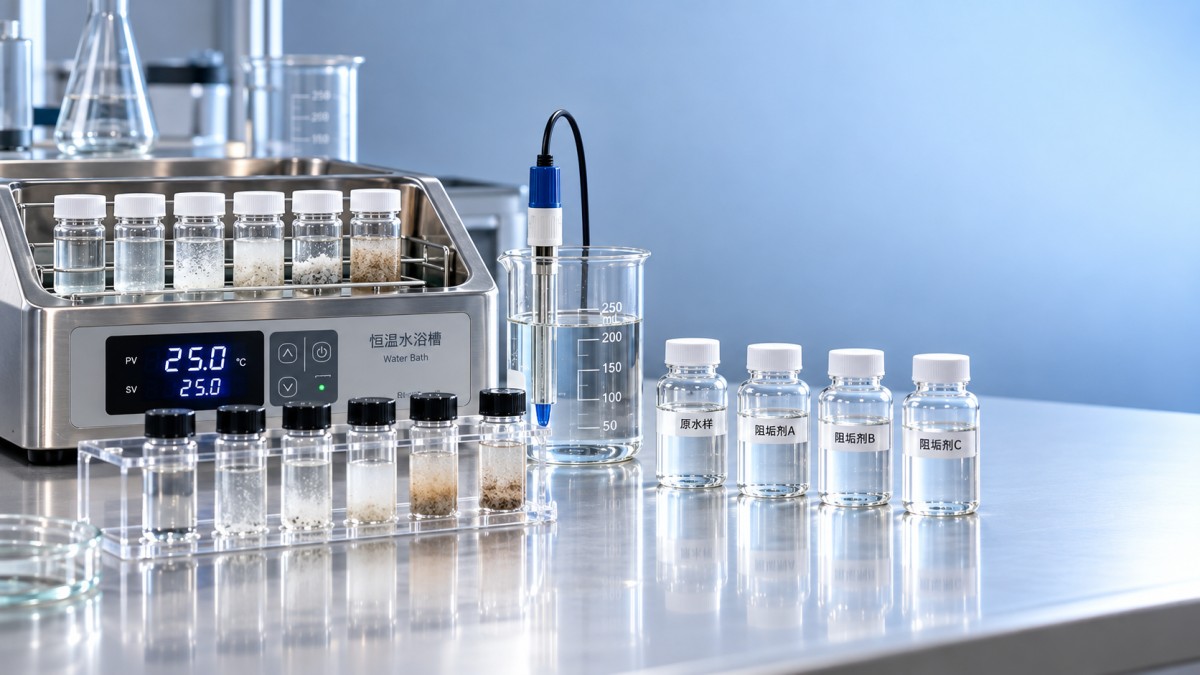
Begin laboratory testing with an untreated blank and, where available, the current treatment as a reference. Compare candidate blends across several doses using the same water and exposure conditions. State whether each dose refers to supplied product, dry solids, or active ingredient; otherwise, comparisons between products with different concentrations can be misleading.
A useful screening sequence is:
- Check formulation stability. Examine the concentrate for precipitation, haze, separation, or viscosity changes during storage under relevant conditions. Test dilution behavior in the actual preparation water.
- Run scale-specific tests. Reproduce the target water chemistry, pH, temperature, and exposure time. Synthetic water can isolate a mechanism, while actual water captures interactions absent from a simplified recipe.
- Measure precipitation and deposition. Combine dissolved-ion measurements with observations of solids and deposits. Keep filtration, sampling, and analytical methods consistent across tests.
- Challenge compatibility. Include other treatment chemicals at representative residual levels and examine mixing order where concentrated chemicals may meet.
When calculating inhibition from retained dissolved ions, account for the starting concentration and the precipitation observed in the untreated blank. If the blank barely precipitates, the test provides little basis for ranking candidates. A clear bottle is also insufficient evidence: fine particles may remain suspended while deposition still occurs on a heated surface or membrane.
6. Test the shortlisted blend under application conditions
Static bottle tests are efficient screening tools, but they do not reproduce flow, heat transfer, or membrane concentration effects. Move promising candidates into a dynamic test suited to the application.
For cooling water, a heated-surface or recirculating test can reveal deposition that bulk-water measurements miss. Assess deposit formation, heat-transfer behavior, and corrosion alongside scale control. A formulation that limits scale but disrupts the corrosion-control program is unsuitable.
For RO, use an appropriate membrane test or pilot arrangement. Track normalized permeate flow, salt passage, and differential pressure while controlling recovery and feed conditions. Interpret these indicators together because particulate fouling, biological growth, and scaling can produce overlapping symptoms.
Include realistic operating variation. A blend that works only at one narrowly controlled pH may be a poor choice for a plant with frequent excursions.
7. Turn the results into a dosing and monitoring plan
Select the formulation using the full evidence: deposit control, chemical compatibility, storage stability, dosing practicality, and treatment cost. Compare cost at the effective operating dose rather than by price per kilogram alone.
A controlled field trial should define the starting dose, injection point, dilution procedure, monitoring frequency, and conditions that require intervention. Confirm dosing-pump calibration and provide enough mixing before the water reaches vulnerable equipment. Track water chemistry and operating performance together so that feedwater changes are not mistaken for formulation failure.
Prio New Materials’ water treatment raw materials, customized formulation development, laboratory testing, and water-condition technical support can support this process. A useful technical brief includes the water analysis, operating range, existing chemical program, deposit findings, and laboratory comparisons. Together, these establish what the formulation must control and which changes in operation should trigger retesting.

ONLINE CONSULTATION
If you have any questions, please contact us and we will contact you as soon as possible.