


Can BHMTPMPA CAS 34690-00-1 improve scale control in hard water?
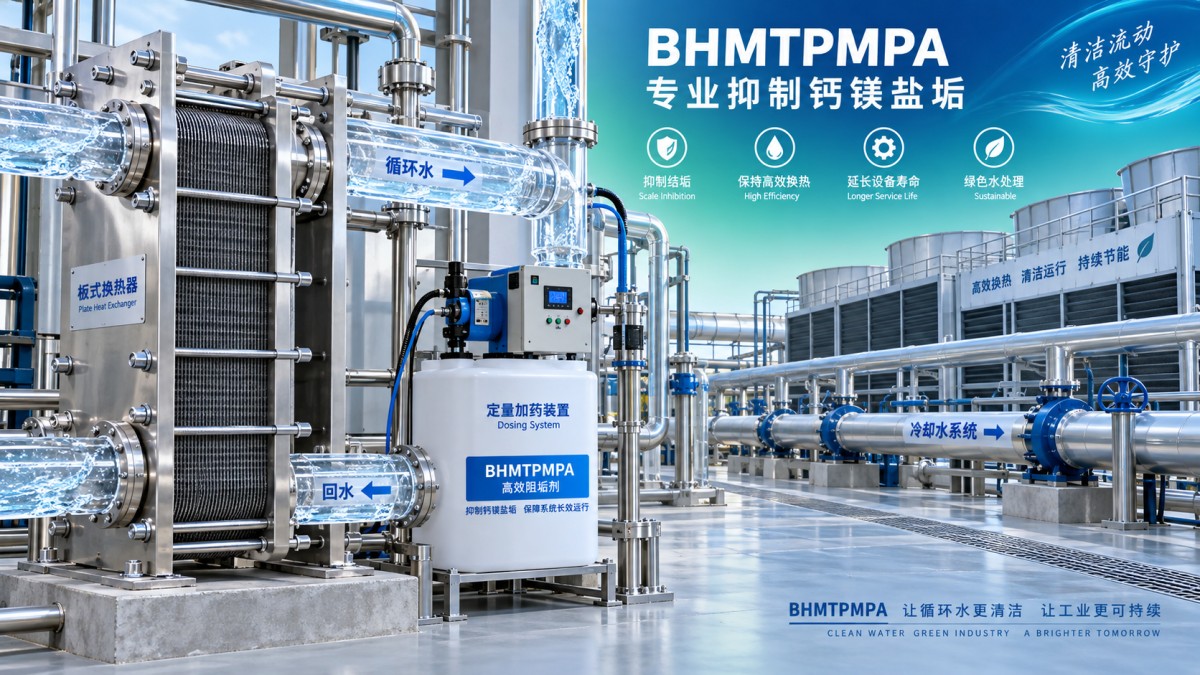
Yes, BHMTPMPA CAS 34690-00-1 can improve scale control in hard-water systems, particularly where conventional phosphonates struggle to keep calcium-, magnesium-, and metal-ion deposits under control at elevated concentration cycles. Its value is not simply that it “removes hardness.” Like other threshold scale inhibitors, it helps prevent dissolved minerals from forming hard, adherent deposits on heat-transfer surfaces, pipelines, RO feed equipment, and cooling-water components.
For an engineering project, the more useful question is whether BHMTPMPA fits the actual water chemistry and operating conditions. A strong scale inhibitor cannot compensate for uncontrolled cycles of concentration, poor side-stream filtration, incompatible coagulants, or a dosing point that provides inadequate mixing. When these fundamentals are managed, BHMTPMPA can be a practical part of a hard-water treatment program.
Why hard water creates a scale-control problem
Hard water contains dissolved calcium and magnesium salts. In industrial systems, these ions become problematic when temperature rises, water evaporates, pH changes, or dissolved solids concentrate. Under those conditions, salts that were initially soluble can precipitate as mineral scale. Calcium carbonate is common in open recirculating cooling systems, while calcium phosphate, calcium sulfate, silica-associated deposits, and mixed iron-calcium deposits may appear depending on the source water and process.
Scale is not merely a cleaning issue. A thin deposit on a heat-exchanger surface reduces heat transfer and can increase energy demand. Deposits also restrict flow, create under-deposit corrosion risks, interfere with sensors, and shorten the service interval of membranes, valves, and process equipment. In a project environment, those effects become schedule, maintenance, and operating-cost risks.
BHMTPMPA is an organophosphorus chelating and scale-inhibiting agent used to interfere with crystal growth and mineral deposition. It can interact with hardness ions and metal ions in water, helping keep potential scale-forming species dispersed or less likely to form strongly attached crystals. This is especially useful where high hardness and high concentration cycles make simple pH adjustment insufficient.
What BHMTPMPA does well, and what it does not do
BHMTPMPA CAS 34690-00-1 is generally selected for difficult industrial water conditions because phosphonate chemistry can offer metal-ion control, threshold inhibition, and stability across a broad range of treatment programs. Rather than needing to bind every calcium ion stoichiometrically, a scale inhibitor can disrupt the early stages of crystal formation. This makes chemical treatment feasible at practical feed rates when the system is correctly designed.
Its performance is most relevant when scale risk is driven by calcium carbonate, calcium sulfate, or mixed mineral deposits under concentrated hard-water conditions. It may also be useful in formulations that need to manage metal ions introduced by corrosion, raw-water variation, or process contamination.
However, BHMTPMPA is not a substitute for softening, clarification, filtration, or membrane pretreatment when those controls are required. If suspended solids are high, a phosphonate alone will not stop particulate fouling. If silica is the dominant limiting factor, the treatment program may need a dedicated dispersant or silica-control component. If an existing exchanger is already heavily scaled, chemical cleaning or mechanical cleaning may be needed before a preventive program can show meaningful results.
The distinction matters: scale inhibitors control the tendency to form new deposits. They are not universal cleaners, sludge removers, or corrosion-control programs by themselves.
Conditions that determine whether the treatment will work
Project teams often compare products before confirming the conditions that determine inhibitor demand. That order can lead to an incorrect selection. Before evaluating BHMTPMPA, establish the operating envelope of the water system.
Sampling only the incoming water is a common mistake. The more representative sample is often the recirculating water at the point where scaling occurs. Cooling-water loops, for example, may operate at much higher dissolved-solids levels than the makeup supply. RO systems need a separate assessment of concentrate-side conditions because supersaturation risk rises as recovery increases.
Start with deposit identification, not a higher chemical dose
When a system has recurring scale, increasing the inhibitor dose may feel like the fastest response. It is often not the most effective one. First identify the deposit or, at minimum, the likely dominant scaling mechanism. A white, hard deposit near hot surfaces may suggest carbonate or sulfate scaling, but visual appearance alone cannot establish the composition. Brown or reddish deposits may include iron oxides, corrosion products, or biologically associated material. Mixed deposits are common.
The treatment strategy changes with that diagnosis. Carbonate-driven scale may respond to improved pH control, concentration-cycle management, and phosphonate treatment. Sulfate-limited operation may require a different concentration target. Deposits rich in iron or suspended matter point toward filtration, corrosion management, and dispersancy. An incorrect diagnosis can make a technically capable product appear ineffective.
A workable project review should connect four items: current water analysis, operating temperature and pH, calculated concentration conditions, and deposit history. This gives the treatment supplier or internal water specialist enough information to assess whether BHMTPMPA should be the primary inhibitor, one component of a blended formula, or not the main solution at all.
Formulation compatibility matters more than a single active ingredient
In demanding systems, BHMTPMPA is commonly evaluated as part of a broader water-treatment formulation. A practical program may include a polymeric dispersant to keep precipitated particles from settling, a corrosion inhibitor suitable for the metallurgy, a biocide program, and controls for pH and blowdown. The best formula is determined by the system’s limiting deposit and the operational constraints, not by choosing the strongest-sounding individual chemical.
For cooling-water programs where corrosion control and zinc handling are also relevant, 2-Hydroxy Phosphonoacetic Acid (HPAA) can be considered as a related phosphonate option. HPAA is used for scale and corrosion inhibition and can improve zinc solubility in appropriate formulations. Its chemical stability and suitability for circulating cooling water make it relevant when the treatment objective includes more than hardness-scale suppression. It should be assessed against BHMTPMPA based on the water analysis, metallurgy, pH range, and the rest of the formula rather than treated as a direct universal replacement.
This is also where raw-material consistency matters. For large or long-term projects, variations in active content, impurity profile, storage stability, or batch-to-batch performance can complicate dosing control. A supplier able to provide formulation support, laboratory evaluation, and stable bulk supply is more useful than a source that supplies an active ingredient without water-condition guidance.
How to introduce BHMTPMPA into an operating system
Implementation should be treated as a controlled operating change rather than a one-time chemical addition. The objective is to establish stable inhibition while confirming that the chemistry is compatible with the existing program.
- Establish the baseline. Record water chemistry, conductivity or concentration control, pH, temperature, flow conditions, makeup volume, blowdown behavior, and current deposit locations.
- Inspect the system condition. Determine whether existing scale, sludge, or corrosion products need removal before preventive treatment begins.
- Review chemical compatibility. Check the intended BHMTPMPA formula against current corrosion inhibitors, biocides, polymers, metal salts, and any process chemicals entering the system.
- Choose the dosing point carefully. Feed should enter a location with reliable turbulence and mixing, not a stagnant branch or an area where concentrated chemical can contact metal surfaces.
- Control concentration cycles. Dosing cannot correct a system that is allowed to concentrate beyond its practical scaling limit. Blowdown and makeup control remain central to performance.
- Monitor response. Track the operational indicators that matter: heat-transfer behavior, pressure drop, inspection findings, water chemistry trends, and inhibitor residual where the program uses residual control.
Exact dosing should be determined from the active formulation, water chemistry, and system severity. Applying a generic dose without understanding these variables can produce both under-treatment and unnecessary chemical consumption.
Where BHMTPMPA is a stronger candidate
It is generally worth considering when hard makeup water is used in circulating cooling systems, industrial wash-water loops, power-related utility water, petrochemical process support systems, or other operations with recurring mineral deposition under concentration. It is particularly relevant when project requirements demand stable operation at more challenging water chemistry than a basic low-hardness system.
It may be less suitable as the sole answer where the main problem is biological fouling, severe oil contamination, high suspended solids, membrane cleaning, or silica-controlled scaling. Those conditions call for a wider treatment design. In RO pretreatment, for example, scale-inhibitor selection must match recovery, concentrate chemistry, membrane compatibility, and upstream pretreatment performance.
The practical decision for project managers
Do not approve BHMTPMPA CAS 34690-00-1 solely because the system uses hard water. Approve it when the water analysis and operating conditions show a mineral-scaling risk that phosphonate-based inhibition can realistically control, and when the wider program addresses solids, corrosion, microbiological control, and concentration management.
The most reliable next step is to submit representative circulating-water or concentrate-water data, not only raw makeup-water data, for formulation review. That creates a basis for selecting the inhibitor package, setting the operating target, and avoiding the familiar cycle of increased dosing, recurring deposits, and unplanned cleaning.

ONLINE CONSULTATION
If you have any questions, please contact us and we will contact you as soon as possible.