


How to verify BHMTPMPA CAS 34690-00-1 on supplier documentation
For procurement teams sourcing water treatment chemicals, verifying BHMTPMPA CAS 34690-00-1 on supplier documentation is essential for ensuring material identity, quality consistency and regulatory confidence.
This guide explains how to cross-check CAS numbers, product names, specifications, certificates of analysis and safety data sheets before placing bulk or long-term orders.
Start With the Procurement Question: Is This the Exact Material You Need?
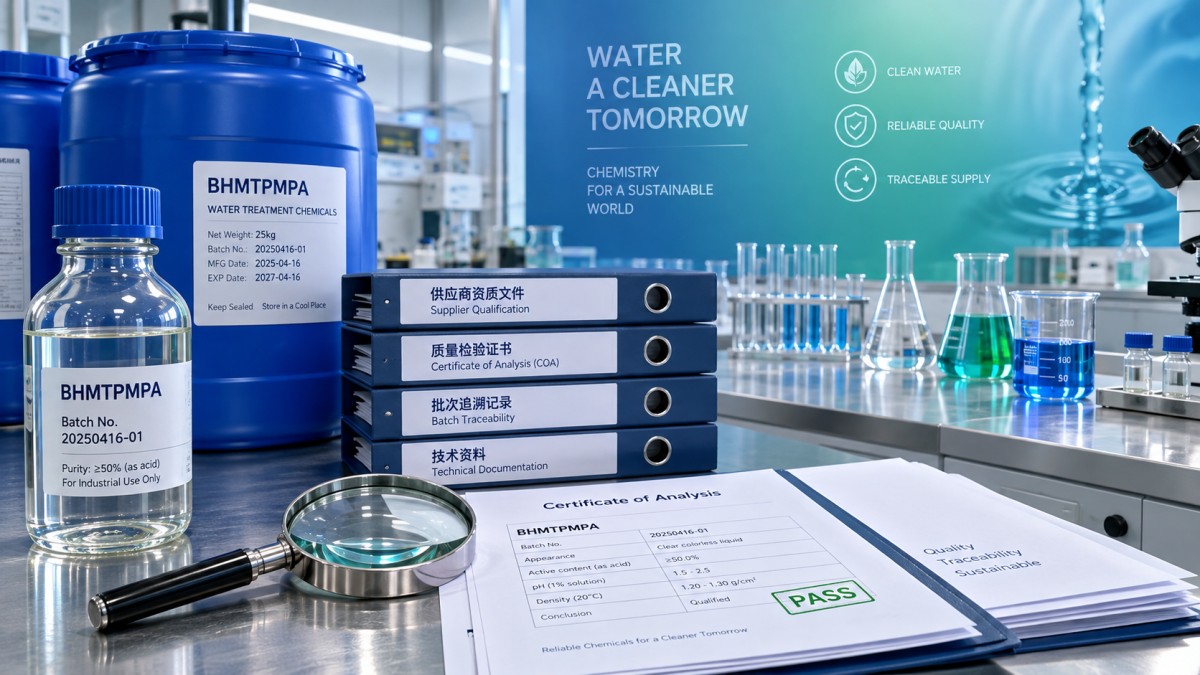
The core search intent behind BHMTPMPA CAS 34690-00-1 is practical verification, not basic chemistry education. Buyers need to confirm that supplier documents describe one consistent, purchasable chemical product.
For a purchaser, an incorrect identity can create much larger issues than a paperwork discrepancy. It may affect dosage programs, compatibility evaluations, import declarations, customer approvals and downstream treatment performance.
BHMTPMPA is generally used as an organophosphorus scale-inhibiting and chelating agent in industrial water treatment programs. Its value depends on stable composition, suitable active content and predictable application performance.
The CAS number 34690-00-1 should be treated as an important identity reference, but it should never be the only acceptance criterion. A CAS number alone does not confirm concentration or formulation quality.
Before comparing quotations, procurement teams should define the exact material requirement. This includes chemical identity, requested active content, appearance, pH range, density, packaging, shelf life and intended water treatment application.
A supplier may use a trade name, an abbreviation or a broad functional description. Those descriptions can be useful, but they must not replace a consistent chemical name and CAS reference.
The most reliable purchasing decision comes from matching several independent documents. The product specification, technical data sheet, certificate of analysis, safety data sheet and commercial quotation should support the same conclusion.
If key data differ between documents, pause the approval process. Ask the supplier to explain the discrepancy in writing before issuing a purchase order, approving a sample or arranging third-party inspection.
Check the Product Name and CAS Number Across Every Document
Begin with the supplier quotation or proforma invoice. The product name should clearly identify BHMTPMPA, while the CAS number should be shown as 34690-00-1 without transposed digits or missing punctuation.
Next, compare this information with the product specification sheet. The chemical name, abbreviation and CAS number should be presented consistently, especially when documents have been translated for export customers.
A common concern is whether a supplier has listed an internal grade name instead of the chemical identity. Internal grade codes are acceptable only when they are traceable to the documented BHMTPMPA product.
Review spelling carefully. Similar phosphonate products can have comparable abbreviations, but different molecular structures, performance profiles and CAS numbers. Do not assume that similarly named products are interchangeable in a treatment program.
Where a document uses only “phosphonate scale inhibitor” or “water treatment chelant,” request clarification. Such generic labels do not provide sufficient evidence that the offered material is BHMTPMPA CAS 34690-00-1.
The safety data sheet deserves particular attention. Section 1 should identify the product, intended use and supplier, while Section 3 should state the hazardous ingredients or relevant chemical composition information.
Some SDS formats identify proprietary mixtures rather than listing every component publicly. In that situation, the supplier should still provide a separate signed identity confirmation for the grade being quoted.
For long-term purchasing, include the verified chemical name and CAS number in your approved material list. This reduces the risk of substitutions when purchase orders are issued by different locations or teams.
Use the Certificate of Analysis to Confirm the Batch, Not Just the Product Family
A certificate of analysis, commonly called a COA, is the primary document for confirming whether a delivered batch meets the agreed quality specification. It should never be a generic marketing attachment.
The COA should contain the supplier name, product name, batch number, manufacturing date, test date and release date. These fields establish traceability between the document and the physical shipment.
Ask whether the batch number on the COA will match the batch number on drums, IBC labels and packing lists. Inconsistent identification weakens the reliability of the release documentation.
For BHMTPMPA CAS 34690-00-1, evaluate the analytical items against your technical requirement rather than accepting a pass statement. Key values should be reported as measured results with units.
Typical purchasing controls may include active content, total phosphonic acid content where applicable, pH, density, appearance, color, solubility and relevant impurity limits. Requirements depend on the formulation and application.
Results should include a stated testing method or a reference to the supplier’s controlled internal method. A value without a method is less useful when investigating future quality deviations.
Check whether the COA specification limits match the negotiated specification sheet. A supplier may issue a compliant COA against a broad internal range that is less demanding than your contractual requirement.
Procurement should also verify that the COA is batch-specific. Reused certificates, generic sample reports or certificates with altered batch dates should be treated as warning signs requiring further review.
Evaluate Specifications That Matter in Industrial Water Treatment
Material identity is necessary, but it is not enough for effective procurement. Water treatment chemicals are selected for specific water conditions, equipment metallurgy, temperatures, operating cycles and treatment objectives.
When evaluating BHMTPMPA, first confirm the intended application. A product suitable for scale control in circulating cooling water may require different performance evidence than one selected for boiler systems.
High-hardness water, elevated alkalinity, high temperature, dissolved iron and mixed inhibitor programs can all change the required dosage and product compatibility. Request application-specific guidance rather than relying on a generic brochure.
Active content is especially important because quoted prices can be misleading when suppliers offer different concentrations. Compare cost per kilogram of active component, not only cost per kilogram of delivered liquid.
Density should be evaluated alongside active content. It affects transport calculations, tank volume planning, dosing-pump calibration and conversion between volume-based operating instructions and mass-based purchasing records.
pH and appearance are useful incoming inspection indicators. They cannot prove full chemical composition, but unexpected results may reveal dilution, contamination, degradation or an incorrect material shipment.
For products used in blended treatment programs, compatibility with zinc salts, polymers, corrosion inhibitors, biocides and dispersants may be commercially important. Ask suppliers for supporting test data where relevant.
Buyers sourcing a broader scale-control portfolio should maintain separate documentation for each chemistry. For example, Copolymer of Sodium P-Styrene Sulfonate and Maleic Anhydride (SSS/MA) is a polymeric dispersant product and should not be documented as a substitute for BHMTPMPA.
Review SDS, TDS and Regulatory Documents as a Matched Set
The technical data sheet, or TDS, describes intended performance and standard properties. The SDS addresses safe handling, hazards, storage, transport and emergency information. Both should correspond to the same commercial product.
Check the SDS revision date and version number. An outdated document may not reflect current classification rules, recent formulation changes or updated transport information relevant to international shipment planning.
Section 1 of the SDS should identify the supplier and product. Section 2 should communicate hazards, while Sections 7, 8 and 10 provide useful information on handling, protection and stability.
For procurement teams importing chemicals, verify whether the supplier can provide documents required in the destination market. These may include REACH status, TSCA information, inventory listings or country-specific declarations.
Do not accept vague language such as “compliant where applicable” without supporting detail. Regulatory status should be connected to the actual chemical identity, manufacturing origin and intended destination.
Where confidentiality prevents detailed disclosure, ask for a formal declaration signed by an authorized regulatory representative. It should identify the product grade, applicable regulation and the basis of compliance.
Also check document consistency in units and terminology. A density reported in g/cm3, active content shown as percent by weight and pH measured at a stated temperature are easier to compare accurately.
If an SDS names a different CAS number from the quotation, treat it as a material identity issue. A supplier explanation may be valid, but it requires documented technical and regulatory review.
Identify Documentation Red Flags Before You Approve a Supplier
Documentation errors do occur, particularly when suppliers handle multiple water treatment products or use standard templates. The key question is whether the supplier can correct and explain discrepancies promptly and transparently.
A major warning sign is a CAS number that changes between the quotation, COA and SDS. This may indicate careless document control, an unclear product identity or an attempted substitution.
Another warning sign is an unusually broad specification range. Broad ranges can reduce rejection risk for the supplier, but they may create inconsistent dosing behavior and operating uncertainty for the buyer.
Be cautious when a supplier cannot provide a batch-specific COA before shipment. This does not automatically prove poor quality, but it limits the buyer’s ability to verify release control.
Missing manufacturer information is also important. Traders can be valid suppliers, but procurement teams should know whether they are buying from a manufacturer, distributor or intermediary with limited technical ownership.
Look for document formatting concerns as well. Different company names, mismatched addresses, incomplete signatures or inconsistent product codes can complicate claims management and traceability after delivery.
Claims of exceptionally high performance should be supported by relevant test conditions. Scale inhibition data without hardness, temperature, concentration ratio or test method cannot be compared meaningfully.
Finally, avoid accepting copied documentation from another chemistry. Product families may share packaging or applications, but analytical requirements and safety classifications must remain specific to the supplied grade.
Build a Repeatable Supplier Verification Workflow
A defined workflow helps procurement teams make consistent decisions across suppliers, regions and order sizes. It also creates an auditable record for quality, operations, finance and regulatory stakeholders.
First, issue a written technical request that identifies BHMTPMPA CAS 34690-00-1, intended application, required specification limits, packaging, delivery destination and documentation requirements before requesting final pricing.
Second, collect the quotation, TDS, SDS, standard specification, recent COA and regulatory declarations. Request documents in English when they will be used for cross-border purchasing or customer approvals.
Third, use a comparison table to cross-check product name, CAS number, active content, density, pH, appearance, batch traceability, shelf life and applicable regulatory status across every file.
Fourth, qualify a representative sample before approving a new source. Test key incoming properties internally or through an independent laboratory when the product supports critical industrial water treatment operations.
Fifth, assess the supplier’s quality system and manufacturing capability. Questions should cover production location, raw material control, laboratory capacity, retained samples, change notification and corrective action procedures.
Sixth, state acceptance requirements directly in the purchase order. Require batch-specific COAs, compliant labeling, agreed packaging and prior written approval for any change in manufacturing site or specification.
Finally, perform incoming checks on every shipment according to risk. Confirm labels and batch numbers, inspect packaging condition and retain samples from significant deliveries for traceability and dispute resolution.
Make the Final Decision Based on Evidence, Not a Single Document
Verifying BHMTPMPA CAS 34690-00-1 is a structured procurement task. The objective is to establish that the quoted material, released batch and delivered containers all represent the same approved product.
A correct CAS number is a strong starting point, but reliable approval requires agreement among the chemical name, specification, COA, SDS, labels and application requirements. Each document answers a different question.
Procurement teams should focus most heavily on identity consistency, batch traceability, active-content comparability, regulatory fitness and supplier change control. These factors directly influence commercial and operational risk.
When documentation is complete and internally consistent, buyers can compare suppliers on a more meaningful basis than unit price alone. This supports stable dosing performance, fewer quality disputes and better long-term supply decisions.
When documents conflict, request clarification before committing to bulk volumes. A capable supplier should provide corrected files, technical explanations and supporting evidence that allow your quality team to make a defensible decision.
For industrial water treatment procurement, the best supplier documentation is not merely complete paperwork. It is verifiable evidence that the material received will perform consistently within the treatment program you are responsible for maintaining.

ONLINE CONSULTATION
If you have any questions, please contact us and we will contact you as soon as possible.