


When geothermal water scale inhibitor is needed before reinjection
Reinjection is where a geothermal project either protects its resource or begins to lose operating flexibility. Once hot brine travels from production equipment toward the injection system, its temperature, pressure, gas balance, and sometimes pH can change quickly. Minerals that remained dissolved in the reservoir may then precipitate on pipe walls, control valves, pumps, well screens, and inside the formation itself. This is the point at which a geothermal water scale inhibitor may become necessary—not as a routine chemical addition, but as a targeted measure to preserve injectivity and avoid costly intervention.
For project managers, the question is rarely “Is there scale?” More often, it is: “Will scale develop fast enough to affect the injection schedule, well capacity, or long-term reservoir plan?” A practical answer requires more than a single laboratory result. It requires connecting water chemistry with the real operating path from separator to reinjection well.
Situations that signal a scale-control program is needed
Scale inhibitor treatment should be considered before reinjection when mineral deposition is likely to occur during fluid handling or after the brine enters the formation. The most common warning signs include declining injection pressure tolerance, a gradual reduction in well injectivity, recurring cleaning of valves or pipelines, and visible deposits in sampling points, strainers, or heat-exchange equipment.
In geothermal systems, silica is often a central concern because its solubility changes as brine cools. Calcium carbonate can become problematic where carbon dioxide flashes off and shifts the water’s saturation balance. Sulfate scales, including calcium sulfate or barium sulfate, may form where incompatible waters mix or where sulfate and hardness ions are present at critical concentrations. Iron-based deposits can further complicate the picture when oxygen ingress, corrosion products, or changes in oxidation state occur.
A treatment decision becomes more urgent when one or more of the following conditions are present:
- Brine temperature drops substantially between production, energy recovery, and injection.
- Pressure reduction causes dissolved gases to release and alters carbonate equilibrium.
- Field data show increasing injection pressure at a constant flow rate.
- Well stimulation or mechanical cleaning is becoming more frequent.
- Produced water is blended with condensate, makeup water, cooling-water blowdown, or another incompatible stream.
- New wells access a reservoir zone with noticeably different brine chemistry.
- Scale is forming downstream even though bulk-water analysis appears acceptable.
The last point deserves attention. Bulk samples can understate risk because scale frequently forms at local “hot spots”: across a throttling valve, near a pump, in a stagnant branch line, at a mixing point, or in the near-wellbore region. A chemical program should therefore be designed around the actual thermal and hydraulic profile, not only the composition recorded in a bottle.
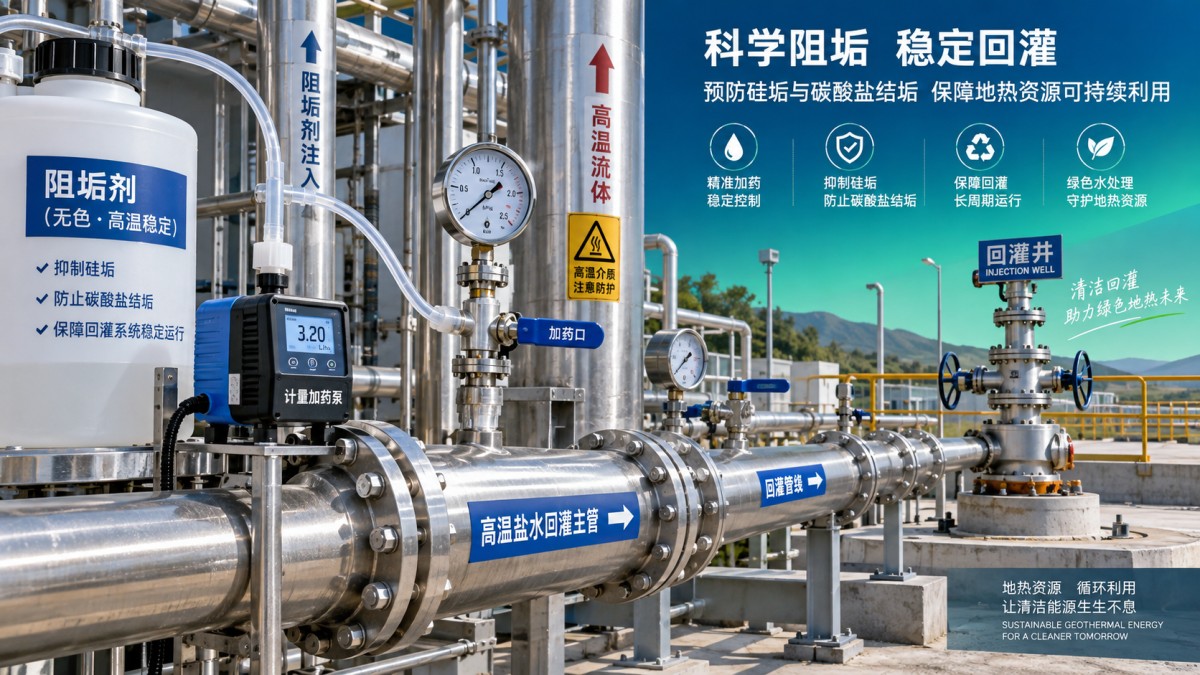
Why reinjection scaling is more serious than surface fouling
Surface deposits are visible and usually accessible. Formation damage is different. When particles or precipitated minerals enter the injection interval, they can block pore throats and reduce permeability near the wellbore. The result may be a slow loss of injectivity that cannot be corrected simply by flushing a pipeline.
For a project team, this creates a chain of consequences: more pumping energy may be required, injection flow may need to be redistributed, production and reinjection balance can become harder to maintain, and well workovers may disrupt plant availability. In a reservoir-management context, preventing deposition before it enters the well is generally more controllable than trying to restore lost injectivity afterward.
This does not mean every geothermal brine needs continuous chemical treatment. Some systems remain stable under their intended temperature and pressure conditions. Others can be managed through operational controls such as minimizing cooling, avoiding turbulent mixing of incompatible streams, or changing the injection point. The need for a geothermal water scale inhibitor arises when these operating adjustments do not sufficiently reduce the calculated or observed precipitation risk.
Start with a water analysis that reflects operating reality
A reliable treatment program begins with representative sampling. Project teams should collect and preserve samples in a way that minimizes changes before analysis, especially for hot brines containing dissolved gases or easily oxidized metals. Testing normally considers pH, conductivity, alkalinity, calcium, magnesium, barium, strontium, iron, silica, sulfate, chloride, total dissolved solids, and relevant dissolved gases.
However, analysis alone is not the decision. The chemical supplier or technical team should model what happens as the water moves through each stage of the process. That means reviewing separator conditions, heat-exchanger outlet temperature, flash events, expected residence time, mixing locations, injection pressure, and the likely temperature at the wellhead and downhole interval.
It is also useful to compare laboratory predictions with field evidence. Deposits should be identified where possible. A white, hard deposit may behave very differently from a soft iron-rich sludge or silica-dominated scale. Without deposit characterization, an inhibitor can be selected for the wrong mechanism and appear ineffective even when the dosage is increased.
Choosing the treatment point and chemistry
In many systems, the inhibitor is injected upstream of the first condition change that triggers precipitation. This may be before pressure reduction, before cooling, or ahead of a mixing point. The objective is to keep scale-forming ions dispersed or delay crystal growth long enough for the brine to reach the intended injection zone without depositing solids.
The chemistry must match the scale risk and the fluid environment. Organophosphorus scale-inhibiting chelating agents and polycarboxylate dispersants are widely used families in industrial water treatment, but their suitability depends on temperature, pH, salinity, hardness, residence time, and compatibility with other process chemicals. A formulation that performs well in moderate-temperature cooling water is not automatically suitable for a high-temperature geothermal brine.
Project managers should ask suppliers for more than a recommended dosage. A useful proposal should explain the expected deposition mechanism, the injection location, the test basis, compatibility considerations, and the monitoring method. It should also address whether the treatment may affect downstream separation, wastewater handling, or reinjection permits.
Do not overlook foam and solids in associated water treatment
Some geothermal projects handle auxiliary wastewater streams, condensate treatment, or water generated during cleaning and chemical conditioning. These streams can carry high solids, surfactants, organics, or treatment residues that create persistent foam. Foam may interfere with tank level control, clarification, biological treatment, and safe plant housekeeping, even though it is not the same problem as mineral scaling.
Where fast foam knockdown is needed in difficult wastewater conditions, a Polyether-ester defoamer can be evaluated as a separate supporting treatment. Its polyether-ester structure is designed for water dispersibility and durable foam suppression, including in high-COD or acidic and alkaline wastewater. It should be assessed for compatibility with the overall water-treatment scheme rather than mixed into the scale-control program without testing.
A practical field-validation checklist
Before committing to full-scale continuous dosing, a staged validation approach reduces uncertainty. Bench testing can compare candidate inhibitors against the actual brine under simulated temperature and pressure conditions. A controlled field trial can then verify injection stability, dosage response, deposit reduction, and any effect on downstream equipment.
- Confirm the scale type through water chemistry, deposit analysis, or both.
- Map the process conditions from production well to injection interval.
- Test chemical compatibility with corrosion inhibitors, biocides, coagulants, and other additives in use.
- Select a dosing point that provides adequate mixing before supersaturation occurs.
- Monitor injection pressure, flow rate, differential pressure, turbidity, and solids loading.
- Inspect accessible equipment regularly during the trial rather than waiting for a shutdown.
- Define a response plan if deposits persist, including dosage adjustment, operational changes, or mechanical cleaning.
One common mistake is treating a rising injection pressure as proof that more inhibitor is always required. The cause may instead be fines migration, corrosion debris, biological growth, mechanical damage, or an unsuitable injection profile. Chemical treatment works best when it is part of a broader integrity and water-condition management plan.
Making the reinjection decision with confidence
A geothermal water scale inhibitor is needed before reinjection when the project’s operating conditions create a credible risk of mineral precipitation that could restrict equipment or formation flow. The strongest basis for action is a combination of representative chemistry, process-condition modeling, deposit evidence, and injectivity trends—not a generic assumption that all geothermal water behaves the same way.
For teams managing schedule, capital exposure, and reservoir performance, early evaluation is usually the safer path. A well-designed treatment program can be adjusted as field conditions evolve, while lost injectivity is often more difficult to recover. Working with a supplier that can provide raw-material consistency, customized formulation support, laboratory evaluation, and practical water-condition guidance helps convert a complex chemical risk into a manageable operating decision.

ONLINE CONSULTATION
If you have any questions, please contact us and we will contact you as soon as possible.