


How to evaluate RO antiscalant dosage without under-treating the system
Accurate dosing of RO Antiscalants is less about finding a “safe” high number and more about proving that the selected dose protects the membrane under the system’s actual concentration conditions. A reverse osmosis train can appear stable at commissioning and still become under-treated after a seasonal shift in feedwater, a higher recovery target, a change in coagulant carryover, or a new membrane element configuration. For quality and safety teams, the practical question is not simply whether antiscalant is being injected. It is whether the treatment program remains chemically adequate, mechanically reliable, and traceable from bulk chemical receipt to membrane performance.
Under-treatment is often discovered late. It may first appear as a gradual rise in normalized differential pressure, reduced normalized permeate flow, increased salt passage, or a cleaning frequency that no longer matches the original operating plan. By then, scale may already be embedded within feed spacers or deposited on membrane surfaces. Increasing the dose after the fact may slow further deposition, but it will not necessarily restore lost performance. A defensible dosage evaluation therefore starts before chemical injection and continues through routine operating review.
Start with the water that reaches the membrane, not the water source label
“Groundwater,” “municipal water,” and “treated wastewater” are not sufficient descriptions for antiscalant selection. The relevant sample is the RO feed after upstream pretreatment, because that is the water being concentrated inside the membrane system. A raw-water analysis can be useful for trend forecasting, but it cannot replace a current feedwater analysis when cartridge filters, softening, clarification, pH adjustment, oxidation, dechlorination, or blending are involved.
The analysis should normally include calcium, magnesium, barium, strontium, sulfate, alkalinity, silica, pH, conductivity or total dissolved solids, iron, manganese, fluoride where relevant, and temperature. For difficult waters, aluminum and residual coagulant should also be considered. Suspended solids, SDI, turbidity, oil contamination, and biological activity do not determine mineral scaling by themselves, but they can make a marginal antiscalant program look ineffective because fouling and scaling produce overlapping operating symptoms.
One recurring mistake is relying on a laboratory report that is several months old. Ion balance may have changed after a new well is brought online, after regeneration problems in an ion-exchange unit, or when reclaimed-water blending is adjusted. A dose that was adequate in a low-sulfate period may be inadequate once sulfate, calcium, or silica rises together. Quality control should establish a sampling frequency that reflects feedwater variability rather than treating water chemistry as a fixed specification.
Evaluate the concentrate condition at the planned recovery
Antiscalant dosage cannot be judged from feedwater concentrations alone. RO selectively removes water, so sparingly soluble salts become more concentrated toward the tail end of the pressure vessel. Recovery is therefore one of the most influential operating variables. If recovery is increased, the concentration factor rises and the scaling margin becomes narrower, sometimes very quickly.
A useful first check is the approximate concentration factor:
Concentration factor ≈ 1 ÷ (1 − recovery)
This is only a screening calculation. It does not account for ion rejection, polarization at the membrane surface, interstage design, or precipitation. Still, it illustrates why a system operating at 75% recovery behaves very differently from one operating at 85% recovery. The latter is not simply “10% harder” to treat. It can place much higher mineral concentrations in the concentrate stream, especially near the last elements.
The next step is to use a credible scaling projection program or membrane manufacturer calculation method. The model should be supplied with verified feedwater chemistry, temperature, pH, membrane configuration, staging, flux, and intended recovery. It should predict relevant risks such as calcium carbonate, calcium sulfate, barium sulfate, strontium sulfate, calcium fluoride, and reactive silica. The output is not a substitute for plant judgment, but it is much stronger than selecting a dosage from a generic product brochure.
If the calculation shows a narrow margin at the selected recovery, the correct response is not automatically to push more chemical into the system. A higher dose may be appropriate, but other options deserve review: reducing recovery, adjusting feed pH where compatible with the membrane and pretreatment train, removing hardness upstream, improving silica control, or changing membrane array design. Chemical treatment is part of the operating envelope, not a license to disregard it.
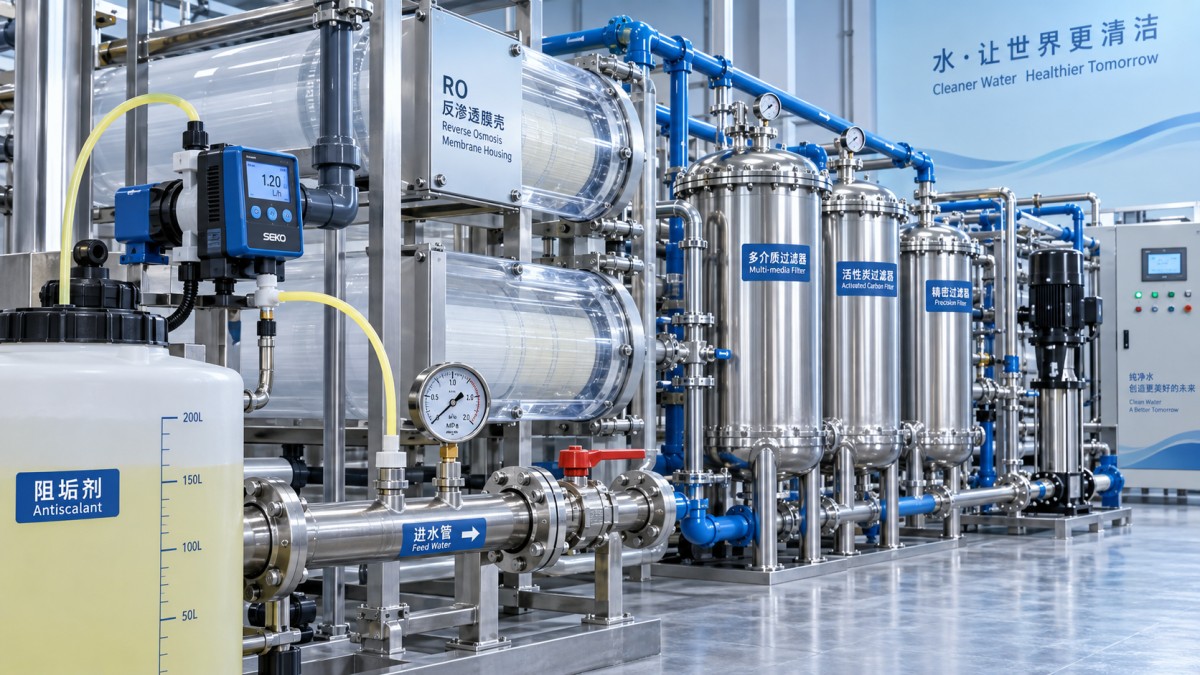
Choose the product chemistry before choosing the pump setting
Not all RO Antiscalants control the same deposits with equal reliability. A formulation intended primarily for calcium carbonate may not provide enough inhibition for barium sulfate or silica-dominated water. Likewise, a product with strong threshold inhibition performance may still be unsuitable if it interacts poorly with residual aluminum, iron, cationic polymers, or oxidizing biocides upstream.
The quality review should ask several basic questions: Which scale species is limiting recovery? Is the water rich in iron or aluminum? Is there residual oxidant exposure? Will the antiscalant be injected before or after the cartridge filters? Is the concentrate discharged, reused, or sent to a downstream process with its own chemical restrictions? These questions influence compatibility, dose, and handling controls.
Organophosphorus and polycarboxylate chemistries are commonly used as formulation building blocks because their functions can complement one another: chelation, threshold inhibition, crystal distortion, and dispersancy are not identical mechanisms. For example, [N-(2-hydroxyethyl) ethlenediamine-1,1,2-tri (methylene phosphonic acid) (HEDTMP) is an organophosphonate raw material with strong chelating characteristics, calcium and iron tolerance, and resistance to elevated temperature. It is often formulated with other phosphonic acids, polycarboxylic acids, or their salts for industrial water treatment applications.
That does not mean a cooling-water or oilfield scale inhibitor should be transferred directly into an RO dosing program without validation. In RO service, membrane compatibility, product purity, phosphorus limits in concentrate discharge, feedwater contaminants, and the actual scale projection all need review. This distinction matters: a chemically capable raw material is not automatically a finished membrane-treatment formulation at a particular dose.
Convert the target dose into a verified active dose
Dosing errors are frequently operational rather than theoretical. The technical recommendation may be expressed in mg/L of commercial product, mg/L of active component, or a specified formulation concentration. These are not interchangeable. Before changing a pump setpoint, confirm the product concentration on the current certificate of analysis, the density where volumetric conversion is needed, and whether the chemical has been diluted on site.
A practical calculation is:
Required product mass per hour = target product dose × RO feed flow per hour
If the recommended value is based on active content, divide by the active fraction of the supplied product before calculating product mass. Then convert mass flow to pump volume using actual density, not an assumed water-like density. A calibration cylinder test remains one of the simplest and most valuable checks. Pump stroke percentage is not proof of delivery. Worn tubing, a blocked injection quill, air locking, crystallization at the injection point, or a suction-side leak can leave the system under-dosed even when the controller displays the expected setting.
Use membrane trends to confirm that the dose is working
A calculated dose is a starting point. The operating record tells the rest of the story. QC personnel should review normalized permeate flow, normalized salt passage, normalized differential pressure, feed and concentrate conductivity, recovery, temperature, feed pH, and cleaning history together. Looking at one value in isolation can lead to the wrong conclusion. For example, higher differential pressure often indicates particulate or biological fouling, while a permeability decline with relatively stable differential pressure may point more strongly toward scale or compaction. Both conditions can coexist.
Trend normalization is essential because temperature and pressure changes affect apparent membrane performance. A drop in permeate flow during cold weather is not automatically a scale event. Conversely, a slow deterioration hidden by increasing feed pressure can be missed if the team looks only at daily production volume. The right comparison is against normalized baseline performance established after commissioning or after a verified successful clean.
When an excursion occurs, resist the habit of immediately doubling the antiscalant dose. First verify feed chemistry, actual recovery, pH, pump calibration, cartridge-filter condition, and pretreatment performance. If a membrane autopsy or deposit analysis is available, use it. The deposit composition can distinguish carbonate scale from sulfate scale, silica, metal hydroxides, organic fouling, or mixed deposits. That evidence is far more useful than treating every decline as a generic “antiscalant problem.”
Safety and quality controls should be built into the dosing routine
Antiscalant programs are often treated as low-risk because dosage rates are small. The chemical hazards, however, are concentrated in receiving, storage, dilution, and maintenance activities. Product-specific safety data sheets should govern PPE, spill response, incompatible materials, ventilation, and container handling. Acidic products require particular attention during dilution and transfer. Never assume compatibility merely because two water-treatment chemicals are used in the same facility.
A disciplined receiving check should confirm product identity, batch traceability, appearance where applicable, packaging integrity, and relevant quality parameters before the material enters the dosing tank. For raw materials used in formulated products, consistency in active content, chloride, iron, density, and pH can affect both formulation control and downstream performance. HEDTMP, for instance, is supplied as a light yellow transparent liquid and may be available in 25 kg, 250 kg, and 1250 kg packaging; handling arrangements should reflect the actual pack size and transfer method rather than relying on a generic chemical-storage procedure.
Prio New Materials supports water-treatment chemical supply, formulation development, laboratory evaluation, and technical water-condition review across RO, circulating cooling water, wastewater, oilfield, boiler, and desalination applications. In practice, the most useful technical support is not a one-time dosage recommendation. It is a documented loop between current water analysis, formulation compatibility, pump verification, and membrane operating trends.
A defensible decision is one that can be revisited
The right RO antiscalant dose is the lowest validated dose that maintains an acceptable scaling margin under the confirmed operating envelope, with enough control discipline to detect when that envelope changes. It should be supported by current feedwater data, a recovery-based scale projection, a verified active-chemical calculation, and normalized membrane performance records.
If any of those four links is missing, the system may still run—but the treatment decision is being made on assumption rather than evidence. For a quality or safety review, that is usually the point where under-treatment begins.

ONLINE CONSULTATION
If you have any questions, please contact us and we will contact you as soon as possible.