


How does DTPMPA CAS 15827-60-8 perform in alkaline cooling water?
In alkaline cooling water systems, scale control, metal-ion chelation and long-term chemical stability are critical to reliable operation. DTPMPA CAS 15827-60-8 is widely evaluated for its ability to inhibit mineral deposits and support corrosion-control programs under demanding pH conditions. For project teams, however, the practical question is not simply whether the chemistry works. It is whether it can remain effective in the actual water balance: high cycles of concentration, variable makeup-water hardness, oxidizing biocides, suspended solids, metallurgy constraints and discharge limits.
DTPMPA is usually selected when a cooling-water program needs strong sequestration and threshold scale inhibition in a relatively alkaline operating window. It is particularly relevant where calcium hardness, bicarbonate alkalinity and elevated heat-transfer surface temperatures create a persistent calcium carbonate risk. Used properly, it can be a robust part of a blended treatment program. Used as a stand-alone answer to every deposition problem, it can disappoint.
Why alkaline cooling water changes the treatment challenge
Most open recirculating cooling systems operate in an alkaline range because this can support certain corrosion-control strategies and may reduce acid consumption. The trade-off is familiar to anyone responsible for a cooling tower: as pH rises, calcium carbonate becomes less soluble. Evaporation concentrates calcium, alkalinity, chloride, sulfate and silica in the recirculating loop. A water chemistry that is manageable at the tower basin can become much less forgiving at a hot exchanger surface.
That is why bulk-water readings alone can be misleading. The local temperature rise and concentration boundary layer at a heat-transfer surface can create conditions more severe than the routine sample suggests. Deposit formation may begin in an area that is difficult to inspect, then gradually show up as increased differential pressure, declining approach temperature, higher energy consumption or a shortened cleaning interval.
At alkaline pH, a useful inhibitor must do more than dissolve hardness temporarily. It must interfere with crystal growth, distort the formation of adherent mineral scale, tolerate dissolved metal ions, and remain compatible with the rest of the chemical program. DTPMPA CAS 15827-60-8 is valued because its phosphonate functionality gives it a strong affinity for multivalent ions, especially calcium and magnesium, while also allowing it to interact with iron and other metal species that can complicate system cleanliness.
How DTPMPA performs under alkaline conditions
In cooling-water treatment, DTPMPA is generally not expected to “remove” all calcium from water. Its more useful function is to keep scale-forming ions from developing into hard, adherent deposits under conditions where precipitation would otherwise occur. This is often described through threshold inhibition and crystal-modification behavior. The product is used at concentrations far below the stoichiometric amount that would be needed to fully chelate all hardness ions.
Its performance is often strongest in programs targeting calcium carbonate scale, but the project assessment should not stop there. Cooling water can also contain calcium phosphate deposits, iron oxide debris, corrosion products, silica-related fouling and biological solids. DTPMPA can contribute to metal-ion control and deposit prevention, yet its result depends heavily on what type of foulant is actually dominant. A system with soft white carbonate scale calls for a different balance than one with reddish iron-rich deposits or sticky microbiological fouling.
Alkaline conditions do not automatically make DTPMPA unstable. It is commonly considered suitable for demanding industrial water applications, including alkaline cooling circuits, when the correct formulation and feed strategy are chosen. Still, “alkaline” is too broad a design description on its own. A pH near the normal operating band for a tower is one situation; a system with very high alkalinity, aggressive concentration cycles, elevated temperature and intermittent chlorine shock treatment is another. Those conditions should be assessed together rather than treated as separate checklist items.
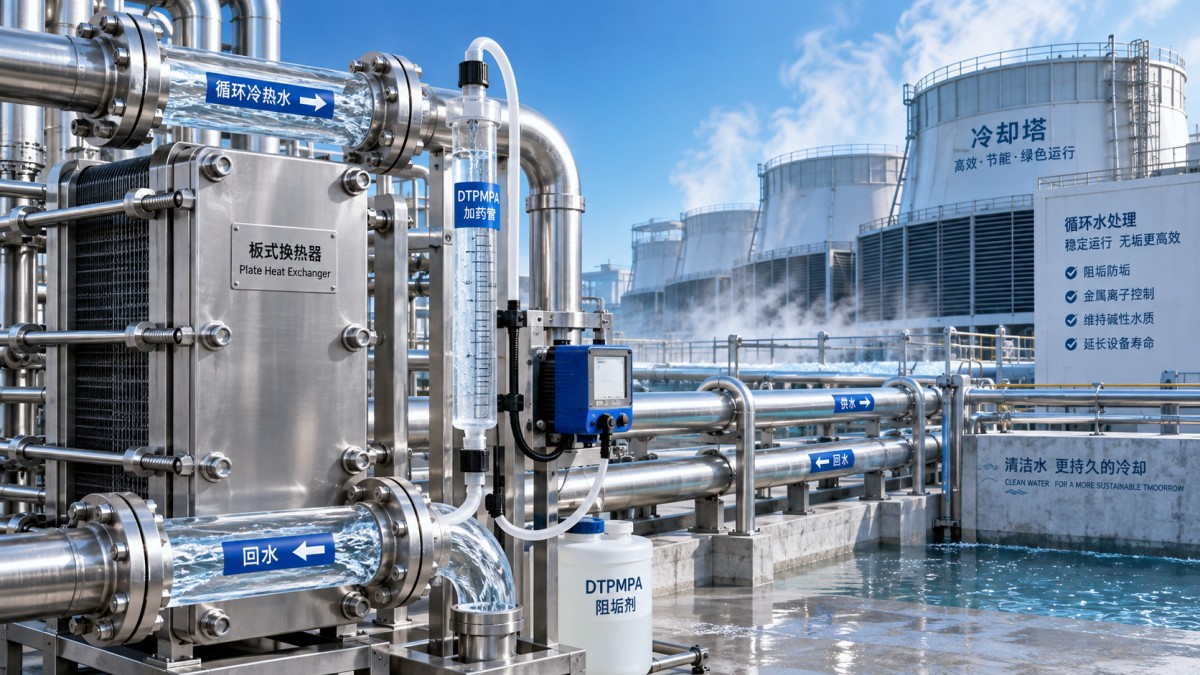
Oxidizing biocides deserve particular attention. Phosphonate-based chemistries can be affected by oxidizing environments, and the extent of impact depends on oxidant type, residual level, contact time, temperature and overall formulation. A program that looks stable in a static laboratory beaker may behave differently when a tower receives periodic oxidant slugs or when control equipment allows residuals to overshoot. In practice, chemical-feed sequencing and continuous versus intermittent dosing can matter as much as the nominal product selection.
What project managers should verify before specifying it
A sensible evaluation of DTPMPA CAS 15827-60-8 begins with a complete water analysis, not a generic dosage request. At minimum, the treatment supplier and project team should examine calcium hardness, magnesium hardness, M-alkalinity, pH, conductivity, chloride, sulfate, silica, iron, manganese and suspended solids. Makeup-water variability matters too. Seasonal source-water shifts can change the scale tendency enough to make a once-stable treatment program look unreliable.
It is also important to establish the practical operating envelope:
- Target cycles of concentration and the control method used to maintain them;
- Highest expected bulk-water and heat-transfer surface temperatures;
- Metallurgy of exchangers, piping, tower components and any galvanized surfaces;
- Current or planned corrosion inhibitors, dispersants, biocides and antifoams;
- Whether phosphate is intentionally present in the corrosion-control program;
- Blowdown, wastewater-treatment and local discharge requirements.
The phosphate point is often underestimated. In some alkaline programs, phosphate supports corrosion control, but calcium phosphate deposition becomes a real concern if the program is not balanced. A phosphonate can help manage this risk, but it should be tested in the intended formulation. The chemistry should not be selected solely from a single active-content comparison or a supplier’s standard technical sheet.
For new projects, laboratory screening can compare likely treatment blends against actual makeup and simulated recirculating water. For operating plants, coupon monitoring, deposit analysis, corrosion monitoring and trend review are more informative than visual tower inspection alone. If deposits are already present, sending a representative sample for analysis can prevent a costly misdiagnosis. It is not unusual for a deposit assumed to be “scale” to contain a significant share of iron oxide, clay, process contamination or biological matter.
DTPMPA is often better in a blended program
A common design mistake is to treat scale inhibition, dispersion and corrosion protection as if one active ingredient should handle all three equally well. DTPMPA is a useful organophosphorus scale inhibitor and chelating component, but alkaline cooling-water programs often benefit from a polymer dispersant alongside it. The phosphonate manages mineral-scale tendency and metal-ion interactions; the polymer helps keep fine particles, precipitated solids and corrosion debris from settling or attaching to surfaces.
For example, where calcium phosphate, iron oxide or suspended particulate deposition is part of the risk profile, a terpolymer with carboxyl, sulfonic acid and sulfonated styrene groups can complement a phosphonate approach. Carboxylate-Sulfonate-Sodium p-Styrene Sulfonate Terpolymer (AA/AMPS/SSS) is intended for low-pressure boilers, circulating water and cooling-water applications. Its stated scale-inhibition and dispersion role includes calcium carbonate, calcium phosphate, barium sulfate and iron oxide deposits, with calcium phosphate inhibition described even at pH 9.0.
That does not mean every system needs the same blend. A high-hardness tower with little suspended matter may require a different ratio from a steel mill circuit with substantial iron loading. Likewise, a clean closed loop does not need the same treatment intensity as an open tower receiving airborne dust and process leakage. The objective is to create a compatible package with a clear function for each component, rather than stacking products until the treatment budget becomes difficult to justify.
Feed point and control discipline are part of performance
Even a well-chosen chemical can underperform if it is fed at the wrong location. DTPMPA-based treatment is usually introduced where rapid mixing is available and before the water reaches the most scale-sensitive surfaces. A stagnant side stream, a dead leg near the tower basin or a point downstream of major heat exchangers may not provide adequate distribution. The exact injection arrangement depends on system hydraulics, but the principle is simple: the inhibitor needs to be in the water before supersaturation is expressed at the equipment surface.
Automatic dosing linked to makeup-water flow, conductivity or another validated control signal is often more reliable than manual batch additions. Manual treatment can appear economical until a missed weekend dose or an unexpected makeup-water increase produces a scale event. On the other hand, excessive dosage is not a substitute for water balance. It can raise operating cost, complicate wastewater handling and mask the fact that cycles, pH or contamination are outside the original design assumptions.
Routine monitoring should connect chemistry to equipment condition. Conductivity and pH indicate operating direction, but they do not prove deposit control. Project specifications should define how treatment performance will be reviewed: trend data, exchanger pressure drop, corrosion indicators, inspection intervals, deposit sampling where relevant, and documented corrective actions when water quality moves outside control limits.
Selection criteria beyond the active ingredient
When sourcing DTPMPA CAS 15827-60-8, project teams should review more than price and active assay. Product consistency, impurity control, storage stability, packaging suitability, safety documentation, logistics capability and technical response time can all affect a long-term cooling-water program. For export projects, it is worth confirming the supplied salt form, concentration basis, transport classification and documentation requirements before procurement is finalized. “DTPMPA” may be used loosely in commercial discussions, while the exact supplied form can influence handling and formulation design.
Suppliers with in-house production, laboratory evaluation and application support can be useful when site water conditions are unusual or when a standard formula needs adjustment. Prio New Materials works across organophosphorus scale inhibitors, water-treatment monomers, polymer dispersants and industrial defoamers, with support covering bulk supply, customized formulations and water-condition technical review. That broader formulation capability is relevant because cooling-water failures rarely stay within one chemical category.
The practical conclusion is that DTPMPA performs well in alkaline cooling water when it is used for the job it is suited to: controlling mineral scale tendency and supporting metal-ion management within a properly designed program. Its value is highest when chemistry, feed location, biocide schedule, cycles of concentration and deposit risks are assessed as one operating system. Before committing to dosage or product grade, validate the treatment package against actual water analysis and the most demanding conditions the plant is expected to see—not only the average conditions reported during commissioning.

ONLINE CONSULTATION
If you have any questions, please contact us and we will contact you as soon as possible.