


How calcium phosphate scale dispersants perform under phosphate-rich conditions
Calcium phosphate scale becomes difficult to control when phosphate levels increase, calcium hardness remains available, and operating pH favors precipitation.
Under these conditions, calcium phosphate scale dispersants can remain effective, but their performance depends on chemistry, dosage, water balance, and system control.
For operators, the practical goal is not simply preventing visible deposits. It is maintaining clean heat-transfer surfaces, stable flow, reliable cycles, and predictable treatment costs.
Phosphate-rich water requires closer monitoring because small changes in pH, temperature, alkalinity, or calcium concentration may quickly move the system toward supersaturation.
Why Phosphate-Rich Water Creates a Higher Scaling Risk
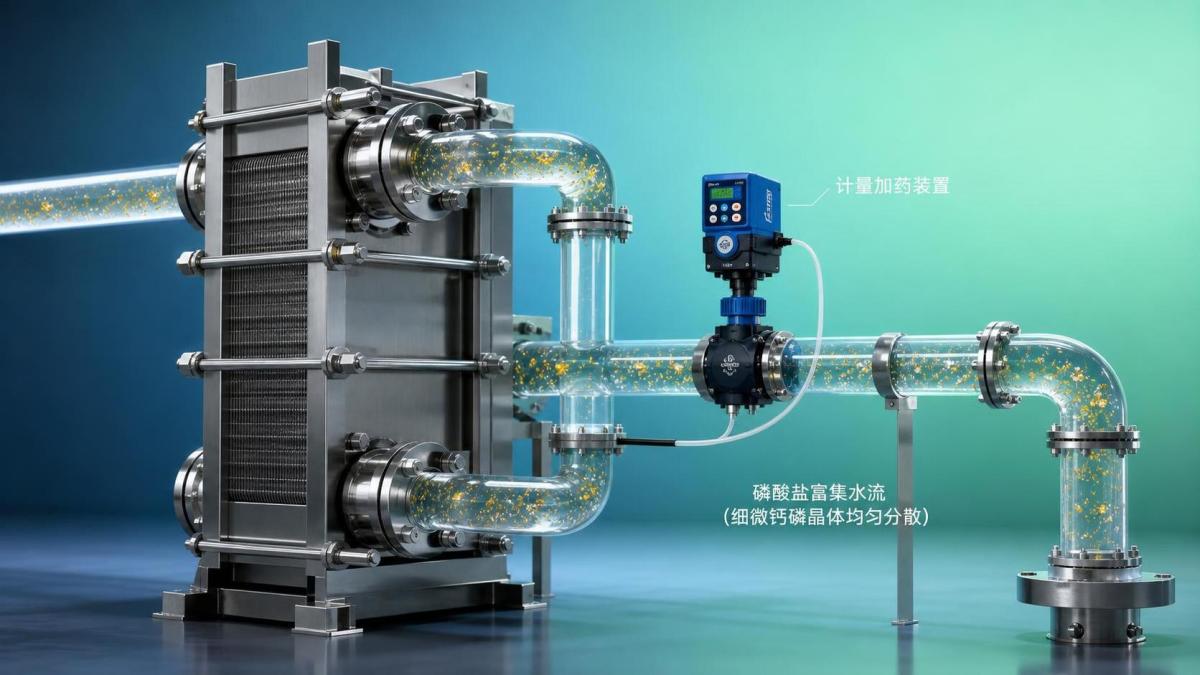
Calcium phosphate deposits form when dissolved calcium ions react with phosphate species and exceed the water's ability to keep those materials dispersed.
Unlike some soft deposits, calcium phosphate scale can adhere strongly to metal surfaces, heat exchangers, piping, filters, and membrane-related equipment.
Higher pH usually increases the risk because phosphate speciation changes and precipitation becomes more favorable in alkaline circulating-water conditions.
Temperature is also important. Hot heat-transfer surfaces may create local concentration effects, allowing deposits to form even when bulk-water testing appears acceptable.
Water loss through evaporation raises dissolved solids and hardness. In open cooling systems, this concentration process can push calcium phosphate toward deposition rapidly.
Phosphate is often intentionally introduced through corrosion-control programs. Therefore, operators must balance corrosion protection with the risk of calcium phosphate precipitation.
Contamination can add another variable. Makeup water changes, process leaks, cleaning residues, and wastewater reuse may increase phosphate loading without immediate notice.
The operating challenge is to maintain protective phosphate chemistry while preventing crystals from growing, agglomerating, and attaching to system surfaces.
How Calcium Phosphate Scale Dispersants Work
Calcium phosphate scale dispersants work primarily by interfering with crystal nucleation, crystal growth, particle agglomeration, and surface deposition during water circulation.
A capable dispersant does not necessarily eliminate all precipitated material. Instead, it helps keep fine particles smaller, mobile, and removable through blowdown or filtration.
Many programs combine dispersant action with threshold inhibition. At low treatment levels, selected polymers or phosphonate chemistries disrupt normal mineral crystal development.
Dispersant molecules can adsorb onto active crystal sites. This changes crystal shape, slows ordered growth, and reduces the ability of particles to form hard deposits.
Polymeric dispersants may also provide electrostatic stabilization. By increasing repulsion between particles, they reduce agglomeration into larger solids that settle or foul equipment.
Performance is strongest when the dispersant is compatible with the whole treatment program, including corrosion inhibitors, biocides, salts, suspended solids, and process contaminants.
Operators should recognize that dispersants manage scale risk rather than replacing basic control. Extreme supersaturation, poor blowdown, or uncontrolled pH can overwhelm any treatment chemistry.
That distinction matters in troubleshooting. A deposit may indicate insufficient dosage, but it may also reveal an operational excursion beyond the program's design range.
What Performance Looks Like in Real Operating Systems
In a well-controlled system, effective calcium phosphate scale dispersants reduce visible deposits, preserve heat-transfer efficiency, and help maintain cleaner strainers, piping, and exchanger surfaces.
Cooling-water operators may see more stable approach temperatures, lower differential pressure increases, and reduced frequency of mechanical cleaning or acid cleaning interventions.
In RO pretreatment applications, the objective is often different. The dispersant must minimize particulate carryover and support stable feed conditions before membrane contact.
For industrial process water, successful performance can mean fewer production interruptions caused by plugged nozzles, restricted lines, scale-covered sensors, or inconsistent water flow.
Visual inspections remain useful, but they should not be the only measure. Deposits often begin in high-temperature or low-flow areas before becoming obvious elsewhere.
Trend data provides earlier warning. Track calcium, phosphate, pH, conductivity, alkalinity, cycles of concentration, turbidity, and make-up-water quality over time.
When deposits are sampled, laboratory analysis is valuable. Calcium phosphate can coexist with calcium carbonate, silica, iron oxides, organic matter, or microbiological material.
A mixed deposit needs a different response than a pure calcium phosphate deposit. The correct dispersant and cleaning strategy should follow confirmed deposit composition.
Operating Factors That Determine Dispersant Effectiveness
pH is one of the most influential variables. A small upward shift can increase calcium phosphate precipitation potential, especially where calcium and phosphate levels are already elevated.
Calcium hardness establishes the available mineral load. Higher hardness may require lower phosphate targets, increased dispersant dosage, different chemistry, or tighter concentration-cycle control.
Phosphate concentration must be evaluated alongside system conditions. A phosphate level that works in one cooling system may be unstable in another system.
Temperature affects both reaction behavior and local surface conditions. Operators should consider the hottest metal surfaces, not only the temperature measured in the recirculating water.
Residence time matters because particles need time to grow and attach. Low-flow zones, dead legs, poorly circulated basins, and stagnant branches require special attention.
Suspended solids can consume dispersant capacity or act as deposition sites. Filtration and side-stream solids removal often improve chemical treatment performance significantly.
Iron contamination is another common complication. Corrosion products can combine with mineral solids, create rough attachment surfaces, and make deposits denser and harder to remove.
Program compatibility should always be verified. Some combinations of additives can reduce dispersancy, alter solubility, or introduce unexpected solids under concentrated operating conditions.
How Operators Can Select a Suitable Treatment Approach
Start with a representative water analysis that includes calcium hardness, total phosphate, orthophosphate, pH, alkalinity, conductivity, iron, silica, and suspended solids.
Then review operational history. Identify when scaling occurs, where deposits appear first, whether makeup water changes seasonally, and how cycles are controlled.
Jar testing, dynamic scale testing, or system-specific laboratory evaluation can help compare treatment behavior under realistic concentration, temperature, and pH conditions.
Product selection should consider more than scale inhibition. A practical product must also remain soluble, stable, compatible, safe to handle, and suitable for available dosing equipment.
Phosphonate-based materials can support broader water-treatment programs because they offer metal-ion complexation and scale-control benefits under demanding industrial conditions.
One applicable raw material is Tetra Sodium Salt of 1-Hydroxy Ethylidene-1,1-Diphosphonic Acid (HEDP·Na4), which is commonly used in circulating-water and boiler-related treatment programs.
This material is water-soluble and available in liquid, powder, and granular forms, allowing treatment programs to match local storage, transport, and dosing requirements.
Its stable complexation with metal ions can be useful where iron, copper, or zinc are present, although final dosage should follow water analysis and field validation.
Practical Dosing and Monitoring Practices
Feed dispersant continuously where possible. Continuous dosing usually provides more stable protection than intermittent additions, particularly in systems with variable makeup-water demand.
Confirm actual feed rates by checking pump calibration, chemical inventory consumption, injection-point condition, and dilution water availability rather than relying only on programmed settings.
Choose an injection point with good turbulence and rapid mixing. Poor chemical distribution can leave high-risk equipment unprotected even when total treatment dosage appears correct.
Control blowdown based on conductivity and verified concentration cycles. Insufficient blowdown concentrates calcium and phosphate, while excessive blowdown increases water and chemical consumption.
Monitor pH routinely and investigate upward drift promptly. Common causes include chemical-feed changes, reduced blowdown, process contamination, and shifts in makeup-water composition.
Inspect vulnerable locations during maintenance windows. Heat exchangers, tower fill, low-flow piping, strainers, transfer lines, and pump suction areas often reveal early treatment problems.
When a scale event occurs, avoid increasing dosage blindly. First confirm deposit chemistry, treatment feed, water balance, pH control, and whether operating limits were exceeded.
After corrective action, review trend data for several weeks. A successful response should produce stable operating readings, reduced solids accumulation, and no renewed deposit growth.
Common Mistakes That Reduce Scale Control
A frequent mistake is treating phosphate concentration as an isolated number. Calcium phosphate risk is determined by interacting conditions, not phosphate level alone.
Another error is ignoring local conditions. Bulk water may look acceptable while a hot exchanger surface or stagnant branch experiences severe deposition.
Some operators overlook incoming water changes. A new makeup source, reclaimed-water increase, or process leak can alter hardness and phosphate balance quickly.
Using a dispersant without sufficient solids management also creates problems. Dispersed particles still need a removal path through blowdown, filtration, or appropriate clarification.
Finally, inconsistent monitoring makes it difficult to distinguish gradual treatment decline from a sudden operational event. Documented trends support faster, more accurate corrective decisions.
Conclusion: Control the Whole Water Condition
Calcium phosphate scale dispersants can perform reliably in phosphate-rich conditions when they are supported by appropriate pH control, concentration management, solids removal, and consistent dosing.
Operators should evaluate actual water chemistry, equipment conditions, and deposit history before adjusting treatment. The strongest results come from treating scale risk as a complete system condition.
With suitable dispersant chemistry and disciplined monitoring, industrial systems can maintain cleaner surfaces, reduce unplanned maintenance, protect heat transfer, and operate more consistently under phosphate-rich water conditions.

ONLINE CONSULTATION
If you have any questions, please contact us and we will contact you as soon as possible.